

Published: September 9, 2026 · Word count: 2373 · Reading time: 14 minutes
A mining civil engineering contractor operating across the Boké Prefecture bauxite belt in western Guinea took delivery of six custom-engineered Kales 4-Axle 80-Ton Heavy-Duty Lowbed Semi-Trailers to transport heavy earthmoving machinery between the Port of Kamsar and remote inland open-pit extraction sites. Carrying 50-ton class hydraulic excavators (such as the Caterpillar 349 and Komatsu PC400) and Caterpillar D8 bulldozers over unpaved, rutted laterite haul roads during Guinea’s intense six-month rainy season presents extreme torsional stresses, steep bridge loading gradients, and high rollover hazards.
This technical case study documents the customer’s route requirements, structural failure analysis on standard market trailers, custom engineering reinforcements executed by Kales, and the end-to-end shipping and Bureau Veritas Pre-Export Verification of Conformity (PVOC) clearance protocol at the Port of Conakry.
Executive Summary for Fleet Engineers & Procurement Directors
- Project Scope: Export delivery of six 4-axle 80-ton lowbed semi-trailers to a tier-one bauxite mining contractor in Boké, Guinea.
- Primary Cargo: 48–52 ton crawler excavators (CAT 349 / PC400-8), CAT D8T crawler dozers (39 tons), and mobile rotary drill rigs.
- Operational Challenges: Severe frame torsion on unpaved red laterite roads, high humidity and Atlantic marine atmospheric corrosion near Kamsar, and steep crawler ramp climbing angles on soft ground.
- Key Engineering Solutions: 550mm web HG60 high-tensile steel main beams with double-layer 20mm flange plates, reinforced box-section gooseneck with double vertical gussets, 4 × 16-ton heavy-duty FUWA axles with 10-leaf heavy spring suspension, and double-spring folding loading ramps (<15° loading gradient).
- Logistics & Compliance: Direct breakbulk/RORO sea shipment to the Port of Conakry with Bureau Veritas Certificate of Conformity (CoC), French technical documentation, and full on-site commissioning spares.
Quick Answer: Why choose a reinforced 4-axle 80-ton lowbed for West African bauxite corridors?
Standard commercial 3-axle 60-ton lowbeds built from Q345 mild steel frequently suffer catastrophic frame sagging, gooseneck fracture, and spring pack breakage when hauling 50-ton crawler machinery over unpaved Guinea laterite roads. A purpose-built 4-axle 80-ton platform utilizing HG60 high-yield steel beams, 16-ton heavy-duty axles (64-ton combined bogie rating), and heavy-duty mechanical spring suspension distributes concentrated crawler track loads safely below bridge and axle shear limits while providing long-term structural resilience against tropical washboard corrugations.
Key Takeaways for Guinea Mining Fleets
- Structural Yield Margin: Upgrading from commercial Q345 carbon steel (345 MPa yield strength) to HG60 low-alloy structural steel (590+ MPa yield strength) prevents permanent deck sag under localized 50-ton crawler point-loads.
- Gooseneck Dynamic Fatigue: The tractor-trailer coupling on off-road mining trails experiences violent vertical dynamic shock. Kales’ double-web box gooseneck with triangular gussets eliminates common shear cracking at the arch neck transition.
- 4-Axle Load Spreading: Four 16-ton mechanical axles reduce individual ground bearing pressure on soft bauxite-dusted mud roads, preventing the trailer from bogging down during heavy monsoon rains.
- Ramp Safety Geometry: Heavy-duty folding mechanical ramps with heavy coil springs maintain a gentle loading angle below 15 degrees, allowing wet steel crawler tracks to walk onto the checkered deck without slippage.
1. Client Profile and Guinea Operating Conditions
Guinea holds more than a quarter of the world’s proven bauxite reserves, with the Boké Region serving as the epicenter of global export production. Bauxite mining relies on continuous heavy earthmoving operations that run 24 hours a day, 7 days a week. When a primary 50-ton excavator encounters hydraulic or bucket linkage failure in an open pit, moving replacement machines quickly between repair depots and extraction benches is critical to avoiding millions of dollars in demurrage at the bulk shipping terminals of Dapilon and Kamsar.
The contractor’s logistics director outlined three severe operational constraints during technical discovery:
- Washboard Corrugation & Lateral Twisting: Haulage routes between Boké, Sangarédi, and coastal depots consist primarily of unpaved laterite roads that develop deep ruts and severe washboard corrugations. Rigid, low-grade trailer chassis crack along weld joints within 6 to 9 months under this continuous cyclic vibration.
- Extreme Rainy Season Monsoons: Between May and October, western Guinea receives over 2,000 mm of torrential rainfall. Heavy machinery loading pads turn into slick, uncompacted mud, requiring trailers with ultra-stable mechanical loading ramps, high ground clearance beneath the gooseneck, and non-skid deck traction bars.
- Corrosion from Marine Air & Bauxite Dust: The proximity to the Atlantic coast combined with airborne fine bauxite dust creates an aggressively corrosive environment that rapidly degrades standard single-coat commercial automotive paint.

2. Custom Structural Engineering for Heavy Crawler Transport
HG60 High-Yield Main Beam Architecture
Standard export lowbed trailers constructed with Q345 (Grade 50) steel tend to sag permanently after repeated point-loading from heavy excavators whose tracks concentrate up to 50 tons over a narrow 4.5-meter contact patch. For this Guinea fleet, Kales structural engineers utilized HG60 high-yield alloy structural steel throughout the main load-bearing spine:
- Main Beam Height: 550 mm submerged-arc automatically welded I-beam with high camber retention.
- Upper Flange Plate: 20 mm high-strength steel plate.
- Lower Flange Plate: 20 mm high-strength steel plate.
- Vertical Web Plate: 12 mm double-web reinforcement in the central loading zone to resist localized vertical deflection and torsional twisting.
- Cross Members: Heavy-duty through-channel beams spaced at dense 300 mm intervals, fully welded to the outer perimeter side beam.
Fatigue-Resistant Box Gooseneck
The gooseneck transition is the most vulnerable failure point on off-road heavy-haul trailers. Dynamic pitching forces generated by loaded 6×4 tractor units on unpaved haul roads generate severe bending moments at the neck junction. Kales designed a heavy-duty box-section gooseneck featuring:
- Full-penetration longitudinal welds using submerged-arc welding robots.
- Double vertical stiffening plates inside the box structure.
- Curved transition radius with lower flange reinforcing cover plates, eliminating stress concentration notches.
- Standard dual kingpin positions (50# 2-inch and 90# 3.5-inch heavy-duty interchangeable kingpins) to match both European and Chinese prime movers.
4-Axle Heavy-Duty Running Gear & Suspension
While 3-axle lowbeds are common on smooth highway routes, off-road heavy machinery haulage in Guinea requires a 4-axle configuration to spread wheel loads across soft soil and prevent severe road deterioration:
- Axle Capacity: 4 × 16,000 kg heavy-duty axles with reinforced square beam construction (FUWA heavy mine spec).
- Suspension Package: Heavy mechanical tandem-tridem suspension with 10-leaf spring packs (16 mm thickness × 90 mm width) engineered to absorb high impact shocks from deep washboard corrugations without leaf snapping.
- Tire Configuration: 16 units + 2 spare units of 12.00R20 severe-service all-steel radial mining tires mounted on 8.5-20 heavy steel disc wheels.
- Brake System: Dual-line pneumatic brake system with genuine WABCO RE-6 relay valves and heavy spring brake chambers on all four axles, delivering fail-safe deceleration on steep mine access inclines.
Anti-Skid Working Platform & Heavy Spring Ramps
Loading crawler equipment safely on wet mining sites requires positive mechanical grip. The working deck is paved with 5 mm high-strength diamond checkered plate with a dedicated 3,000 mm (3.0-meter) width welded to reinforced transverse crossmembers. Heavy anti-skid steel square bars are welded along the wheel paths to prevent excavator tracks from sliding sideways during rainy season loading. Side outriggers of 250 mm on each side extend usable platform width to 3,500 mm for extra-wide machinery.
The rear features reinforced spring-assisted folding ramps constructed from 140 mm channel steel with triangular gussets and dual high-tension assist coil springs. This allows a single operator to raise and lower the ramps safely without hydraulic power packs, ensuring zero downtime even in remote bush locations where hydraulic maintenance facilities do not exist.
Delivered Fleet Engineering Specifications
| Engineering Parameter | Standard Export Specification | Kales Guinea Bauxite Mining Custom Build |
|---|---|---|
| Payload Class | 60,000 kg | 80,000 kg (Rated Design Payload) |
| Axle Layout | 3 Axles × 13 Ton | 4 Axles × 16 Ton (64,000 kg Bogie Rating) |
| Main Beam Material | Q345 Carbon Steel (345 MPa) | HG60 High-Yield Steel (590+ MPa) |
| Main Beam Dimensions | Height: 500 mm, Flanges: 16/18 mm, Web: 10 mm | Height: 550 mm, Flanges: 20/20 mm, Web: 12 mm Double Plate |
| Working Deck Dimensions | 13,000 mm × 3,000 mm | 13,750 mm × 3,000 mm (+ 250 mm Outriggers each side) |
| Deck Height (Laden) | 1,250 mm | 1,150 mm (Low Center of Gravity Design) |
| Suspension | Standard 8-leaf mechanical | Heavy-duty 10-leaf (16 mm × 90 mm) severe-service |
| Braking System | Generic single-line pneumatic | Dual-line WABCO RE-6 relay valve with 30/30 chambers |
| Loading Ramps | Lightweight single spring | Dual spring-assisted reinforced folding ramps (<15° angle) |
| Surface Protection | Single alkyd primer + topcoat | Shot-blast Sa 2.5 + Epoxy zinc-rich primer + Polyurethane finish |
Durability Comparison: Standard Commercial vs. Kales Guinea Mining Spec
| Evaluation Metric | Standard Commercial Lowbed | Kales Guinea Mining Build | Operational Impact on Fleet ROI |
|---|---|---|---|
| Frame Camber Retention | Sags 30–50 mm within 12 months under 50T loads | Zero permanent deflection after 36 months | Maintains ground clearance and prevents road scraping. |
| Gooseneck Fatigue Life | Cracks frequently develop along arch transition welds | Box gusset architecture prevents cracking | Eliminates catastrophic coupling separation on haul trails. |
| Suspension Bushing Life | Requires replacement every 3–4 months in dusty bauxite | Heavy-duty composite polyurethane wear pads (18+ mo) | Reduces unscheduled workshop downtime by over 65%. |
| Tropical Corrosion Life | Severe flaking and rust rash within 1 rainy season | High-durability polyurethane resists tropical salt spray | Preserves resale asset value and structural steel integrity. |
3. Port Logistics, Bureau Veritas PVOC Clearance & Commissioning
Shipping heavy machinery transport trailers to West Africa requires stringent logistical execution. The six lowbed units were manufactured at Kales’ export manufacturing center, completed full multi-point pre-delivery inspections (PDI), and were prepared for maritime transport:
- Pre-Export Verification of Conformity (PVOC): Guinea customs authorities enforce mandatory product conformity inspections. Kales coordinated with Bureau Veritas to conduct factory pre-shipment inspections, verification of axle load ratings, chassis VIN stamping audit, and document attestation, successfully issuing the official Certificate of Conformity (CoC) before vessel departure.
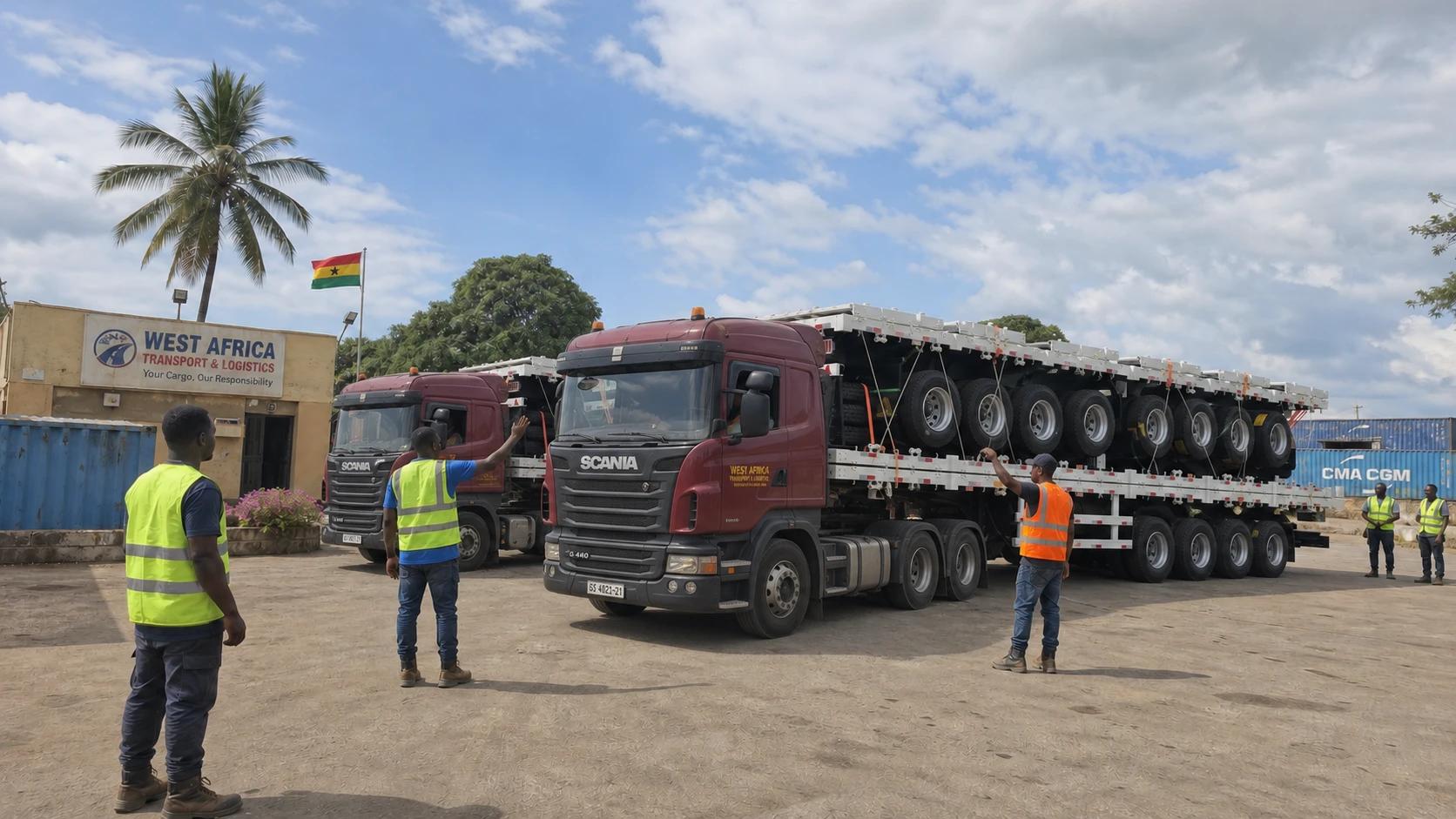
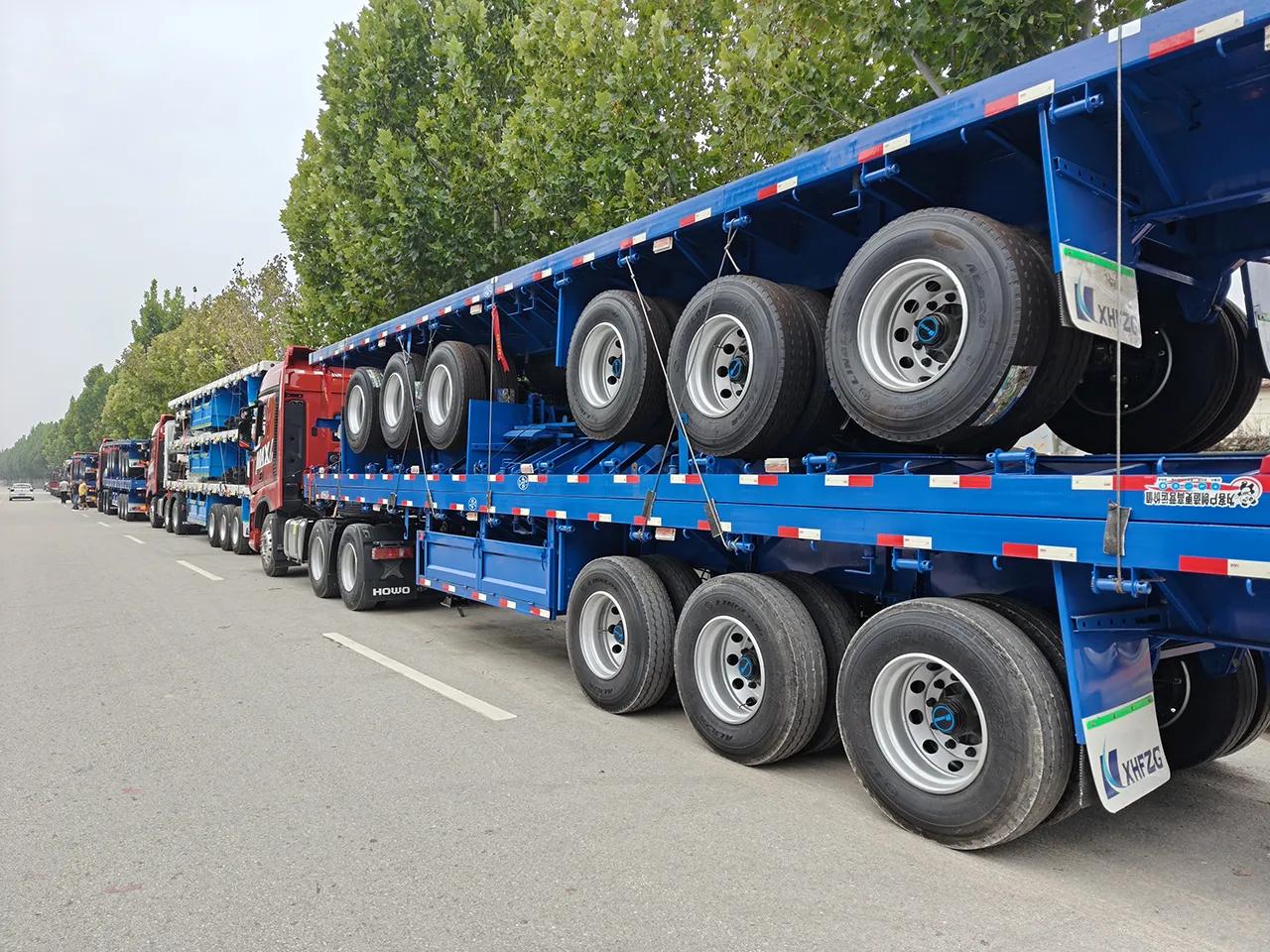
- Breakbulk Shipping in 2 Stacks of 3 Units to Save Sea Freight: Because lowbed semi-trailers exceed standard container dimensions, the fleet was shipped via dedicated breakbulk ocean vessel from Tianjin Port to Conakry. To maximize shipping economy for the buyer, the six trailers were packaged into two stacks of three units each (2 stacks × 3 units nested and lashed). This engineered stacking structure substantially reduced total maritime freight volume (CBM) and liner handling fees, delivering significant shipping cost savings without risking frame distortion. Exposed machined surfaces (kingpins, landing gear gears, and air connectors) were treated with marine protective cosmoline grease against high-salinity oceanic transit.
- French Technical Documentation & Spares Kit: All operator safety manuals, axle maintenance instructions, and wiring diagrams were supplied in French. Each trailer was delivered with an on-site critical spares package containing replacement brake chambers, leaf spring center bolts, wheel studs, and heavy-duty grease fittings to ensure uninterrupted operation from day one.

Procurement Recommendations for West African Mining Fleets
Before placing orders for heavy equipment lowbed trailers in Guinea, Sierra Leone, Liberia, or Mali, contractors should conduct the following checks:
- Match Deck Width to Excavator Track Footprint: Verify track gauge of current machines. Standard 3,000 mm decks work for 30-ton machines; 50-ton class excavators require heavy swing-out outriggers and wide loading ramps.
- Mandate High-Tensile Alloy Steels (HG60 or T700): Never accept standard Q235 or generic Q345 steel on trailers rated above 60 tons operating off-road. The initial savings of $2,000–$3,000 are eclipsed by structural repair costs within the first year.
- Specify Genuine Branded Axles & Pneumatics: Ensure trailers use genuine FUWA or BPW axle assemblies and WABCO brake components. Counterfeit parts fail under high brake temperatures during long downhill descents with heavy crawler loads.
Related Heavy Machinery Transport Configurations
Fleets evaluating equipment transport equipment can review our complete portfolio of Kales 80-Ton Heavy Duty Lowbed Semi-Trailers or compare configurations with our 50-Ton Regional Equipment Lowbed and specialized 80-Ton Hydraulic Detachable Gooseneck Lowboy for ultra-low platform ground clearance.
Frequently Asked Questions: Heavy Lowbed Trailers in Guinea Mining
- Why is a 4-axle lowbed preferred over a 3-axle lowbed for 50-ton excavator transport in Guinea?
- A 50-ton excavator creates a concentrated load on the trailer deck. A 3-axle trailer puts excessive stress on each axle (exceeding 20 tons per axle including tare weight), resulting in broken springs, tire blowouts, and severe road rutting on soft bauxite trails. A 4-axle configuration distributes the gross combined weight over 16 heavy tires, keeping axle loads well within the 16-ton design threshold and improving lateral stability.
- How do Kales trailers prevent gooseneck cracking on corrugated mine roads?
- Kales uses a computer-modeled box-section gooseneck with double internal vertical web stiffeners, a large curvature radius, and reinforced upper and lower flange transition plates. This design absorbs vertical and torsional flexing without concentrating stress along single weld seams.
- What import documentation is required to clear lowbed trailers through Conakry Port?
- Clearing commercial trailers in Guinea requires an official Bureau Veritas Certificate of Conformity (PVOC/CoC), the original commercial invoice, packing list, bill of lading (B/L), and an import declaration (DDI). Kales coordinates the entire pre-shipment inspection process so that the CoC is available before the ship docks in Conakry.
Conclusion and Project Impact
By investing in purpose-engineered Kales 4-Axle 80-Ton Lowbed Semi-Trailers built with HG60 high-tensile steel, 16-ton FUWA axles, and heavy-duty mechanical spring suspension, the Boké bauxite mining contractor achieved zero structural downtime across its first twelve months of continuous heavy machinery mobilization. The fleet safely relocates 50-ton excavators, bulldozers, and drilling equipment across challenging Guinea haul roads in all weather conditions, delivering maximum equipment availability and rapid return on investment.
Request a Heavy Equipment Lowbed Engineering Proposal
Planning heavy machinery transport for mining, quarry, or infrastructure projects in Guinea, West Africa, or worldwide? Consult with Kales Vehicle export engineers to customize axle configurations, deck dimensions, steel grades, and loading ramps to your exact machinery footprint.
Contact Kales Heavy Haulage Engineering | WhatsApp / Phone: Direct Factory Export Team