

15 Tri-Axle Flatbed Trailers for Ghana: A Tema Port Fleet Case Study
Case-study disclosure and evidence basis
This case was prepared by the Kales Vehicle export sales team from a completed customer project. Jenny Lee, the sales consultant responsible for the order, wrote the account, and the Overseas Business Department reviewed it before publication. Customer name and project details are published with the customer’s permission. Commercially sensitive terms, including the transaction price, remain confidential by mutual agreement.
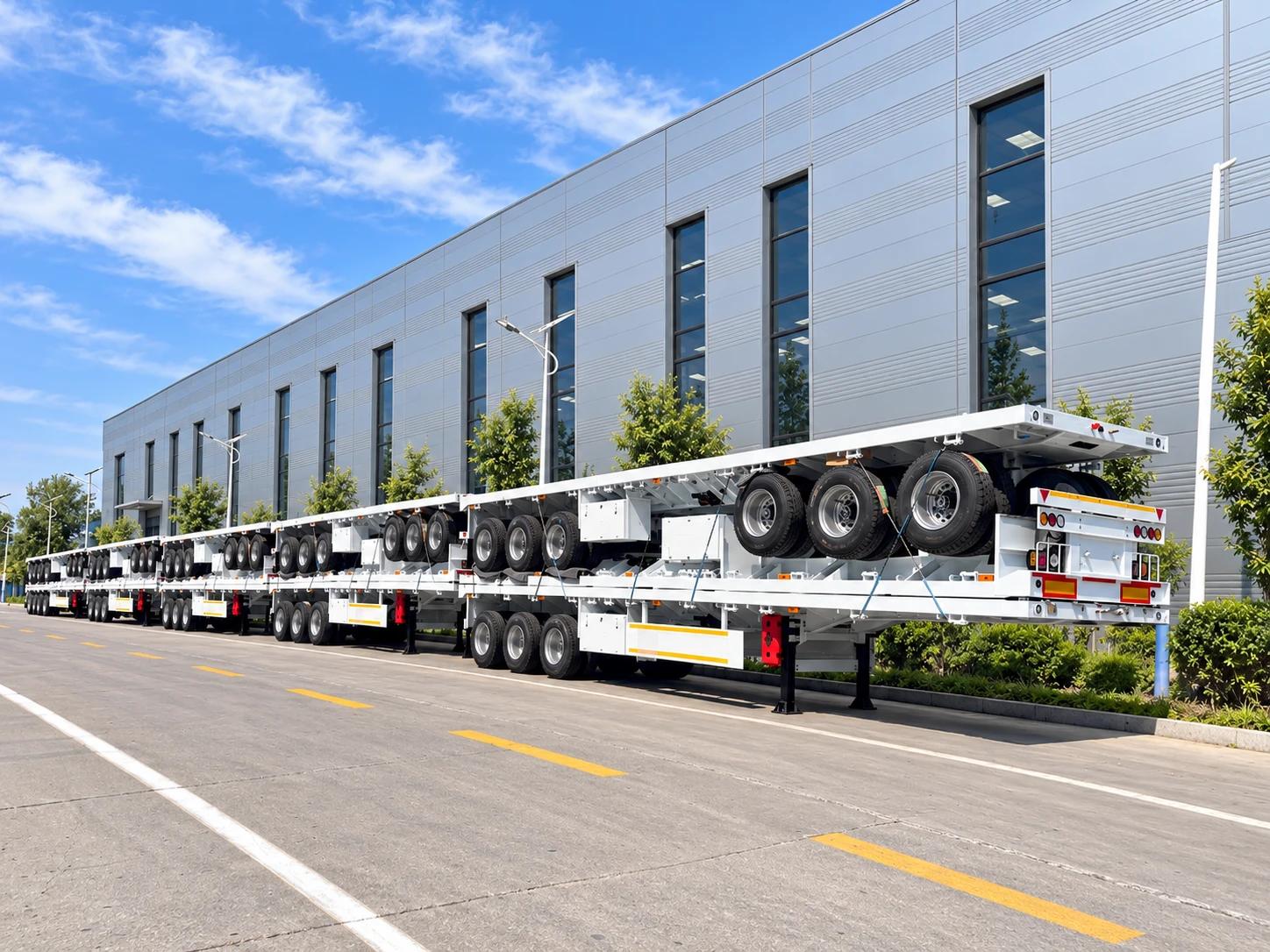
A Ghanaian transport company needed 15 heavy-duty, 3-axle 15m flatbed semi-trailers for container haulage and inland freight from Tema Port toward Kumasi, Tamale and the Burkina Faso border. The buyer was not looking for a generic catalog trailer. He wanted a maintainable West Africa semi-trailer specification, proof of the actual units before shipment, and a supplier willing to help when documentation issues appeared during clearance.
Ghana flatbed trailer project at a glance
- Customer: Kwame Mensah, procurement and fleet manager for a medium-sized Ghanaian transport company.
- Operating area: Tema Port, Accra, Kumasi, Tamale and northern cross-border freight corridors.
- Order: 15 tri-axle, 15m flatbed semi-trailers for container and building-material transport.
- Key configuration: reinforced Q345B double-layer main beams, three 13-ton axles, mechanical leaf-spring suspension, 2-inch kingpin and WABCO relay-valve braking.
- Trust requirement: individual photos and chassis videos of the real trailers before shipment.
- Result: all 15 trailers reached Tema Port, cleared customs and entered the customer’s operating fleet.
Customer background: an experienced Ghana fleet buyer
Kwame Mensah is the procurement and fleet manager of a medium-sized transport company headquartered in Accra. The company’s fleet and maintenance base are located near Tema Port, one of West Africa’s most important container gateways. Its work combines inland line-haul freight with port container transport along the Tema–Kumasi–Tamale corridor and onward toward the Burkina Faso border.
The company operates approximately 30 to 40 vehicles, mainly Sinotruk HOWO and SHACMAN tractor trucks and dump trucks. Mensah previously worked as a truck driver and a workshop apprentice. That practical background shaped the purchasing process: his questions focused on durability, brake performance, spare-parts availability, workshop familiarity and compatibility with the tractors already in service.
The operating problem behind the order
Growing container volumes around Tema Port and increasing building-material demand on northern routes had pushed the customer’s existing flatbed capacity close to its limit. The fleet therefore planned to add 15 tri-axle flatbed trailers, each 15 metres long, while keeping the equipment compatible with its existing tractors and workshop capability.
The request included five practical requirements that are common among experienced Ghana and West Africa fleet buyers:
- Structural reserve for demanding work: the customer wanted a heavy-duty chassis designed for a 60-ton load class and rough rainy-season roads. Structural capacity does not replace Ghanaian axle-load, gross-combination-mass or route compliance requirements; legal operating load must always follow the applicable rules.
- Simple local maintenance: mechanical leaf-spring suspension was preferred over air suspension because local technicians understood it well and replacement parts were easier to source.
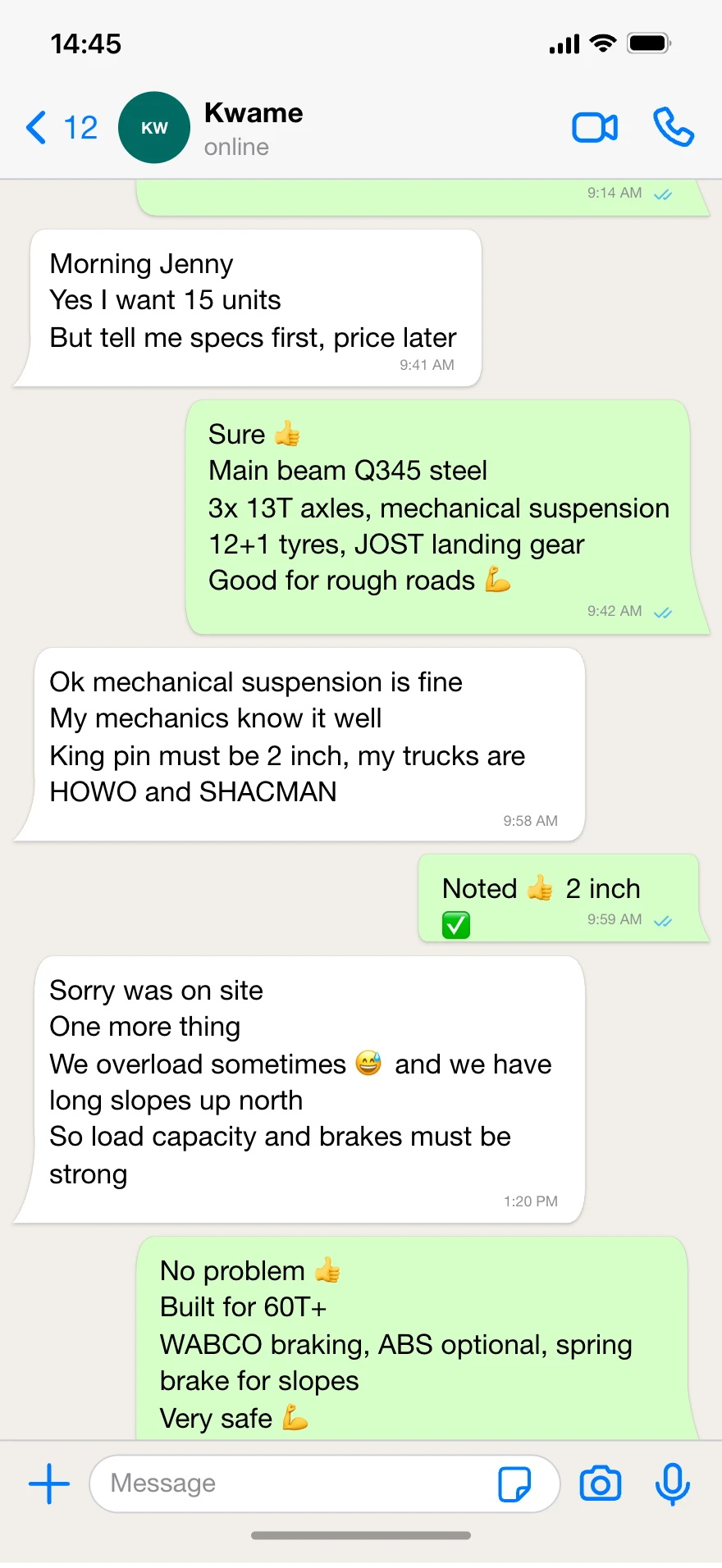
- Compatibility with existing tractors: a 2-inch kingpin was required for the fleet’s HOWO and SHACMAN tractor units.
- Reliable braking on gradients: long descents on northern routes made relay-valve performance, spring braking and optional ABS important discussion points.
- Shipping and import coordination: the customer expected the supplier to prepare the shipment for Tema Port and respond quickly if the clearing agent needed document clarification.
Why visible condition evidence mattered
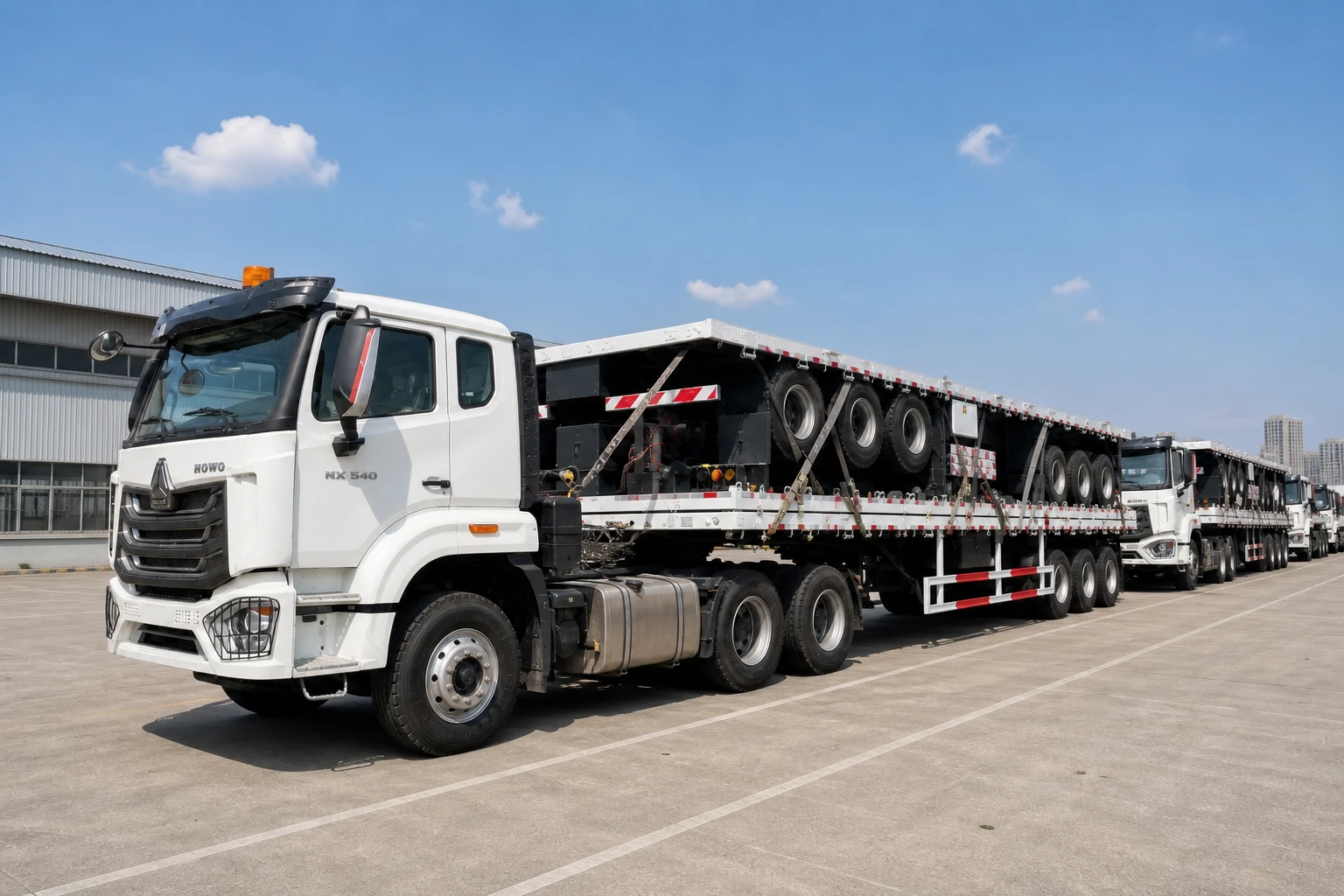
The customer had previously received trailers of inconsistent quality from another supplier. He therefore made one requirement especially clear: catalog images were not enough. Before shipment, he wanted unit-by-unit photos, underside views and chassis videos showing the actual trailers allocated to his order.
This changed the service process. Production follow-up was not treated as a single final inspection message. Jenny and the factory team maintained a visual record during completion, inspection, packing and dispatch so the buyer could check the real equipment before it left China.
How the 3-axle 15m flatbed trailer was configured
The technical discussion followed a specification-first approach. Each choice was tied to the customer’s cargo, tractor fleet, route and maintenance environment rather than added as a marketing upgrade.
| Decision area | Project configuration | Reason for the choice |
|---|---|---|
| Main beam | Q345B high-strength steel with a reinforced double-layer structure | Improved resistance to bending and fatigue during repeated heavy container and building-material work |
| Axles | Three 13-ton axles | Matched the heavy-duty design target while keeping a familiar tri-axle service layout |
| Suspension | Mechanical leaf-spring suspension | Better fit for the customer’s workshop skills, rough-road use and local parts access |
| Braking | WABCO relay-valve system, optional ABS and spring parking/emergency braking | Addressed the customer’s repeated concern about long downhill sections and dependable air-brake response |
| Tractor connection | 2-inch kingpin | Confirmed compatibility with the fleet’s HOWO and SHACMAN tractor trucks |
| Electrical system | LED lighting and water-resistant wiring protection | Reduced exposure to rainwater, road spray and wet-season electrical faults |
| Tyres and support parts | 12 tyres plus one spare per trailer configuration, with additional spares and a starter parts package for the order | Reduced the risk of avoidable downtime while replacement parts were being sourced |
Buyers comparing a similar specification can review the 3-axle flatbed container semi-trailer and then confirm the final length, load distribution, axle group, deck, twist locks and tractor interface for their own route.
Production evidence and shipment to Tema Port
During the production cycle, the factory and export team photographed the completed units and shared videos showing chassis condition, running gear, lighting and the general finish. This evidence was sent through the same WhatsApp project channel used for technical confirmation, giving the customer a traceable record instead of a generic shipment update.
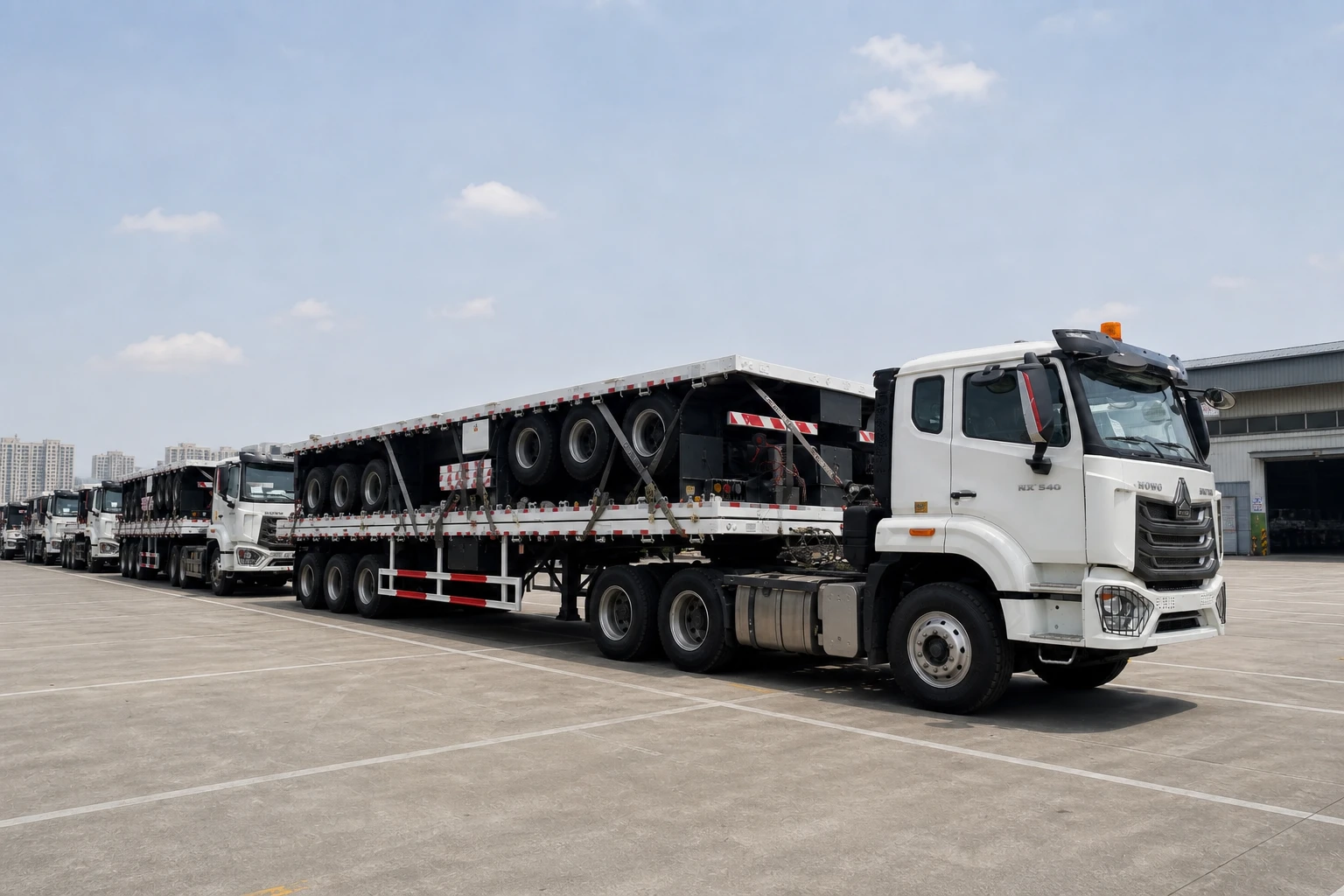
The trailers were then prepared for ocean transport through Tianjin Port. The shipping scope included packing coordination, export documentation and communication with the customer’s clearing agent. When a documentation question arose during clearance, the Kales export team helped clarify the required information rather than leaving the buyer to resolve it alone.
Delivery result and customer feedback
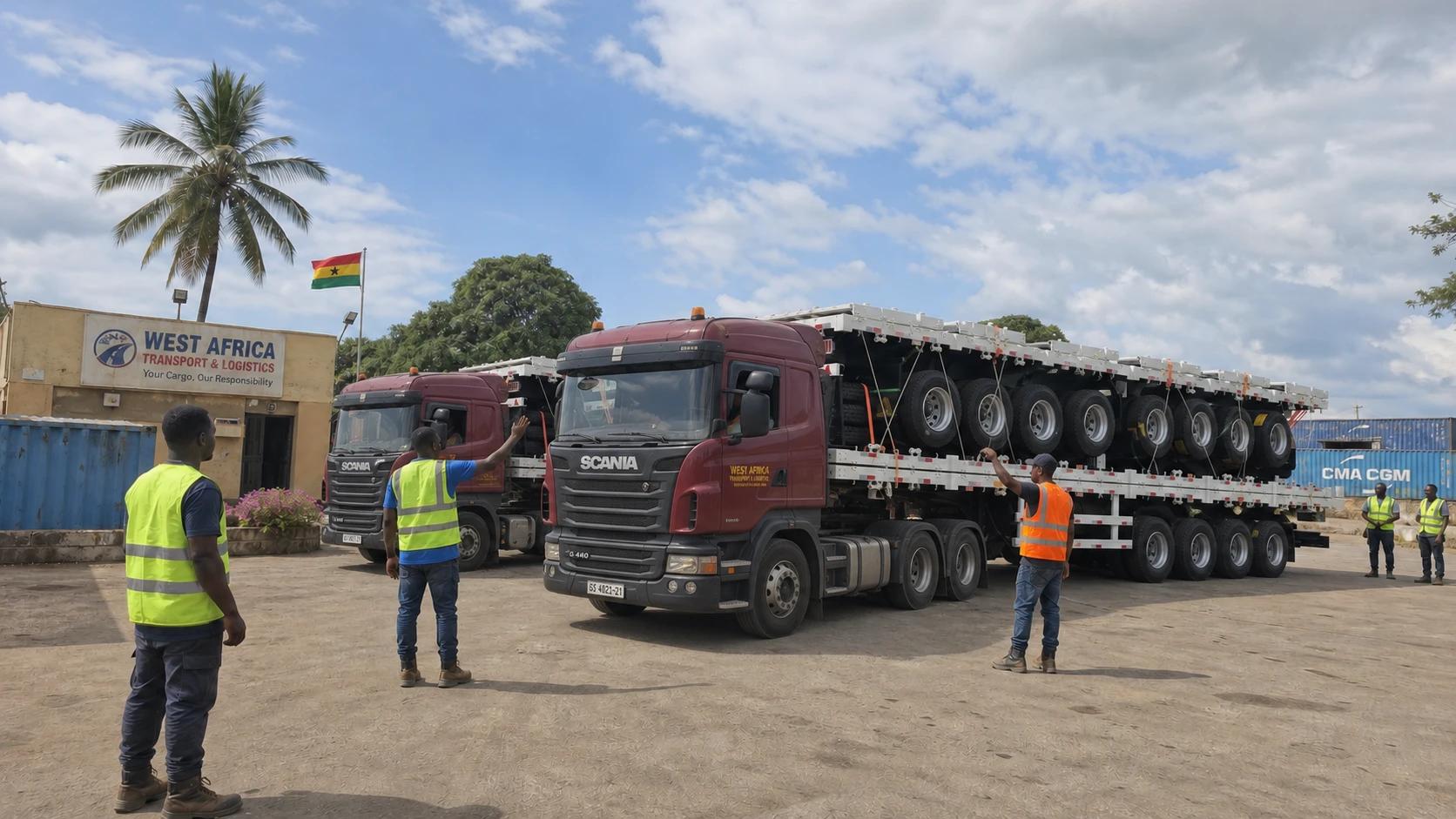
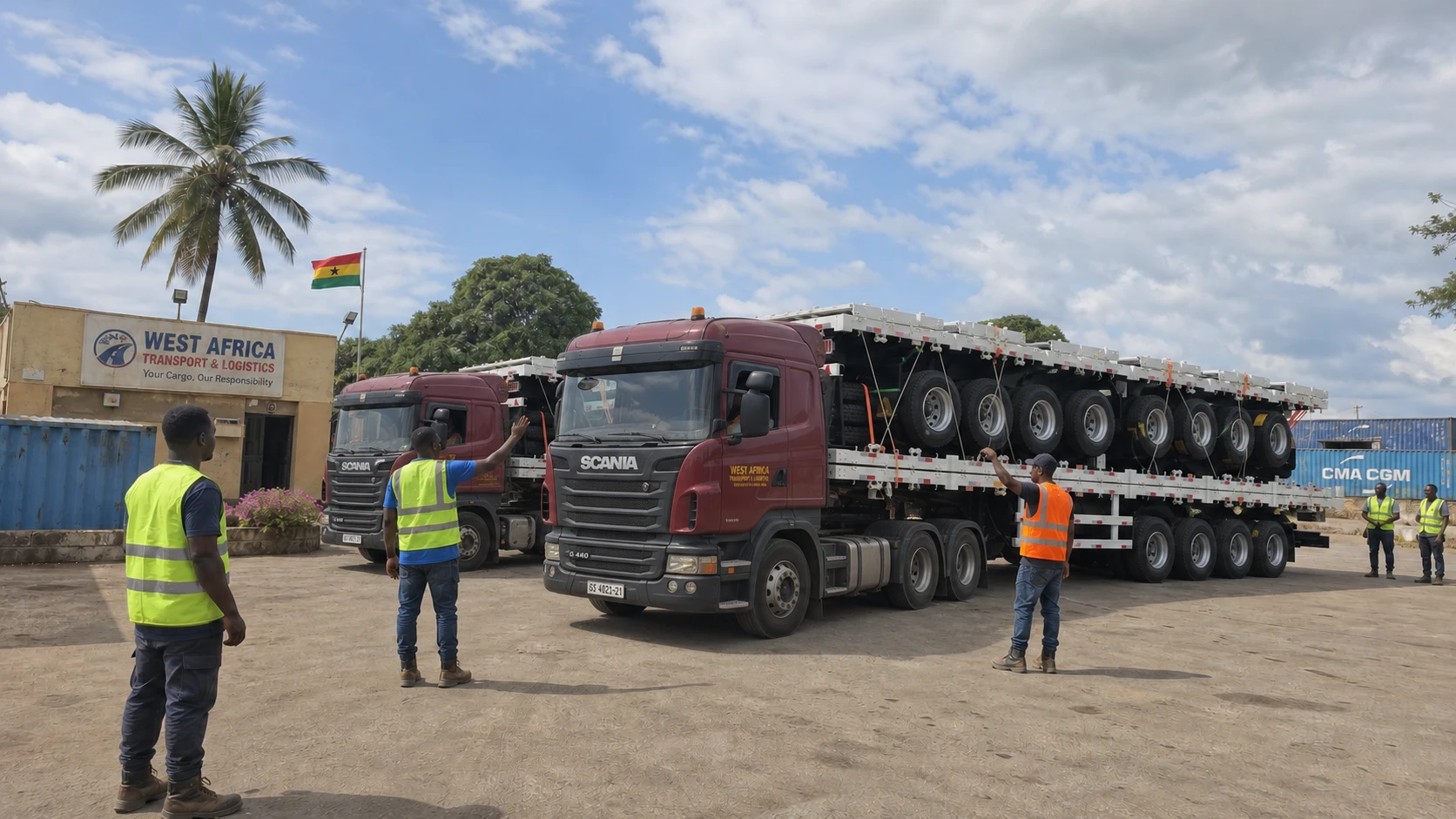
Within the March–June 2026 project window, all 15 flatbed semi-trailers arrived at Tema Port and cleared customs. The first units were then placed into service on the Tema–Tamale route for container and inland freight work.
After the trailers entered operation, Mensah authorised Kales Vehicle to publish the following feedback:
“The steel is solid and the welding is clean. Fully loaded with containers, the trailers have handled our rough roads without problems. The drivers are happy, and my mechanics say the workmanship is much better than on trailers we bought before.”
— Kwame Mensah, Procurement and Fleet Manager
His service feedback was equally specific: the promised photos and videos were delivered before shipment, messages were answered promptly, and the export team assisted when the clearing agent encountered a documentation issue. In his words, this kind of service “is not easy to find.”
Important context: this case reflects one customer’s experience under its own routes, loading practices, driver behaviour and maintenance system. Performance can differ under other axle loads, road surfaces, speeds, climates and maintenance conditions.
The customer’s follow-up purchase plan
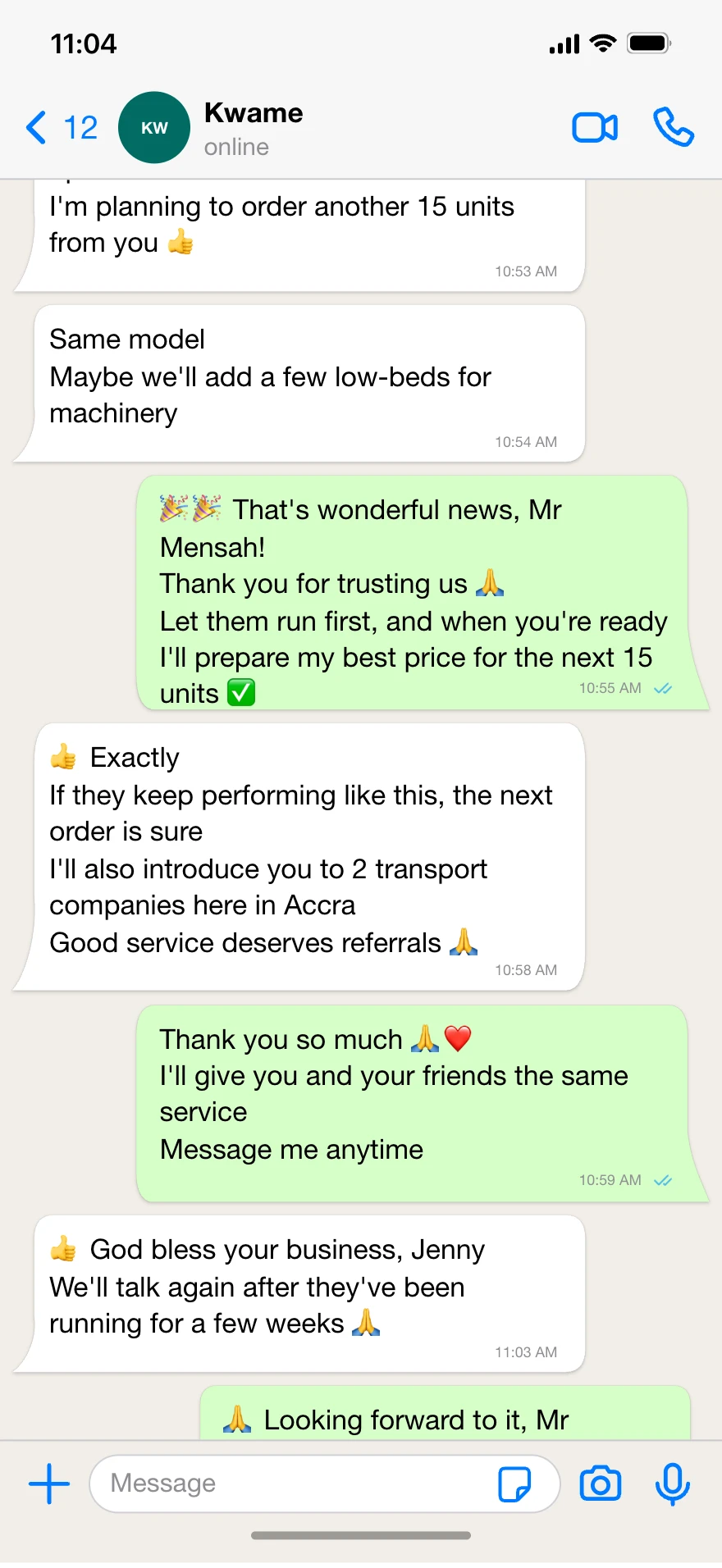
The first 15 trailers were described as the initial phase of a broader fleet expansion. Mensah plans to operate them for two to three months before making the next decision. If the operating results continue to meet expectations, the company intends to consider another 15 trailers of the same type and may also add low-bed trailers for machinery transport.
He also offered to introduce Kales Vehicle to two transport companies in Accra. This is a stated customer plan, not a completed repeat order, and it will depend on the fleet’s continuing operating results and future procurement approval.
What other West African fleet buyers can learn
- Match the trailer to the local maintenance ecosystem. Mechanical suspension was selected because the customer’s technicians could repair it and source parts locally. Air suspension may be the better choice for other fleets, but it was not automatically the right choice here.
- Confirm tractor compatibility before production. Kingpin size, fifth-wheel height, turning clearance, air couplings, electrical connectors and brake interfaces must be checked together. The site’s tractor-trailer matching guide explains the measurements buyers should provide.
- Use evidence instead of promises. Photos and videos of the allocated units gave the buyer a practical way to check condition before shipment.
- Bring documentation support into the project early. Export delivery does not end when the trailer leaves the factory. Packing, shipping documents and clarification for the clearing agent can determine whether equipment reaches service on schedule.
- Compare route fit, not only purchase price. The broader Africa semi-trailer buying guide covers axle rules, suspension, brakes, tyres, corrosion and landed lifecycle cost.
Buyer questions from this Ghana flatbed trailer project
Why did this Ghana fleet choose mechanical leaf-spring suspension?
The customer’s technicians already understood mechanical suspension, replacement parts were easier to source locally, and the fleet expected rough-road service. The choice was based on maintenance capability and route conditions, not on a claim that leaf springs are always better than air suspension.
How were the trailers matched to the customer’s HOWO and SHACMAN tractors?
The project confirmed a 2-inch kingpin and reviewed tractor compatibility as part of the specification discussion. Buyers should also confirm fifth-wheel height and position, turning clearance, air couplings, voltage, lighting connectors and ABS or EBS interfaces before production.
What pre-shipment evidence did the customer receive?
The customer received photos and videos of the actual trailers, including chassis, underside, running gear, lighting, packing and dispatch views. These were project records for the allocated units rather than catalog images.
Does a 60-ton structural design mean 60 tonnes can be carried legally on every Ghana route?
No. Structural design capacity and legal road payload are different. Legal operation depends on Ghanaian axle-load limits, axle spacing, tractor configuration, gross combination mass, cargo distribution and any route-specific requirements. Buyers must confirm the complete combination with the relevant authorities and operators.
Project records used for this case study
- Customer-approved project summary and publication consent.
- WhatsApp specification discussions between the buyer and Jenny Lee.
- Factory completion photos, chassis videos and pre-shipment inspection records.
- Shipment and Tema Port clearance communication from the March–June 2026 project.
- Customer feedback shared after the first trailers entered service.
Transaction price and other agreed commercial terms are intentionally excluded.
Final project takeaway
This Ghana flatbed trailer case was won through a combination of route-specific configuration, workshop-friendly component choices, visible production evidence and practical export support. The result does not prove one universal specification for West Africa. It shows why a fleet buyer and manufacturer should define cargo, route, tractor, legal limits, maintenance resources and inspection evidence before finalising a heavy-duty semi-trailer order.
Request a flatbed trailer specification for your African route
Send your destination country, cargo, container size, legal payload target, tractor model, fifth-wheel height, route conditions and preferred suspension. The Kales Vehicle overseas team can review the operating requirement and prepare a configuration for discussion.