


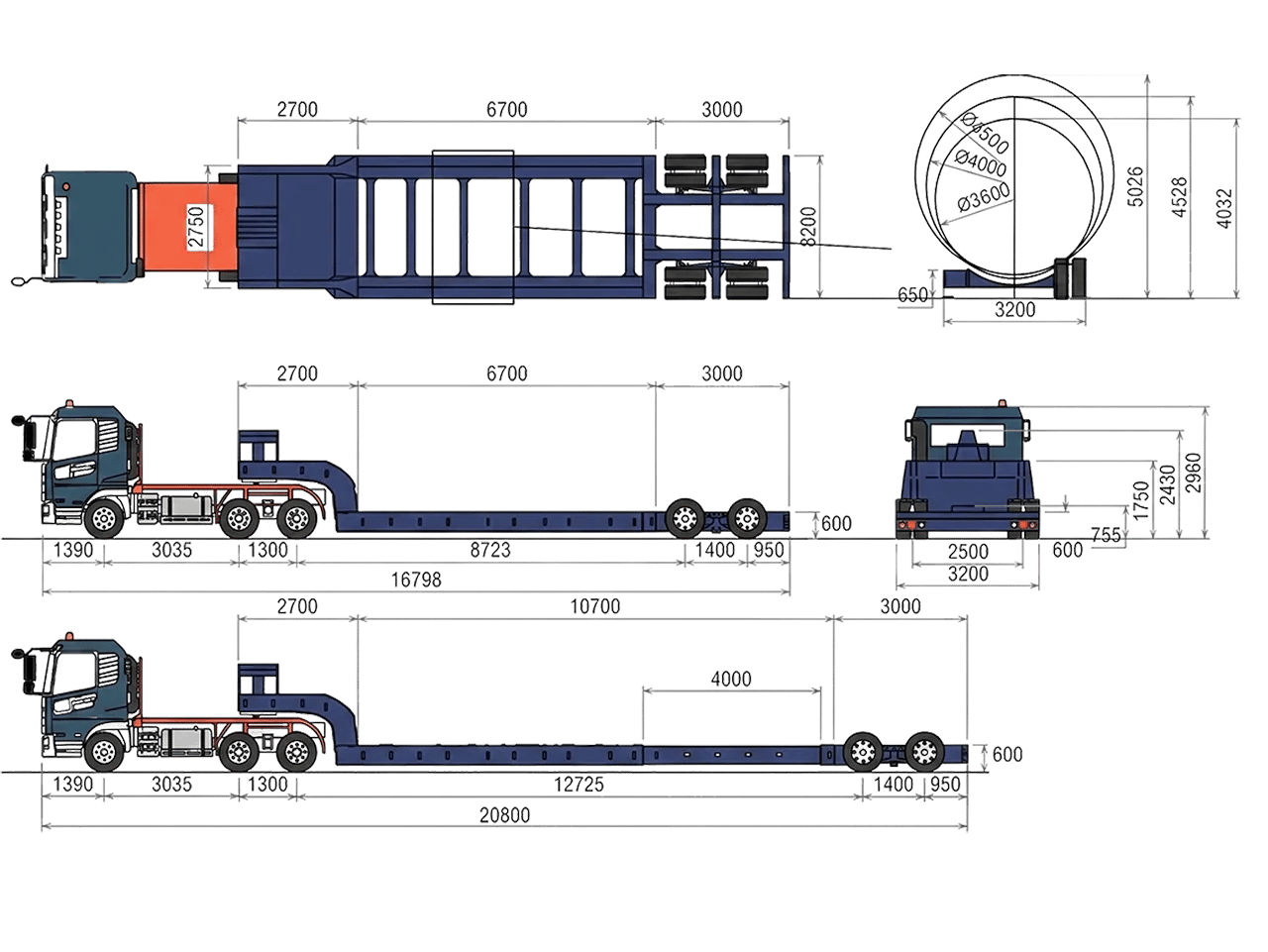
Technical Guide by Kales Vehicle
How to Measure Your tractor truck for the Perfect Semi-Trailer Match
The complete guide to 4 critical measurements that ensure your custom trailer fits flawlessly — from fifth wheel height to axle load distribution.
Measurement Method and Scope
This guide is written for export buyers who need Kales to confirm tractor-trailer compatibility before production. It does not replace the tractor manufacturer’s engineering data, but it gives procurement teams, workshop managers, and drivers a practical field method for recording the dimensions that affect trailer design.
- Use it for: flatbed trailers, lowbed trailers, tanker trailers, container chassis, and other custom semi-trailers
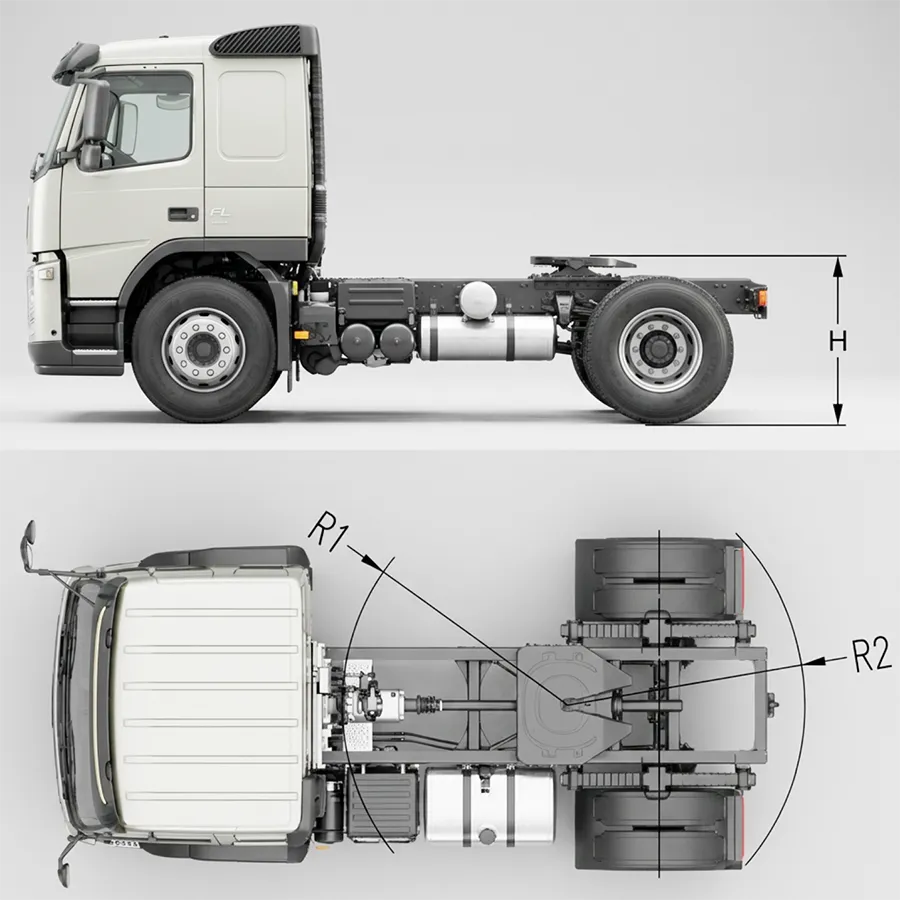
- Record together: fifth wheel height H, rear swing radius R2, front clearance radius R1, and fifth wheel setback Fx
- Send with photos: side view, rear chassis view, fifth wheel close-up, and any CNG, LNG, hydraulic, or battery equipment behind the cab
Why Tractor-Trailer Matching Matters More Than You Think
A semi-trailer has no driving power of its own — it relies entirely on the tractor truck for traction, steering, and braking. This means the trailer must be engineered around your specific tractor’s dimensions, not built as a one-size-fits-all product.
At Kales Vehicle, we’ve seen what happens when tractor-trailer matching goes wrong: premature tire wear, axle overload, suspension failure, poor steering, and even dangerous jackknifing. Every one of these problems is preventable — if you provide the right measurements before production begins.
| # | Parameter | Symbol | Why It Matters |
|---|---|---|---|
| 1 | Fifth Wheel Height | H | Cargo platform height & suspension selection |
| 2 | Rear Swing Radius | R2 | Gooseneck design & landing gear placement |
| 3 | Front Clearance Radius | R1 | Front overhang & cab-to-trailer gap |
| 4 | Fifth Wheel Setback | Fx | Axle load distribution |
Before You Measure: Record the Tractor Configuration
Before measuring dimensions, write down the tractor model, wheelbase, fifth wheel model, tire size, suspension type, and any rear-cab equipment. These details explain why two tractors with similar horsepower can require different trailer neck height, kingpin position, landing gear position, or front clearance.
| Item to record | Why it matters |
|---|---|
| Fifth wheel model and height | Sets trailer front height and keeps the deck level under load. |
| Rear-cab equipment | CNG tanks, LNG tanks, battery boxes, hydraulic tanks, and toolboxes can reduce turning clearance. |
| Suspension and tire size | Ride height changes with tire and suspension choices, especially on rough-road export configurations. |
1. Fifth Wheel Height (H) — The Foundation of Every Trailer Design
What Is Fifth Wheel Height?
The fifth wheel height (also called saddle height or coupling height) is the vertical distance from the ground to the top surface of the fifth wheel coupling plate when the tractor is parked on level ground and the fifth wheel is in its horizontal position.
There are two types: Unladen (empty) — measured with no trailer connected, and Laden (loaded) — measured under full load.
Why Fifth Wheel Height Is Critical
- Determines the cargo platform height (loading height)
- Dictates the suspension type and ride height
- Directly affects axle load distribution between tractor and trailer
- Without this measurement, no trailer can be designed
How to Measure – Step by Step
Tools: Straight ruler or steel tape measure (min. 1.5m / 5ft)
- Park your tractor on a hard, flat, level surface (concrete or asphalt)
- Ensure the fifth wheel plate is in its horizontal (level) position
- Measure the vertical distance from the ground to the highest point on the fifth wheel plate top surface
Industry Standards
| Condition | Max Height |
|---|---|
| Standard unladen tractor | ≤ 1,400 mm |
| For 8’6″ (2,591mm) ISO containers | ≤ 1,320 mm |
| For 9’6″ (2,896mm) high-cube containers | ≤ 1,110 mm |
| Laden (general semi-trailer, excl. skeleton) | 1,150 – 1,300 mm |
What Happens When Height Is Wrong?
Warning: Fifth Wheel TOO HIGH:
- Trailer front axle load decreases → front tires wear flat
- Tractor fifth wheel position overloaded → understeer
- Tractor may wheelie on inclines
Warning: Fifth Wheel TOO LOW:
- Trailer rear axle load decreases → rear tires wear flat
- Front axle overloaded → tire blowouts, shoulder wear
- Front axle leaf springs may crack or deform
- Tractor drive wheels lose traction, may spin
2. Rear Swing Radius (R2) — Preventing Tractor-Trailer Collision
What Is Rear Swing Radius?
The rear swing radius (R2) is the horizontal distance from the center of the fifth wheel king pin hole to the rearmost point of the tractor — measured as a projected distance on the ground plane. When the tractor turns sharply, the rear end swings outward — R2 tells us how far back the tractor extends behind the coupling point.
Why It Matters
- Determines the gooseneck transition dimensions
- Determines landing gear placement position
- Too large R2 creates interference during turns
How to Measure – Step by Step
Tools: Steel tape measure (min. 3m / 10ft)
- Park your tractor on a hard, flat, level surface
- Measure the horizontal distance from the king pin hole center to the rearmost point of the tractor chassis or body
| Guideline | Value |
|---|---|
| Max recommended R2 (swap-body operations) | ≤ 2,200 mm |
| Min clearance: tractor rear ↔ trailer gooseneck | 70 – 100 mm |
3. Front Clearance Radius (R1) — Protecting Cab-Mounted Equipment
What Is Front Clearance Radius?
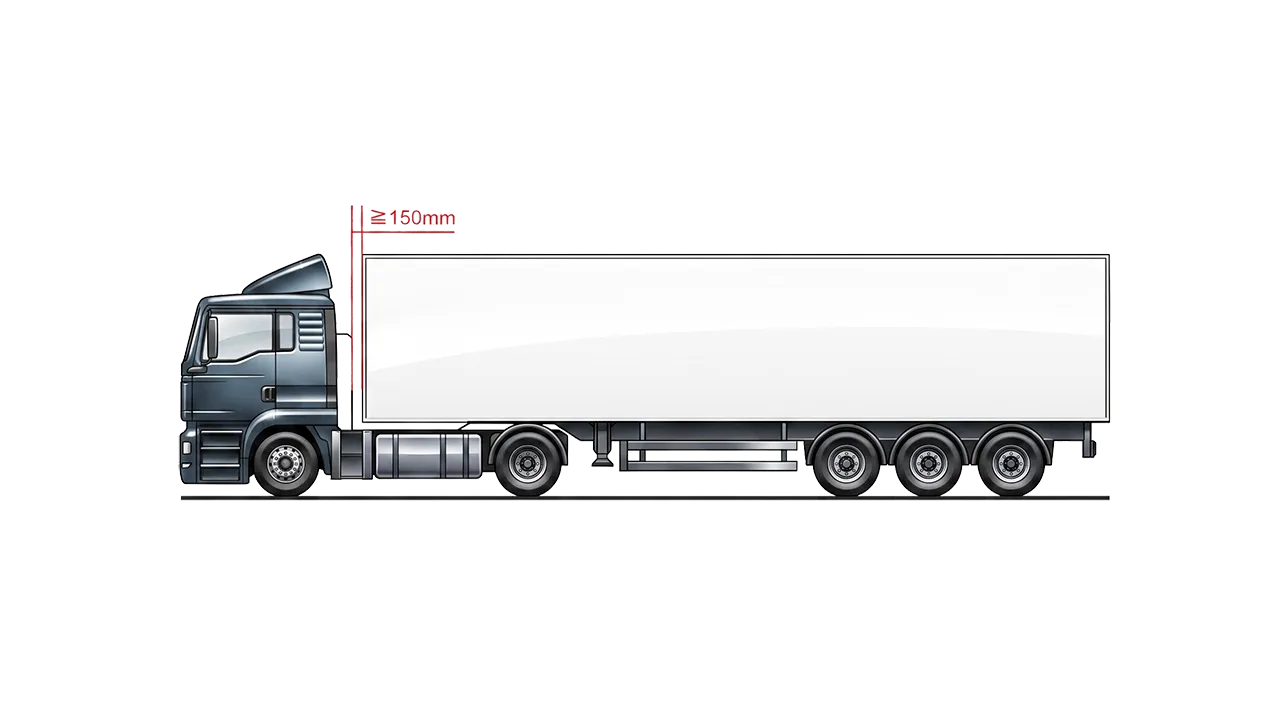
The front clearance radius (R1) is the horizontal distance from the center of the fifth wheel king pin hole to the nearest obstruction behind the cab — measured on the Y-plane (lateral vertical plane).
Common obstructions include: air filter housings, CNG/LNG gas cylinders, battery boxes, exhaust aftertreatment systems (SCR, DPF), and hydraulic tanks.
Why It Matters
- Determines the front overhang design of the trailer
- Prevents trailer front from colliding with cab equipment during turns
- Especially critical for CNG, LNG, and electric tractors with large equipment behind the cab
How to Measure – Step by Step
Tools: Steel tape measure (min. 3m / 10ft)
- Park your tractor on a hard, flat, level surface
- Identify the closest obstruction behind the cab
- Measure horizontal distance from king pin center to this nearest point, along the Y-plane
| Guideline | Value |
|---|---|
| Typical R1 range | ≤ 2,040 + 150 mm |
| Min clearance: trailer front ↔ tractor cab equipment | ≥ 150 mm |
What Happens When R1 Is Wrong?
- R1 too large / trailer too short: Excessive gap → aerodynamic drag, wider turning radius, instability, possible overlength
- R1 too small / trailer too long: Front-end collision → may rupture gas cylinders or damage electrical systems
4. Fifth Wheel Setback (Fx) — The Key to Axle Load Distribution
What Is Fifth Wheel Setback?
The fifth wheel setback (Fx) is the horizontal distance from the vertical plane through the fifth wheel pivot axis to the vertical plane through the center of the rear axle(s). In simpler terms: how far forward the fifth wheel sits relative to the rear axle.
Why It Matters
- Critical for axle load distribution calculations
- Determines how much weight each axle carries when loaded
- Incorrect Fx causes dangerous driving conditions
How to Measure – Step by Step
Tools: Straight ruler or tape measure (min. 2m / 6.5ft)
- Park your tractor on a hard, flat, level surface
- Measure horizontal distance from king pin center to rear axle center (or midpoint between tandem axles)
What Happens When Fx Is Wrong?
Warning: Fx TOO LARGE (fifth wheel too far forward):
- Rear axle load decreases, reducing traction
- Dangerous on 6×2 tractors: drive axle may lose grip → wheel spin on grades
- Tractor struggles to start on inclines
Warning: Fx TOO SMALL (fifth wheel too far back):
- Rear axle load exceeds rated capacity
- Axles, wheels, leaf springs may deform or fail
- Tractor experiences front-end lift, steering becomes heavy
Measurement release gate: approve H, R1, R2 and Fx before trailer drawing freeze
Tractor-trailer matching should have a release gate before the trailer drawing is frozen. The buyer should submit measured fifth wheel height H, rear swing radius R2, front clearance radius R1, fifth wheel setback Fx, tire size, suspension type, fifth wheel model, and photos from both sides plus the rear of cab. These records protect the project when the tractor has been modified, fitted with CNG/LNG tanks, battery boxes, hydraulic kits, toolboxes or a non-standard fifth wheel mounting plate.
The engineering logic is supported by interchangeability references. ISO 1726-1 covers mechanical coupling interchangeability between tractors and semi-trailers for general cargo, ISO 337 defines the 50 semi-trailer fifth wheel coupling pin dimensions, and SAE J701 addresses truck tractor and semitrailer interchange coupling dimensions. These standards do not replace local regulations, but they are a solid basis for a measurement checklist.
Approve before drawing freeze
- H measured on level ground with normal tire pressure and working ride height.
- R1 checked against rear-cab tanks, batteries, toolboxes and hydraulic equipment.
- R2 checked against chassis tail, mudguards, fifth wheel plate and gooseneck path.
- Fx reviewed with axle load target, trailer axle group and payload center.
Block release if found
- Only factory spec sheet is provided, but tractor tires, suspension or fifth wheel were changed.
- No rear-cab photos for CNG, LNG, electric or hydraulic tractors.
- R1/R2 clearance is not checked at the expected steering angle and articulation.
- Fx is approved without reviewing axle load distribution and legal payload.
For African mining, container, fuel, bulk and flatbed fleets, this gate prevents expensive rework after the trailer arrives. A small mismatch can cause kingpin lock problems, landing gear interference, cab-equipment damage, poor axle load distribution or an unsafe trailer nose-up/nose-down attitude. Send the measurement package before production, then keep it with the delivery documents for future fleet replacements.
Your Measurement Checklist
Before contacting Kales Vehicle, prepare these four measurements:
| Check | Parameter | Symbol | Tools | Key Tip |
|---|---|---|---|---|
| ☐ | Fifth Wheel Height | H | Tape ≥ 1.5m | Measure unladen, flat ground |
| ☐ | Rear Swing Radius | R2 | Tape ≥ 3m | To the rearmost point |
| ☐ | Front Clearance Radius | R1 | Tape ≥ 3m | Nearest obstruction behind cab |
| ☐ | Fifth Wheel Setback | Fx | Tape ≥ 2m | To rear axle centerline |
Frequently Asked Questions
Q: What measurements do I need from my tractor to order a custom semi-trailer?
You need exactly four measurements: Fifth Wheel Height (H), Rear Swing Radius (R2), Front Clearance Radius (R1), and Fifth Wheel Setback (Fx). These are mandatory — no responsible manufacturer can design a matched trailer without all four. Always measure your actual tractor on flat ground using a steel tape measure.
Q: What is fifth wheel height and what is the standard range?
Fifth wheel height is the vertical distance from ground to the top of the coupling plate. Standard unladen height should not exceed 1,400mm. For ISO containers: ≤1,320mm for 8’6″ and ≤1,110mm for 9’6″ high-cube. Loaded range is typically 1,150–1,300mm.
Q: What happens if my fifth wheel height doesn’t match the trailer?
A mismatch beyond +10mm (too high) or -15mm (too low) causes serious issues. Too high reduces front axle load causing flat tire wear. Too low overloads the front axle, risking blowouts, spring failure, and loss of drive traction.
Q: Do I need different measurements for CNG, LNG, or electric tractors?
The same four measurements apply, but Front Clearance Radius (R1) requires extra attention. Alternative-fuel tractors mount large gas cylinders or battery packs behind the cab, significantly reducing clearance. At Kales Vehicle, we recommend sending photos of the cab rear area alongside measurements.
Q: Can I use the manufacturer’s spec sheet instead of measuring?
No. Even tractors of the same make and model vary due to spring pack configurations and mounting plate thickness. Always measure your specific tractor. Kales Vehicle provides free remote guidance via WhatsApp or video call.
Why Kales Vehicle Takes Matching So Seriously
At Kales Vehicle, every semi-trailer is designed around your specific tractor.
- Factory-Direct Engineering: No middleman — your data goes straight to the design table
- Precision Matching: Every gooseneck angle, suspension height, and landing gear position is calculated for your exact tractor
- Global Experience: Customers across Africa, Latin America, Middle East, and Central Asia — matched to Mercedes-Benz, Volvo, Scania, HOWO, Shacman, FAW, Dongfeng, and more
- Remote Assistance: Free measurement guidance via WhatsApp, video call, or photo analysis
Ready to Get Started?
Taking accurate measurements is the first step toward a trailer that performs perfectly.
- Measure all four parameters
- Photograph your tractor (side, rear, behind cab)
- Contact Kales Vehicle with measurements & requirements
- Receive a custom proposal within 24 hours
Email: jennylee@kalestruck.com | WhatsApp: +86 131 5638 8843