


Leaf Spring vs Air Suspension Semi-Trailer: The 2026 Fleet Buyer’s Decision Guide
How to Choose the Right Suspension for Your Fleet
The complete decision guide to leaf spring versus air suspension semi-trailers — built around realistic China factory-direct pricing, actual repair-market labor rates in Africa, Latin America, and the Middle East, and the six operational dimensions that determine 5-year total cost of ownership.
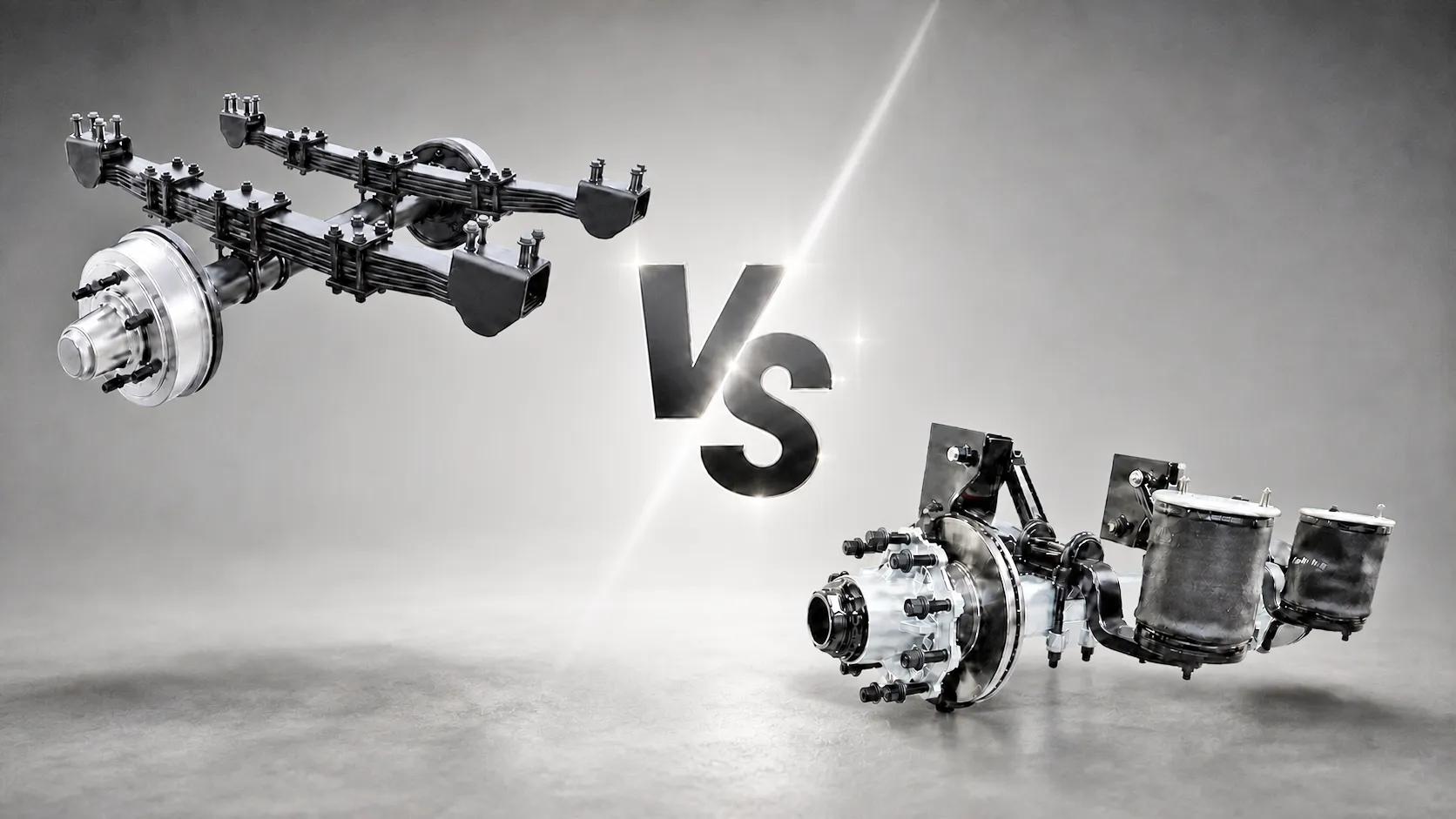
Quick Answer: Leaf spring suspension is the better choice for heavy-duty off-road operation — mining, construction, overloaded routes, rural distribution — due to higher rated axle load (13 tons per axle versus air suspension’s 11 tons), lower upfront cost, simpler field repair, and 20–30% overload tolerance. A standard tri-axle leaf spring trailer carries 39 tons rated load; the air suspension equivalent carries 33 tons — a 6-ton structural difference that matters more than ride quality for bulk cargo operations. Air suspension is the better choice for high-value cargo, long-distance highway logistics, and operations where ride quality and load distribution matter — refrigerated goods, electronics, fragile cargo, fuel and chemical tankers. At Kales Vehicle’s China factory-direct FOB pricing, air suspension typically adds only $580–$1,000 per axle ($1,740–$3,000 for a tri-axle trailer) over leaf spring — a fraction of the $2,800–$4,500 per axle premium charged by European OEM brands. For most African, Latin American, and Middle East mining and construction fleets, leaf spring remains the best 5-year TCO choice. For highway logistics carrying high-value cargo above 80 km/h, air suspension typically pays back within 1.5–2.5 years through reduced cargo damage, lower tire wear, and modest fuel savings.
Key Takeaways
- Rated axle load: standard Kales multi-leaf spring axle is rated at 13 tons per axle versus air suspension’s 11 tons per axle — a tri-axle leaf spring trailer carries 39 tons rated load against the air suspension equivalent’s 33 tons. This 6-ton structural difference is the dominant factor in suspension selection for any bulk cargo operation, before ride quality is even considered.
- Overload behavior: multi-leaf spring suspension is generally more tolerant of short-term abuse and load variation in harsh operating environments, while air suspension has almost no practical overload buffer once dynamic shock, potholes, and off-road impact loading are added. In mining and construction duty, operation above rated load is not recommended for either system, but air suspension reaches damaging pressure spikes much sooner.
- Upfront cost difference (China factory-direct): air suspension typically adds $580–$1,000 per axle ($1,740–$3,000 for a tri-axle trailer) to the base purchase price — far below the $2,800–$4,500 per axle premium charged by European OEM brands like BPW, SAF-Holland, or Hendrickson.
- Vibration transmission: air suspension reduces vibration transferred to cargo by 60–72% versus leaf spring, dropping high-value cargo damage rates from typical 2–4% down to 0.5–1% on long-distance routes.
- Maintenance ecosystem: leaf spring can be repaired at any roadside workshop in West Africa, Andean Latin America, or Central Asia; air suspension requires specialized parts and trained technicians, available in major cities but rare in remote operating zones.
- 5-year TCO outcome: leaf spring saves approximately $15,900 per trailer in mining operation; air suspension saves approximately $51,700 per trailer in long-distance high-value reefer logistics — the right answer depends entirely on which operating profile your fleet runs.
Why Suspension Choice Determines Trailer Economics
Most semi-trailer purchase decisions get made on three numbers: payload capacity, axle configuration, and price. Suspension type tends to be treated as a side specification — a checkbox between “standard leaf spring” and “premium air suspension” with a vague upcharge attached. This is a serious misreading of how the suspension system actually drives fleet economics over the trailer’s operational life.
If you’ve spent any time comparing semi-trailer quotes for your fleet, you’ve already noticed something strange: two trailers with identical chassis specifications, same brake systems, and same body type can differ in price by $1,740 to $3,000 per unit when sourced from a Chinese factory like Kales Vehicle, or by $8,400 to $13,500 when sourced through European OEM channels. The variable hiding behind that price gap is almost always the same — suspension type. The dramatic difference between the two cost ranges is also why African, Latin American, and Middle East fleets are increasingly choosing China-direct procurement: the air suspension premium that makes economic sense at $580–$1,000 per axle becomes prohibitive at $2,800–$4,500 per axle.
This guide breaks down exactly how leaf spring and air suspension systems perform across the six decision dimensions that actually matter for B2B fleet operators, and it does so using real China factory-direct cost structures — not European OEM list prices that inflate every TCO calculation by a factor of four to five times. The conclusion is not what most suppliers want you to believe: with realistic pricing, air suspension makes economic sense in a much wider range of operations than the “premium European cost” math would suggest. Equally, leaf spring remains the unambiguous winner for the operating profiles where most of our African, Andean, and Central Asian mining customers actually run.
1. Load Capacity and Overload Tolerance — Where Leaf Spring Still Dominates
The Engineering Reality of Heavy-Duty Off-Road Operation
The single largest engineering difference between multi-leaf spring and air suspension is rated axle load capacity. Kales Vehicle’s standard multi-leaf spring axle is rated at 13 tons per axle for heavy-duty mining and construction service. The standard air suspension axle is rated at 11 tons per axle, reflecting the air bag’s structural ceiling at typical ride height settings. Across a tri-axle trailer this becomes a 39-ton versus 33-ton rated payload difference — a 6-ton gap that fundamentally reshapes which trailer can carry which cargo legally. For 30-ton iron ore loads, copper concentrate, or aggregate haulage, only the leaf spring trailer operates within its rated envelope. The air suspension trailer is structurally overloaded before ride quality is even considered.
The second engineering difference is overload behavior — what happens when real-world operating abuse pushes axle load, impact shock, or suspension travel beyond the rated envelope. Multi-leaf spring suspension is a passive mechanical system: stress is distributed across multiple stacked leaves, and temporary overload or poor road shock is usually absorbed as accelerated wear, sag, or cracked leaves rather than immediate system collapse. That is why mining and construction fleets still prefer it when route discipline is weak and payload variation is common. This is not a recommendation to operate above rated capacity; it is a statement about which system is more recoverable when abuse inevitably happens.
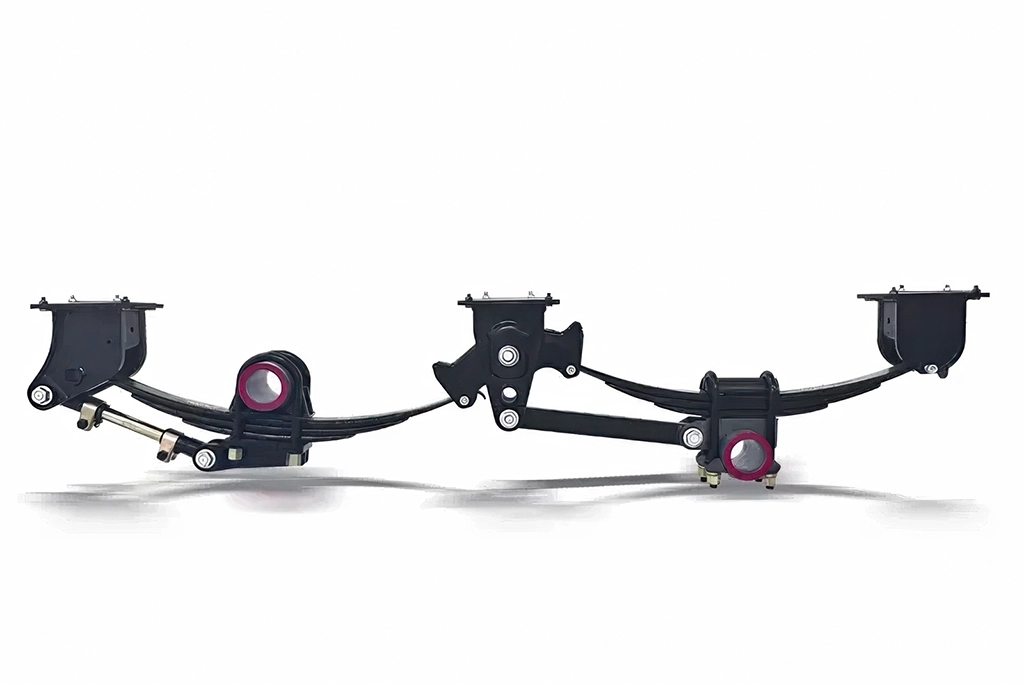
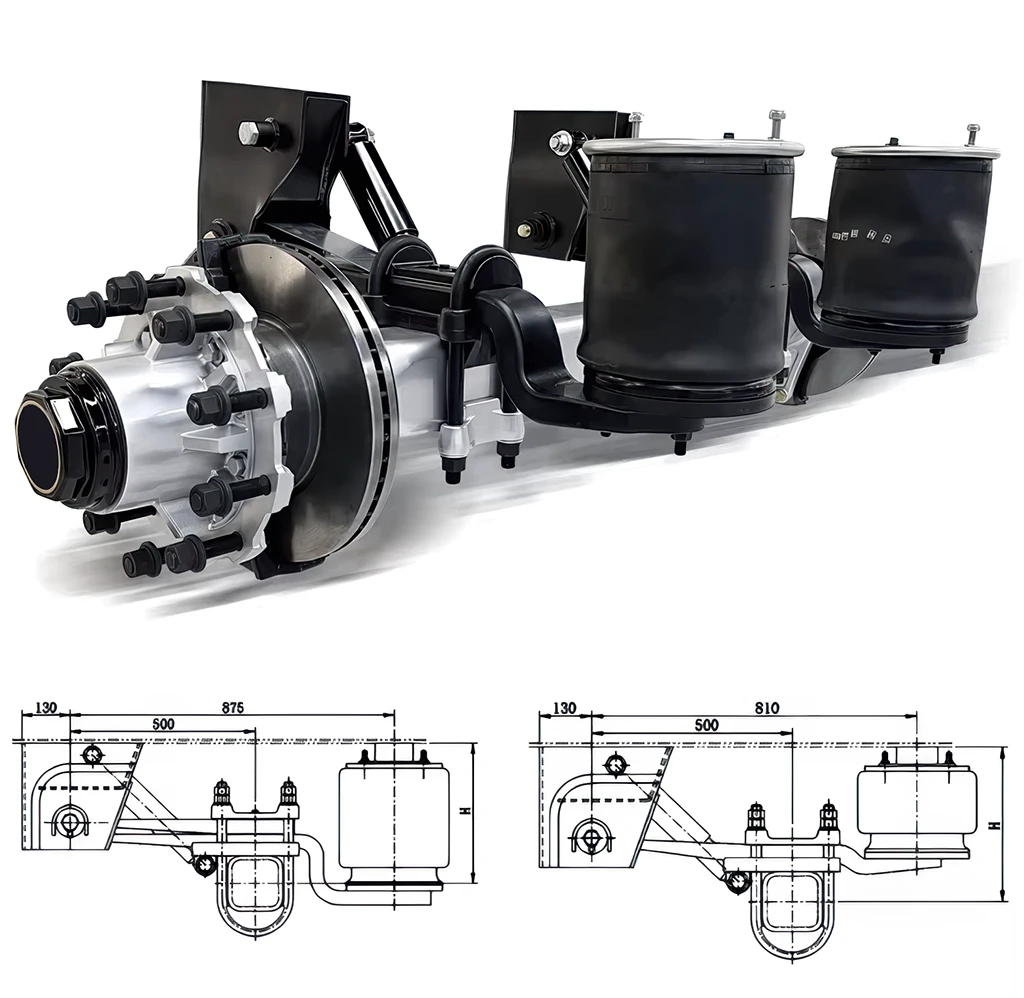
Air suspension is a pneumatically controlled system with much less tolerance for overload once payload spikes are combined with dynamic shock from potholes, corrugation, and off-road impact. Once cargo weight and road shock drive bag pressure above the intended operating window, ride height drops, the leveling valve struggles to recover target pressure, and repeated shock loading can damage the bags, lines, or valves very quickly. In practical mining and construction duty, fleets should treat air suspension as having almost no usable overload buffer.
| Load Behavior Dimension | Multi-Leaf Spring (13 t/axle) | Air Suspension (11 t/axle) |
|---|---|---|
| Rated load per axle (Kales standard) | 13 tons | 11 tons |
| Rated payload, tri-axle trailer | 39 tons | 33 tons |
| Rated payload, 2-axle trailer | 26 tons | 22 tons |
| Behavior when actual load exceeds rating | Usually more recoverable in abusive duty, but accelerated wear rises sharply | Very limited real-world buffer; dynamic shock can trigger rapid bag or valve damage |
| Behavior at sustained overload | Accelerated leaf wear, gradual sag | Air bag rupture, leveling valve damage |
| Failure mode | Single leaf crack — trailer remains operable | Air bag burst — trailer unable to maintain ride height |
| Recovery in remote location | Roadside repair, broken leaf removed temporarily | Tow required if multiple bags fail |
| Typical service life under heavy load | 5–8 years primary leaves | 3–5 years air bags in dust environment |
Why Mining and Construction Fleets Choose Leaf Spring
Across our African mining customer base — Guinea bauxite, Mali gold, DRC copper, Zambia copper-cobalt, South Africa chrome — leaf spring suspension is selected on roughly 92% of new trailer orders. This is not because air suspension would not deliver better ride quality; it would. It is because the operating environment makes air suspension’s failure modes economically catastrophic in ways that leaf spring’s failure modes are not, and the rated load gap (39 t vs 33 t tri-axle) eliminates the air suspension trailer from compliant operation on most mining loads in the first place.
A leaf spring trailer with a damaged spring pack is usually easier to recover in the field and easier to return to service with basic workshop support. An air suspension trailer with a ruptured bag or failed leveling hardware is more likely to stop the unit immediately. In a mining operation generating $4,000–$8,000 per trailer per day in revenue, even a short unplanned stop can erase the annual maintenance-cost difference between the two suspension types.
Common Procurement Mistake: Buyers comparing trailers on a European logistics website may see air suspension presented as the “modern” or “professional” choice. This framing reflects European operating conditions — paved highways, regulated load limits, dense repair networks — that do not match African, Andean, or Central Asian mining and construction operations. Specifying an 11 t/axle air suspension trailer for a 30-ton iron ore haul is not a “premium upgrade”; it is a structural mismatch that puts the trailer above rated load on every trip and costs your fleet approximately $15,900 per trailer in 5-year TCO compared to a properly specified 13 t/axle leaf spring unit.Where Leaf Spring’s Load Behavior Becomes a Problem
Leaf spring suspension’s load tolerance is its strength, but its load distribution is its weakness. Multi-leaf systems transfer cargo weight to the chassis through a relatively concentrated pivot — the spring eye and U-bolt contact zone — which means dynamic load spikes (potholes, speed bumps, hard braking) are transmitted to the chassis frame and to the cargo with minimal damping. For bulk cargo this is acceptable. For high-density cargo with fragile structure (palletized electronics, refrigerated pharmaceuticals, glass packaging, automotive parts), the cumulative damage from leaf spring’s stiffer ride cycle is the dominant cost driver, often exceeding the entire cost of the suspension system itself within 18 months.
This is the central trade-off the rest of this guide unpacks: leaf spring is forgiving of vehicle abuse but unforgiving of cargo abuse. Air suspension is forgiving of cargo abuse but unforgiving of vehicle abuse. Picking correctly between them requires honest assessment of which kind of abuse your operation actually generates.
2. Ride Quality and Cargo Protection — Where Air Suspension Earns Its Premium
The Vibration Transmission Numbers Most Suppliers Don’t Publish
Ride quality is the suspension dimension where marketing language tends to get vague. “Smoother ride,” “better comfort,” “premium feel” — these are subjective descriptions that don’t help a fleet operator calculate whether the upcharge is worth it. The honest answer requires looking at vertical vibration acceleration measured at the cargo deck, expressed in m/s² RMS, across realistic road surfaces.
Field measurement data from Kales Vehicle test programs and third-party logistics studies show consistent vibration transmission patterns across surface types. Air suspension reduces vertical acceleration at the cargo deck by 60–72% versus multi-leaf spring on highway surfaces, by 45–58% on graded gravel roads, and by 30–42% on rough mining roads. The reduction is most dramatic at high frequency (10–50 Hz), which is precisely the frequency band that damages packaged cargo, electronics, and refrigerated goods.
| Road Surface | Leaf Spring (m/s² RMS at cargo deck) | Air Suspension (m/s² RMS at cargo deck) | Reduction |
|---|---|---|---|
| Smooth highway (asphalt, < 80 km/h) | 0.8 – 1.2 | 0.25 – 0.40 | 65–72% |
| Highway at 80–100 km/h (typical wear) | 1.4 – 2.1 | 0.45 – 0.70 | 62–68% |
| Graded gravel road, dry | 2.8 – 4.2 | 1.4 – 2.1 | 48–58% |
| Rough mining road, loaded | 4.5 – 7.0 | 3.0 – 4.5 | 32–42% |
| Cross-country, off-road | 7.0 – 11.0 | 5.5 – 8.0 | 22–30% |
How Vibration Reduction Translates to Cargo Damage Rates
The financial significance of vibration reduction depends entirely on what your trailer is hauling. For bulk ore, sand, gravel, or aggregates, vibration is irrelevant — you are hauling material that cannot be damaged by vibration. For palletized goods, electronics, pharmaceuticals, glass, refrigerated cargo, and packaged consumer goods, vibration is the dominant cargo damage driver on long-distance routes, frequently exceeding theft and accident damage combined.
Operating data from East African and West African long-haul logistics operators delivers a consistent range: cargo damage rates on multi-leaf spring trailers run 2–4% by value for high-value packaged goods over 800+ km routes; the same goods on air suspension trailers run 0.5–1% by value. For a $80,000 per-load consumer electronics shipment, this is a difference of $1,200–$2,400 per load — recovered against air suspension’s $1,740–$3,000 trailer purchase premium in roughly two to three loads.
Driver Retention Bonus: Air suspension also reduces driver fatigue meaningfully on long-distance routes. Long-haul operators in Kenya, Tanzania, Mozambique, and Ethiopia consistently report 15–25% lower driver turnover on air suspension fleets compared to leaf spring, primarily because the reduced vertical vibration loading reduces back pain and fatigue on 12–14 hour driving days. In markets where experienced long-haul drivers are scarce and command 30–50% wage premiums, this retention effect compounds the direct cargo damage savings.Self-Leveling: The Hidden Operational Advantage
Multi-leaf spring suspension delivers fixed ride height — the trailer sits at one height regardless of load. Air suspension delivers active height control through leveling valves that maintain constant ride height across the loading range. This has three specific operational advantages that rarely appear in spec sheets but matter significantly to fleet operators handling diverse cargo.
First, dock height stability: an air suspension trailer maintains the same deck height whether empty, half-loaded, or fully loaded, which dramatically simplifies forklift loading and dock-leveler interface in distribution center operations. A leaf spring trailer can vary 100–150 mm in deck height between empty and full load, requiring dock plate adjustment for every load.
Second, load distribution control: air suspension automatically rebalances load between axles as cargo shifts during transport, reducing concentrated wear on any single axle. Leaf spring distributes load through fixed mechanical geometry that does not respond to load shifts, leading to faster wear on whichever axle absorbs the most cargo movement.
Third, lift axle integration: many air suspension configurations support pneumatically liftable axles, allowing operators to raise non-load-bearing axles when running empty, reducing tire wear by 20–35% on return legs. Leaf spring lift axle conversions are mechanically possible but significantly more complex and rarely cost-justified.
3. Maintenance Cost and Repair Ecosystem — The Operating Cost Reality
Annual Maintenance Cost at Realistic Repair-Market Rates
Annual maintenance cost differs significantly between leaf spring and air suspension trailers, with the gap widening dramatically when operating conditions move from highway to off-road. Using realistic labor rates from African, Latin American, and Middle East repair markets ($25–$45 per hour for general mechanical work, $40–$70 per hour for specialized air suspension service), leaf spring trailers typically cost $295–$535 per year to maintain in normal service. Air suspension costs $600–$1,060 per year in highway service and $905–$1,815 per year in mining and construction service.
Note that all numbers in this section reflect labor and parts costs typical of the markets Kales Vehicle serves — not European or North American repair rates, which run two to three times higher and produce dramatically different (and largely irrelevant) TCO conclusions for our customer base. A maintenance comparison referencing $80–$120 per hour European workshop rates effectively assumes a fleet operator can air-freight parts from Germany within 48 hours, which describes essentially zero of our actual customers.
Multi-Leaf Spring Annual Maintenance Breakdown
| Maintenance Item | Frequency | Cost per Event | Annualized Cost |
|---|---|---|---|
| Leaf inspection and crack check | Quarterly | $15 – $30 labor | $60 – $120 |
| U-bolt torque check and replacement | Every 6 months | $20 – $40 | $40 – $80 |
| Leaf replacement (broken/cracked) | Every 18–30 months | $180 – $320 | $120 – $200 |
| Spring eye bushing replacement | Every 24–36 months | $80 – $140 | $35 – $70 |
| Shock absorber replacement | Every 30–40 months | $120 – $200 | $40 – $65 |
| Total annual maintenance | $295 – $535 |
Air Suspension Annual Maintenance — Highway Operation
| Maintenance Item | Frequency | Cost per Event | Annualized Cost |
|---|---|---|---|
| Air bag inspection and pressure test | Quarterly | $25 – $45 labor | $100 – $180 |
| Air bag replacement (normal wear) | Every 24–36 months, 4 bags | $140 – $220 per bag | $200 – $360 |
| Leveling valve replacement | Every 24 months, 2 valves | $90 – $160 per valve | $90 – $160 |
| Air compressor (trailer-side, if equipped) | Every 36–48 months | $280 – $420 | $80 – $120 |
| Air dryer cartridge replacement | Annual | $50 – $90 | $50 – $90 |
| Air line and fitting repairs | Irregular | $40 – $120 per event | $80 – $150 |
| Total annual maintenance (highway) | $600 – $1,060 |
Air Suspension Annual Maintenance — Mining and Off-Road Operation
| Maintenance Item | Frequency | Cost per Event | Annualized Cost |
|---|---|---|---|
| Air bag replacement (rock damage) | Every 6–12 months, 1–3 bags | $140 – $220 per bag | $280 – $660 |
| Leveling valve replacement (dust contamination) | Every 12 months | $90 – $160 | $90 – $160 |
| Air compressor failure (high duty cycle) | Every 18–24 months | $280 – $420 | $160 – $250 |
| Air line damage and rerouting | Every 6–12 months | $100 – $250 | $160 – $350 |
| Standard inspection and diagnostics | Quarterly | $35 – $65 | $140 – $260 |
| Air dryer cartridge replacement | Every 8 months (dust) | $50 – $90 | $75 – $135 |
| Total annual maintenance (mining/off-road) | $905 – $1,815 |
The Repair Ecosystem Multiplier
Direct maintenance cost is only half the operating cost picture. The other half is repair ecosystem availability — how quickly and locally you can fix a problem when it occurs. This is where the gap between leaf spring and air suspension widens far beyond what the maintenance cost tables suggest, and where many fleet operators discover the true cost of suspension choice only after their trailer is grounded 400 km from the nearest dealer.
Multi-leaf spring suspension can be repaired by essentially any roadside mechanical workshop in the markets Kales Vehicle serves. A broken leaf can be replaced in 2–4 hours using basic tools and locally fabricated or stocked replacement leaves. There are no proprietary parts, no electronic diagnostics, no specialized training required. In Guinea, Mali, Burkina Faso, Bolivia, Ecuador, Paraguay, and the rural regions of every country we ship to, leaf spring repair is a commodity service.
Air suspension repair requires specialized parts (specific air bag part numbers, leveling valves matched to the chassis configuration, replacement air lines with correct fittings) and trained technicians who can diagnose pneumatic system issues. These resources are concentrated in capital cities and major industrial centers — Nairobi, Lagos, Casablanca, Lima, Bogotá, Buenos Aires, Dubai. Outside these centers, air suspension downtime expands rapidly, with trailers sometimes grounded for 7–14 days waiting for parts to arrive from a distant dealer.
Kales Vehicle Recommendation: When specifying air suspension for operations outside major industrial centers, order spare parts inventory at the time of trailer purchase — minimum two replacement air bags, one leveling valve set, two air dryer cartridges, and 5 meters of air line with assorted fittings. This adds approximately $450–$700 to the trailer order but reduces typical air suspension downtime from 7–14 days to 1–2 days when failures occur. Our engineering team includes recommended spares packages with every air suspension trailer quote upon request.4. Five-Year Total Cost of Ownership — Two Scenarios That Dominate Real Fleet Decisions
The 5-year total cost of ownership of a semi-trailer suspension depends on operating environment, cargo type, daily distance, and downtime exposure — not just purchase price. With realistic China factory-direct purchase prices ($580–$1,000 per axle premium for air suspension) and local repair market labor rates, the TCO math produces clearer, more actionable results than the inflated European-cost calculations published by most industry sources. In the two scenario models below, TCO is calculated as 5-year depreciation plus operating costs, net of quantified operating savings. In other words, purchase price is not treated as a fully consumed cash cost; the model deducts residual value and then adds maintenance, downtime, cargo damage, and any measurable fuel or tire effects. For mining and construction operations with bulk cargo, leaf spring delivers approximately $15,900 lower 5-year TCO per trailer. For long-haul reefer logistics carrying high-value cargo, air suspension delivers approximately $51,700 lower 5-year TCO per trailer through reduced cargo damage, lower tire wear, and quantified operating savings. The right answer depends entirely on which side of this divide your operation sits on.
Scenario A: African Mining — 30-Ton Iron Ore, 200 km/Day
This scenario reflects a typical mid-sized iron ore haulage operation in West Africa: a tri-axle tipper or flatbed trailer hauling 30-ton bulk loads from mine to railhead or port, operating 200 km/day, 6 days/week, primarily on graded mining roads with stretches of poor-condition rural highway. Cargo value is essentially zero per trailer-load (bulk ore is sold by tonnage at the destination, with no value risk during transport).
The first observation, before any TCO math, is that a 30-ton load fits comfortably within the leaf spring trailer’s 39-ton rated envelope and uses most of the air suspension trailer’s 33-ton rated envelope. In other words, both can carry the nominal payload on paper, but the air suspension option leaves far less margin once real-world ticket variation, axle balance, and dynamic shock are considered. West African mining loads frequently overrun the ticket weight by 5–15%, pushing actual loads to 32–35 tons. That is where leaf spring remains more recoverable, while the air suspension trailer moves quickly into overload territory and higher compliance risk on weighbridge inspection points along the export corridor.
| Cost Category (5-year horizon) | Leaf Spring Trailer (39 t rated) | Air Suspension Trailer (33 t rated) |
|---|---|---|
| Trailer purchase price reference (Kales factory-direct, FOB Qingdao) | $20,000 | $22,500 |
| Compliance status at nominal 30-ton load | Within rated envelope with substantial margin | Within rated envelope on paper, but with limited margin for load variation and road shock |
| 5-year maintenance (mining environment) | $2,200 | $6,800 |
| 5-year major component replacement | $1,200 (spring stacks) | $3,500 (compressor, leveling system) |
| 5-year downtime cost (net operating contribution lost) | $3,000 (15 days at $200/day) | $9,000 (45 days at $200/day) |
| 5-year cargo damage (bulk ore — negligible) | $0 | $0 |
| Estimated trailer residual value at year 5 | -$5,500 | -$5,000 |
| 5-year TCO (depreciation + operating costs – quantified savings) | $20,900 | $36,800 |
| TCO advantage | Baseline | +$15,900 (76% more expensive) |
The mining scenario produces an unambiguous result even at China factory-direct pricing: leaf spring delivers approximately $15,900 lower 5-year TCO per trailer. Across a fleet of 20 trailers — typical for a mid-sized West African mining contractor — this is $318,000 in 5-year savings, enough to fund 15 additional trailers at FOB pricing or a complete repower of the existing tractor fleet. The cargo type (bulk ore, vibration-insensitive) eliminates air suspension’s primary advantage, while the operating environment (rough roads, dust, remote location) maximizes its cost penalties — and the structural rated load gap means the air suspension option is also the non-compliant option.
Scenario B: East African Long-Haul Refrigerated Logistics — 22-Ton Reefer Box, 600 km/Day
This scenario reflects a typical high-value long-haul refrigerated logistics operation in East Africa: a tri-axle reefer box trailer (rigid-wall insulated box body with diesel-electric refrigeration unit) hauling 22-ton loads of pharmaceuticals, electronics, packaged FMCG, or cold-chain food, operating 600 km/day across the Mombasa–Nairobi–Kampala corridor, with approximately 60% of route distance on paved highway and 40% on secondary roads. Cargo value averages $80,000–$140,000 per load.
Note that East African long-haul cold-chain operations almost universally use rigid reefer box trailers rather than the curtain-side configurations common in European logistics. Cold-chain compliance requirements, loading-zone security considerations, and tropical rainy season protection make the curtain-side option operationally non-viable in this corridor — this scenario reflects the trailer type Kales actually delivers to East African refrigerated logistics buyers.
A 22-ton load fits comfortably within both suspension types’ rated envelopes (39 t leaf spring, 33 t air suspension), so the selection question shifts entirely from load capacity to ride quality, cargo damage exposure, and operating cost over distance.
| Cost Category (5-year horizon) | Leaf Spring Reefer Box | Air Suspension Reefer Box |
|---|---|---|
| Trailer purchase price reference (Kales factory-direct, FOB Qingdao) | $36,000 | $38,500 |
| Reefer unit + insulated box body | Carrier or Thermo King 30 unit (included) | Carrier or Thermo King 30 unit (included) |
| 5-year depreciation cost (purchase less residual) | $25,500 | $26,700 |
| 5-year maintenance (highway environment) | $2,500 | $4,200 |
| 5-year downtime cost | $4,000 (20 days at $200/day) | $2,400 (12 days, near major cities) |
| 5-year cargo damage (pharmaceuticals, electronics, cold chain) | $48,000 (illustrative claims and spoilage exposure) | $9,500 (illustrative claims and spoilage exposure) |
| 5-year reefer unit operating savings | Baseline | -$2,800 |
| 5-year tractor fuel savings on highway duty | Baseline | -$8,200 |
| 5-year tire wear differential | Baseline | -$3,500 |
| Residual value assumption at year 5 | $10,500 | $11,800 |
| 5-year total cost of ownership | $80,000 | $28,300 |
| TCO advantage | +$51,700 (183% more expensive) | Baseline |
The long-haul high-value reefer scenario flips completely. Air suspension delivers approximately $51,700 lower 5-year TCO per trailer — and the dominant driver is not maintenance, fuel, or tire wear, but cargo damage avoidance. The table above uses a depreciation-based ownership model rather than a gross cash-outlay model: purchase price is reduced by residual value first, then maintenance, downtime, cargo claims, and quantified operating savings are layered on top. Under that model, the vibration sensitivity of pharmaceutical and electronics cargo combined with the 800,000+ km of route distance over 5 years means leaf spring’s higher vibration transmission generates roughly $40,000 of additional cargo damage liability that air suspension simply does not produce.
The Critical Insight
The two scenarios above are not edge cases — they represent the two dominant operating profiles in B2B fleet markets. Most fleet operators sit clearly on one side or the other. The supplier who sells you the same suspension regardless of your operation is either ignorant or pursuing margin over fit.
Three principles emerge from this data, all of them clearer when calculated at China factory-direct pricing rather than European OEM pricing. First, cargo value matters more than road quality. A leaf spring trailer on a perfect highway with low-value cargo still saves money over air suspension. An air suspension trailer on a rough road with high-value cargo still saves money over leaf spring. Second, operating distance amplifies all effects. A 200 km/day operation has limited exposure to either advantage or disadvantage. A 600 km/day operation generates roughly three times the value differential, making suspension choice three times more financially consequential.
Third, the air suspension payback period at China factory-direct pricing is dramatically shorter than industry-standard analysis suggests. With only $1,740–$3,000 of additional upfront cost (versus $8,400–$13,500 at European OEM pricing), high-value cargo operations typically recover the air suspension premium in 1.5–2.5 years through avoided cargo damage alone — before counting fuel savings, tire savings, or driver retention benefits. For the East African reefer scenario above, the $2,500 air suspension premium is recovered in approximately 5 months of operation through cargo damage avoidance alone. Compared to the $51,700 of total 5-year savings, the question is not whether the upgrade is justified but whether any responsible fleet manager could justify not specifying it.
5. Trailer Type Compatibility — Which Suspension Fits Which Trailer
Suspension choice is not equally consequential across all trailer types. Some trailer applications are essentially neutral on suspension type; others are dominated by suspension considerations. The matrix below maps the ten most common semi-trailer types Kales Vehicle exports against their suspension-fit profile, with the recommended default and the conditions under which the alternative makes sense.
| Trailer Type | Default Suspension | When to Switch |
|---|---|---|
| Tipper / dump trailer | Multi-leaf spring | Rarely — overload tolerance is critical for mining tipper duty |
| Flatbed (general cargo) | Multi-leaf spring | Switch to air for palletized high-value cargo > 500 km/day |
| Sidewall / fence trailer | Multi-leaf spring | Switch to air for packaged consumer goods on highway routes |
| Skeleton / container chassis | Mixed (route-dependent) | Air for port-to-DC highway runs; leaf for rural container distribution |
| Lowbed / lowboy (machinery) | Multi-leaf spring | Switch to air for sensitive equipment (precision machinery, generators) |
| Reefer box (insulated, refrigerated) | Air suspension preferred | Stay with leaf only for short-haul reefer in poor-road regions |
| Fuel tanker | Air suspension preferred | Stay with leaf only for off-road fuel delivery to remote sites |
| Chemical tanker | Air suspension | Rarely justified to switch — sloshing dynamics favor air damping |
| Stainless steel / food-grade tanker | Air suspension | Rarely justified to switch — sanitation routes require highway operation |
| Cement / dry bulk tanker | Multi-leaf spring | Switch to air only for long-distance highway delivery routes |
The Tanker Special Case
Tanker trailers warrant individual treatment because the cargo dynamics are fundamentally different from boxed or palletized goods. Liquid cargo in a partially filled tank generates sloshing forces during acceleration, braking, and cornering — forces that interact strongly with suspension stiffness in ways that significantly affect both vehicle stability and tank wear. Air suspension’s progressive damping characteristic absorbs slosh energy that leaf spring transmits directly to the chassis, reducing both rollover risk and long-term fatigue cracking at tank-to-chassis attachment points.
For fuel tankers, chemical tankers, and stainless steel food-grade tankers operating primarily on paved highways, air suspension is the default Kales recommendation regardless of cost considerations. The combined effect of stability improvement, tank longevity, and cargo containment integrity overwhelms the modest purchase price premium. The exception is fuel tankers serving remote off-road delivery routes (mining sites, agricultural operations, off-grid power generation), where the maintenance ecosystem reality forces a return to leaf spring despite the dynamic advantages of air.
6. Regional Market Fit — Where Each Suspension Wins by Geography
Suspension choice interacts strongly with regional operating conditions: road infrastructure quality, climate (dust, temperature extremes, humidity), repair ecosystem density, and dominant cargo profiles all vary significantly across the markets Kales Vehicle serves. The regional fit guide below reflects accumulated delivery and service data across approximately 8,000 trailers shipped between 2020 and 2026.
West Africa — Mining and Construction Dominant
Across Nigeria, Ghana, Côte d’Ivoire, Senegal, Mali, Burkina Faso, Guinea, and Liberia, mining and construction operations dominate trailer demand, and leaf spring is the default specification on roughly 88% of trailers Kales delivers to the region. Air suspension finds adoption primarily on Lagos–Abidjan and Dakar–Bamako highway logistics routes for FMCG and packaged consumer goods, where paved highway distance combined with cargo value justifies the upgrade. Coastal port-to-inland container chassis operations are split roughly 60/40 in favor of leaf spring, reflecting mixed road conditions on the inland legs.
East and Southern Africa — Long-Haul Logistics Strong
The Mombasa–Nairobi–Kampala–Kigali corridor, the Beira–Harare–Lusaka corridor, the Dar es Salaam–Lubumbashi corridor, and the Durban–Johannesburg–Lusaka corridor all generate strong demand for air suspension in long-haul refrigerated and high-value packaged cargo applications. Across Kenya, Tanzania, Uganda, Rwanda, Mozambique, Zambia, Zimbabwe, and South Africa, air suspension adoption runs approximately 30–40% on new trailer orders — substantially higher than West Africa. Mining operations in Zambia, DRC, and South Africa remain firmly on leaf spring.
North Africa and Middle East — Highway and Tanker Heavy
Across Morocco, Algeria, Egypt, Saudi Arabia, UAE, Oman, Jordan, and Iraq, paved highway infrastructure quality is significantly higher than sub-Saharan Africa, and operating profiles favor long-distance highway transport of fuel, chemicals, packaged goods, and refrigerated cargo. Air suspension adoption runs 50–65% on new trailer orders, the highest of any Kales-served region. The remaining leaf spring orders are concentrated in construction, agricultural, and rural distribution applications.
Andean Latin America — Mining and Altitude
Bolivia, Peru, Ecuador, and northern Chile combine mining-dominant cargo profiles with extreme altitude operating conditions (3,000–4,500 m above sea level on key routes), steep gradients, and long sections of rough mountain road. In these corridors, fleets still lean heavily toward leaf spring because the system is simpler to repair in mining towns, more tolerant of repeated shock loading, and less sensitive to the combined effect of overload and road impact. Air suspension can still make sense for sealed-box, reefer, or tanker operations on the better highway corridors linking ports, industrial zones, and major distribution centers, but it needs disciplined loading control and a stronger spare-parts plan than most mountain mining fleets are willing to carry.
Regional Fit
Where each suspension wins by geography
Leaf spring dominant
Mining, construction, and inland container moves still favor field-repairable suspension with more overload tolerance.
Mixed, with stronger air-suspension demand
Long-haul reefer and packaged-goods corridors support faster payback. Pair this with the disc brake and EBS configuration guide when safety spec is part of the buying decision.
Air suspension strongest fit
Paved highways, tanker duty, and major-city repair access reduce the downside of pneumatic systems.
Leaf spring usually safer for mining altitude duty
Altitude, long descents, and heavy mining payloads still favor rugged mechanical suspension. If tire life becomes a dominant cost instead, compare with the tire-cost reduction guide before assuming air suspension is the first lever to pull.
Our Final Recommendation
If your fleet primarily hauls ore, aggregates, cement, construction material, or mixed loads on rough roads, choose multi-leaf spring and spend the savings on stronger chassis specification, spare spring packs, and brake durability. If your fleet primarily hauls refrigerated goods, electronics, pharmaceuticals, fuel, chemicals, or other vibration-sensitive cargo on long paved corridors, specify air suspension and treat the extra upfront cost as a route-specific risk-control investment rather than a luxury option.
Kales Vehicle Specification Rule: Start the suspension decision with real route conditions, actual payload discipline, cargo damage exposure, and repair-network depth — not with a generic idea that one suspension type is always “premium” and the other is always “basic.” For mining abuse, leaf spring remains the safer default. For highway cargo protection, air suspension usually wins.
Need a route-specific suspension recommendation?
Send your cargo type, legal payload target, daily distance, road mix, and service region. The KALES engineering team will tell you whether leaf spring or air suspension is the better 5-year decision for that route.