


Flatbed vs. Step-Deck vs. Lowbed: The Ultimate Semi-Trailer Chassis Guide
Which chassis should you lock first: flatbed, step-deck, or lowbed? Start with cargo height, single-item weight, route conditions, and retrofit needs. Flatbed wins on cost and versatility, step-deck wins on highway volume and stability, and lowbed is the only compliant answer once cargo height or machinery weight exceeds standard deck limits.
3-Minute Quick Read: Core Decision Takeaways
- Straight beam chassis (flatbed): the most economical and versatile solution, with a fully flat deck around 1450-1550 mm from the ground and the strongest payload capacity for bulk cargo, construction materials, containers, and heavy-duty mining.
- Gooseneck or step-deck chassis: the mainstream solution for long-haul highway logistics, with a dropped front section, lower main deck, better volume utilization, and better stability for reefer, sidewall, and other value-sensitive highway freight.
- Lowbed or lowboy chassis: the dedicated over-dimensional solution, with a deeply recessed deck around 600-900 mm from the ground and clear specialization for construction machinery, transformers, and wind-power equipment.
- Golden procurement rule: these are not low-end versus high-end options. They are parallel engineering solutions. Define cargo first, lock the chassis second, and compare prices last.
- Five-year TCO only matters after fit: a cheaper trailer with the wrong deck height, stress path, or route suitability can create fines, downtime, cracked welds, and lost revenue that dwarf the factory price difference.
Quick answer: choose flatbed when payload strength, low purchase cost, and multi-purpose retrofit flexibility matter most; choose step-deck when highway volume utilization, lower center of gravity, and cargo stability drive revenue; choose lowbed when cargo height, machinery geometry, or single-item weight makes a standard deck illegal or operationally impractical.
Why the Chassis Structure Is the First Decision in Semi-Trailer Procurement
Many buyers start inquiries by saying, “I need a 40ft 3-axle semi-trailer,” without defining the actual cargo profile. Comparing quotes only by price while leaving the chassis type undefined is one of the fastest ways to buy the wrong trailer for the job.
- Pain point 1: the buyer chooses the cheapest straight-beam trailer, then finds that an excavator loaded onto it exceeds legal height by 0.5 meters and triggers fines, route restrictions, or impoundment.
- Pain point 2: the fleet runs a straight-beam chassis in long-haul cold chain or light-cargo highway service, then loses yearly revenue because it cannot use the volume advantage of a step-deck style layout.
- Pain point 3: the operator sends a highway-oriented gooseneck trailer into heavy West African mining duty, then cracks the weld seams around the bend within two years and ends up outside warranty because the trailer was structurally mismatched to the mission.
Once the chassis type is locked, roughly 80% of the trailer’s payload logic, retrofit boundaries, maintenance pattern, and legal compliance path is already decided. That is why the first real procurement question is not “What is the cheapest 40ft trailer?” but “What structure actually matches the cargo and route?”
The Golden Procurement Rule
Flatbed, step-deck, and lowbed are not low-end versus high-end choices. They are separate engineering solutions built around different cargo geometry, route stability, and structural load paths. Cargo first, chassis second, price third.
Quick Structure Comparison Before You Request Quotes
| Chassis type | Typical deck height | Best-fit mission | Main limitation | Typical FOB China range |
|---|---|---|---|---|
| Straight beam flatbed | 1450-1550 mm | Bulk cargo, building materials, containers, mining and general heavy-duty haulage | Limited cargo height under legal road limits | $9,500 – $13,500 |
| Gooseneck / step-deck | Main deck 1200-1380 mm, upper deck 1900-2100 mm | Long-haul highway logistics, reefer, express sidewall, lightweight high-value cargo | Less tolerant of severe off-road overload and torsional abuse | $14,000 – $18,000 |
| Lowbed / lowboy | 600-900 mm, or lower on special designs | Excavators, transformers, oversized machinery, wind-power and OOG cargo | High tare weight, high procurement cost, and very low versatility for standard freight | $18,000 – $35,000+ |
1. Straight Beam Chassis: The Most Economical and Versatile Solution
Structural characteristics
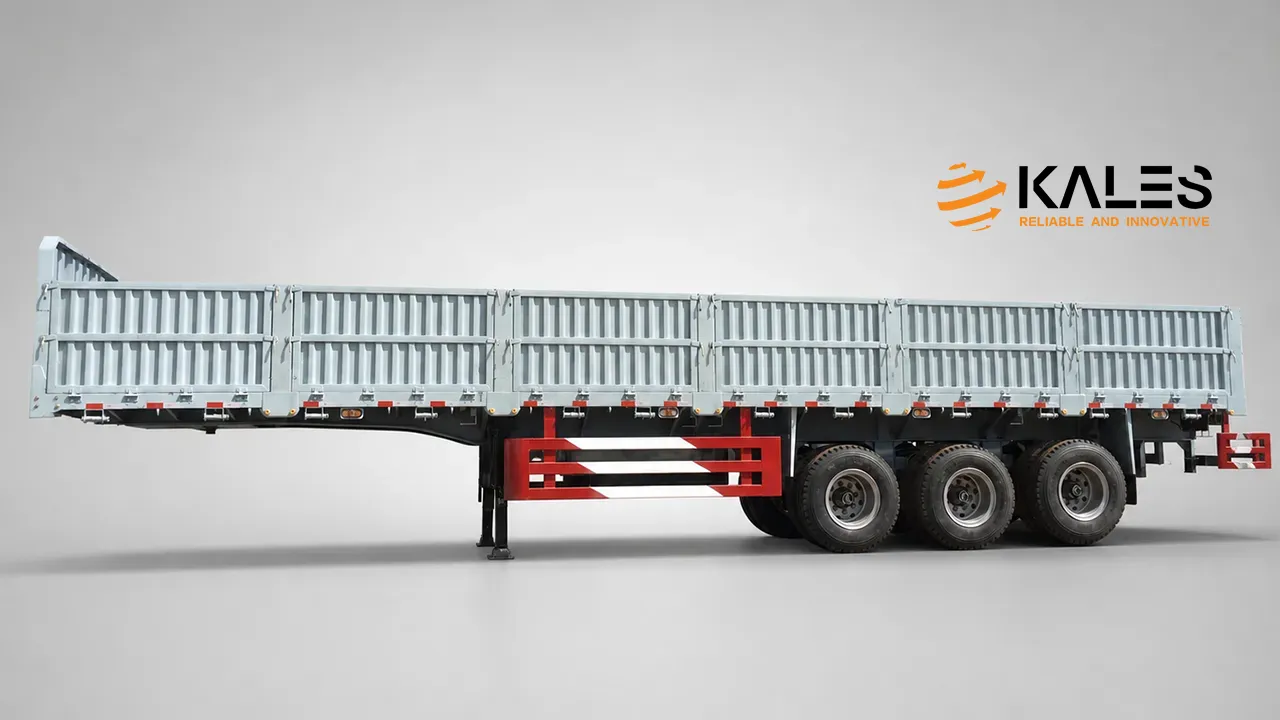
The straight beam is the most fundamental and most widely used trailer chassis. The two main longitudinal beams hold a consistent section height from front to rear, typically around 360-450 mm in web height, which creates a fully flat loading deck and a ground clearance around 1450-1550 mm. Standard materials are usually Q345B or Q355B high-tensile steel, with no bends, drops, or stepped transitions in the primary load path.
Core advantages
- Maximum payload capacity: with the same steel input, the straight beam gives the most direct structural path and the fewest stress concentration points. A standard 3-axle straight beam can carry roughly 60 tons payload, including a short-term overload margin around 30% in real field conditions.
- Lowest manufacturing cost: fewer processing steps, easier beam fabrication, and lower scrap rates usually keep the FOB factory price about 20% below a comparable step-deck and more than 40% below a specialized lowbed.
- Excellent retrofit compatibility: it is far easier to add sidewalls, fence structures, container twist locks, or even tipping systems later. That makes straight beam the default “multi-purpose fleet” platform.
For fleets that need a dependable baseline trailer, the 40ft flatbed semi-trailer platform is still the default reference because it stays useful across construction material, mixed cargo, and container-linked transport.
Core limitations
- Restricted loading height: with a 1.5 m deck and legal road height limits usually around 4.0-4.2 m, real cargo height is only about 2.5-2.7 m. That immediately blocks taller machinery.
- Higher center of gravity: the higher deck makes top-heavy cargo less stable on curves and less attractive for fast long-distance highway service.
This is why straight beam remains dominant in mining, agriculture-linked heavy haulage, and flexible general cargo fleets. In fact, the West Africa flatbed trailer case study reflects exactly this preference for rugged, repairable structure over highway optimization.
2. Gooseneck / Step-Deck Chassis: The Mainstream Choice for Long-Haul Logistics
Structural characteristics
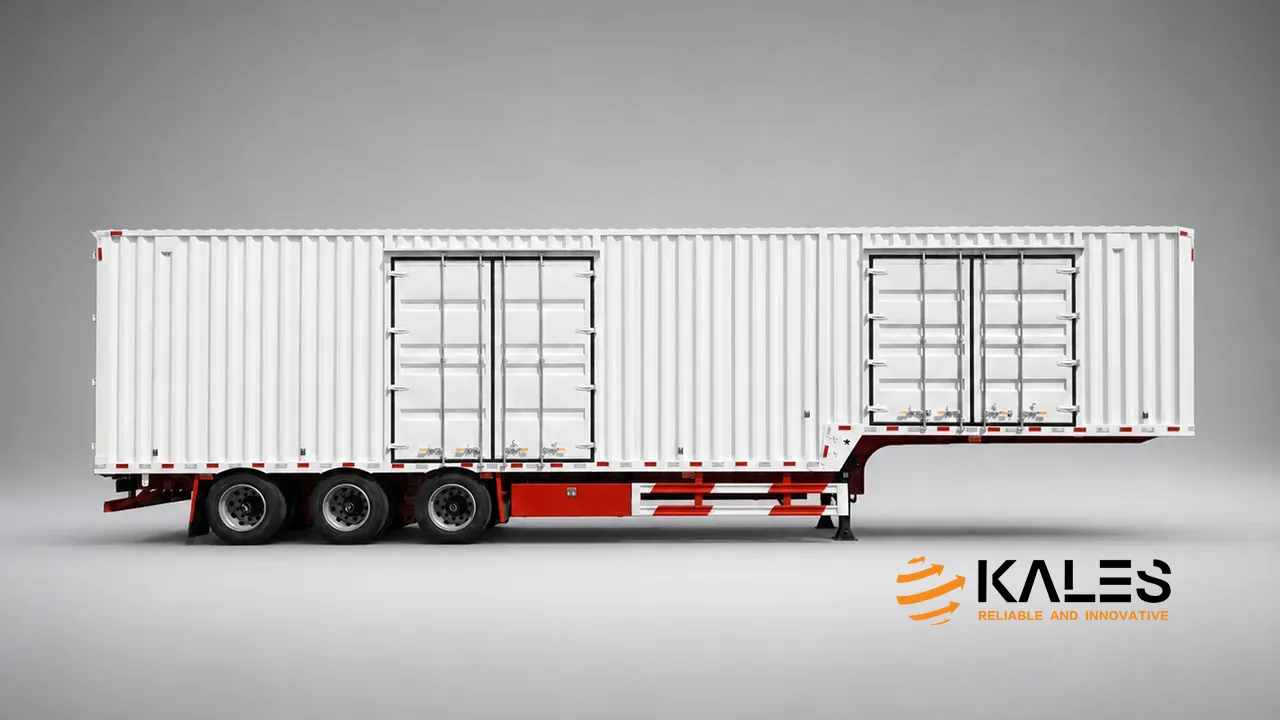
The front section of a step-deck trailer drops after the fifth-wheel connection, creating a stepped transition that lowers the main deck to around 1200-1380 mm while keeping an upper deck over the gooseneck at roughly 1900-2100 mm. That upper deck can still carry short, light cargo such as pallets, small crates, or short boxed freight.
Core advantages
- Maximum volume utilization: on the same overall trailer length, a step-deck can create about 8-10% more usable loading space than a straight beam. For fleets paid by cubic volume, that space advantage directly improves per-trip margin.
- Superior highway stability: lowering the main deck and the cargo center of gravity reduces rollover risk and improves behavior at sustained highway speed.
- Better compatibility with air suspension: step-deck geometry naturally gives more room for air bag travel and installation precision, which improves ride control for fragile cargo.
This is why step-deck logic dominates long-haul reefer, van, and curtainsider applications. When the business case is built around fast loading, damage control, and highway efficiency, structures like a 13M curtainsider semi-trailer or other lower-deck highway builds become more competitive than a purely flat heavy-haul platform. If suspension choice is part of the same specification discussion, compare it against the leaf spring vs. air suspension guide before locking the axle package.
Core limitations
- Weaker tolerance for harsh off-road abuse: the bend area around the gooseneck creates natural stress concentration. Continuous overload on rough, twisting mining roads raises the risk of weld cracking compared with a straight beam.
- Difficult retrofit path: once the stepped geometry is fixed, it becomes much harder to add universal non-standard attachments or convert the trailer into something like a tipper configuration later.
In other words, step-deck is excellent when the route is primarily paved and the revenue model values cube, stability, and freight protection. It is the wrong chassis to treat as a rough-road universal heavy-duty tool.
3. Lowbed Trailer / Lowboy Chassis: The Exclusive Solution for Over-Dimensional Cargo
Structural characteristics
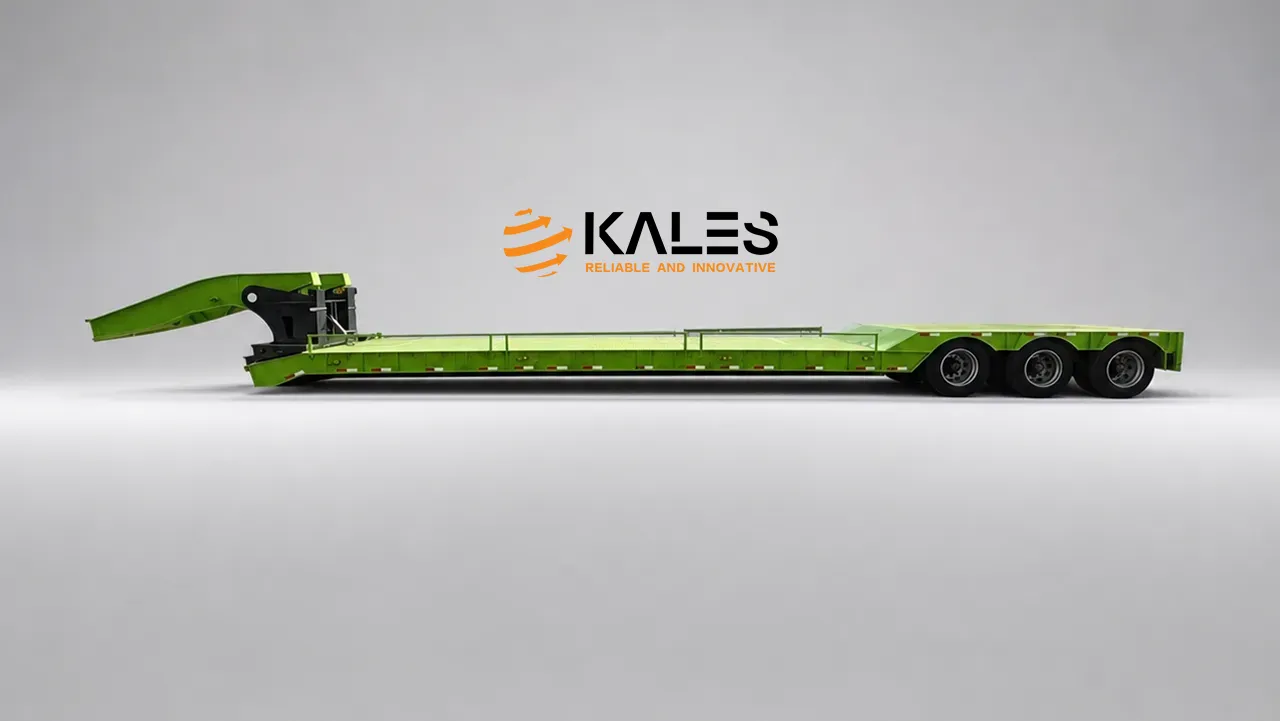
The lowbed is the most engineering-intensive of the three mainstream chassis families. Its “high-low-high” architecture creates a deeply recessed loading zone, typically 600-900 mm from the ground, so that tall machinery can stay within legal total vehicle height once loaded.
This is not a premium version of a flatbed. It is a special-purpose structure built because standard deck height simply cannot solve over-height cargo legally.
High-end derivatives
| Lowbed subtype | Structural idea | Best use case |
|---|---|---|
| Well deck / drop-in deck | Main loading area is recessed even deeper, sometimes down to 300-400 mm clearance | Extreme-height cargo such as large chemical tanks and heavy transformers |
| Removable gooseneck (RGN) | Front gooseneck detaches hydraulically so crawler machinery can drive on from the front | Heavy excavators, crawler equipment, safer self-loading without cranes |
| Extendable / telescopic beam | Beam slides outward to extend overall deck length | Wind blades, bridge members, long industrial steel and oversized project cargo |
Core advantages
- The only compliant over-height solution: if a 3.4 m excavator must stay under a 4.1 m road limit, deck height becomes a legal issue, not a preference issue.
- Extreme heavy-haul customization: payload design can scale from around 60 tons to well above 200 tons using extra axles or hydraulic modular systems.
- Loading efficiency on machinery jobs: removable-gooseneck designs can remove expensive and risky crane loading steps.
The practical product path depends on cargo profile. A fleet moving standard excavators may fit a 50T lowbed semi-trailer, while mixed oversized contracts are closer to a telescopic detachable gooseneck lowbed trailer.
Core limitations
- Very high procurement cost: even a basic 3-axle lowbed often costs two to three times more than a straight beam with similar nominal tonnage. Advanced hydraulic RGN or telescopic builds can move far beyond $40,000 to $80,000.
- High tare weight and low versatility: tare weight often lands around 11-16 tons or more, and the deck geometry makes standard pallets, containers, and bulk cargo far less efficient to load. Empty-run risk is high.
The lowbed is therefore not a general logistics trailer. It is a project, machinery, and OOG transport tool, and it only pays when the cargo profile genuinely requires it.
4. Cost and 5-Year TCO Comparison of the Three Chassis
Do not compare these chassis families by base procurement price alone. The reference below only helps in gray-area cases where more than one structure might physically work. It is not a claim that one trailer can replace the others in every operation.
Baseline reference: 30-ton payload, 200 km/day, 5 years, estimated FOB Qingdao pricing. The step-deck column represents a reefer-box style highway logistics application, and the lowbed column represents a 3-axle machinery-haul profile.
| Cost category | Straight beam (general flatbed) | Gooseneck / step-deck (reefer profile) | Lowbed 3-axle (machinery profile) |
|---|---|---|---|
| Base procurement price (FOB) | $11,500 | $26,000 (including box and cooling unit) | $22,000 |
| 5-year maintenance cost | $2,200 | $4,500 | $5,500 |
| 5-year downtime / wear | $3,000 | $2,400 | $6,500 |
| 5-year estimated cargo damage | $1,500 (physical friction / wear) | $3,500 (temperature loss / collision exposure) | $1,000 (mechanical shifting) |
| Residual value at year 5 | -$3,500 | -$7,500 | -$8,000 |
| 5-year total cost of ownership | $14,700 | $28,900 | $27,000 |
| Estimated payback period | 7-9 months | 12-16 months | 14-18 months |
The key lesson is straightforward: a flatbed is cheapest because it is structurally simple and versatile; a step-deck earns back its higher cost only when volume and highway productivity matter; a lowbed justifies its cost only when legal machinery transport or specialized project cargo leaves no compliant alternative.
5. Cargo vs. Trailer Matching Matrix
| Cargo type | Recommended chassis | Alternative chassis |
|---|---|---|
| Iron ore, coal, heavy-duty off-road haulage | Straight beam tipper / dump | Straight beam flatbed |
| 20ft / 40ft / 45ft containers | Straight beam skeleton chassis | None |
| Cement, steel rebar, construction materials | Straight beam flatbed or sidewall | – |
| Cold chain, pharmaceuticals, electronics | Step-deck reefer trailer | – |
| FMCG, express parcels, furniture | Step-deck sidewall / van | Straight beam sidewall for short-haul work |
| Medium machinery, 30-60 tons | Lowbed, 3-4 axles | Straight beam heavy-duty, only for short machinery that stays legal |
| Mining trucks, transformers, 80-ton-plus projects | Custom lowbed, 6+ axles or RGN | – |
6. Regional Market Preferences at a Glance
West Africa and Latin America, non-trunk and rough-route operations
Straight beam remains the dominant choice, usually around 65-70% of demand. That reflects mining, rough agricultural transport, construction materials, and a strong economic preference for chassis that can be repaired locally and tolerate structural abuse.
East Africa and MENA, highway-linked corridors
Gooseneck and step-deck platforms become more competitive, often around 45-55% share, because better highway infrastructure supports long-haul, high-value freight, cold chain, and highway tanker transport.
Global heavy-project and mining logistics
Lowbed trailers typically hold a smaller but durable 10-20% share. Whether it is bauxite transport support in Guinea, machinery relocation in Latin America, or oil-field project logistics in Central Asia, oversized equipment movement still depends on custom lowboy and RGN solutions.
7. The 5-Second Decision Tree
- Is the cargo over 2.7 meters tall, or is a single item over 60 tons?
Yes: lock Lowbed Trailer / RGN. Other structures will be illegal, overloaded, or operationally unsafe.
No: go to question 2. - Is the cargo highly sensitive to loading volume, such as lightweight consumer goods or express cargo?
Yes: prioritize Gooseneck / Step-Deck.
No: go to question 3. - Is the route mainly long-haul highway service with high-value freight?
Yes: prioritize Gooseneck / Step-Deck for better stability and a lower center of gravity.
No: go to question 4. - Do you need heavy-duty off-road mining access, or frequent future retrofits for multi-purpose work?
Yes: lock Straight Beam for the strongest structure and easiest modification path.
8. Core Engineering FAQ
Can I cut and weld a straight beam trailer into a step-deck later?
Strongly not recommended. The conversion cost is high, the original stress path is destroyed, payload capacity usually drops sharply, and factory warranty coverage disappears. If long-haul volume demand is even reasonably likely, order the step-deck up front.
Can a step-deck trailer survive open-pit mining roads?
It is a vulnerable match. Severe torsional load and repeated impact on unpaved mining roads make the weld zone around the gooseneck bend a high-risk failure point. For sustained heavy off-road duty, the safer combination is still straight beam plus mechanical leaf spring suspension.
Is the gooseneck on a lowbed the same as the gooseneck on a step-deck?
No. On a lowbed, the gooseneck exists mainly to connect the trailer to the fifth wheel and create the drop architecture; it is usually not a freight deck. On a step-deck, the upper deck over the gooseneck is intentionally usable cargo space for short and light freight.
Why can straight beam and step-deck trailers share the same suspension families?
Standard mechanical leaf spring systems can be used across many trailer geometries. The more important difference appears when air suspension enters the picture: step-deck geometry usually gives better vertical clearance and travel for air bags, which improves ride control and freight protection.
Final Recommendation
If your freight profile is still broad, rough-road, and payload-driven, straight beam remains the safest economic default. If your revenue depends on highway volume utilization, freight stability, and lower center of gravity, move toward step-deck. If cargo height or unit weight pushes beyond normal road limits, stop comparing standard trailers and move directly into lowbed or RGN planning.
The real mistake is not paying more for the wrong trailer. It is buying a structurally mismatched trailer because the quote looked cheaper before the cargo geometry was defined.
Start Your Precision Procurement Planning
Avoid comparing prices before matching specifications. Send the Kales Vehicle engineering team the top three cargoes your fleet transports most often, including length, width, height, single-item weight, and daily mileage.
- Audit your requirements: list cargo dimensions, single-item weight, route condition, and daily operating distance.
- Request blueprints and bottom-line pricing: we will return a CAD-matched proposal and a real FOB quote within 24 hours.
- Lock logistics timing: once the design is confirmed, ocean freight from major Chinese ports to Africa or Latin America usually lands in roughly 30-45 days, and freight often accounts for about 15-25% of total procurement cost.
Email: jennylee@kalestruck.com
WhatsApp: +86 131 5638 8843
Request a quote or chassis recommendation