

Published: September 9, 2026 · Word count: 2460 · Reading time: 14 minutes
Mobilizing oversized industrial machinery—including hydraulic excavators, crawler bulldozers, rotary drilling rigs, crushers, and electrical power transformers—presents the most complex structural and regulatory challenges in commercial transport. Transporting a 50-ton machine on an under-specified 3-axle trailer risks main beam fatigue cracking, excessive tire blowouts, and severe bridge overload penalties. Conversely, purchasing an over-specified 5-axle hydraulic modular trailer for routine 30-ton excavator transport inflates tare weight, increases tire wear, and destroys operational profitability.
Selecting the optimal lowbed semi-trailer requires matching three interdependent engineering factors: axle line capacity and spacing, gooseneck coupling architecture (fixed vs. detachable RGN), and working deck height relative to bridge clearance limits. This comprehensive engineering guide breaks down lowbed configurations from 30 to 120 tons to assist fleet directors and heavy haulage contractors in making data-driven procurement decisions.
Executive Summary: Lowbed Selection Framework
- Payload Class Spectrum:
- 2-Axle Lowbed (30,000–40,000 kg): Ideal for compact 15–25T excavators (e.g. CAT 320), wheel loaders, and road rollers.
- 3-Axle Lowbed (50,000–70,000 kg): The global workhorse for mainstream 30–40T civil engineering equipment (e.g. CAT 336, Komatsu PC300).
- 4-Axle Lowbed (75,000–100,000 kg): Heavy mining spec for 45–55T production excavators (CAT 349, Komatsu PC400) and CAT D8 bulldozers.
- Detachable Gooseneck (RGN / Lowboy): Features a detachable hydraulic neck allowing low-ground-clearance equipment (asphalt pavers, milling machines, drilling rigs) to drive directly onto the deck from ground level at a safe 6° angle.
- Deck Height & Clearance Dynamics: Standard flat decks (1,150–1,250 mm) suit standard-height cargo. Drop-deck / step-decks (850–950 mm) lower equipment overall travel height to clear standard 4.5m–4.8m highway overpasses. Ultra-low well/vessel decks (500–650 mm) accommodate giant transformers and industrial vessels.
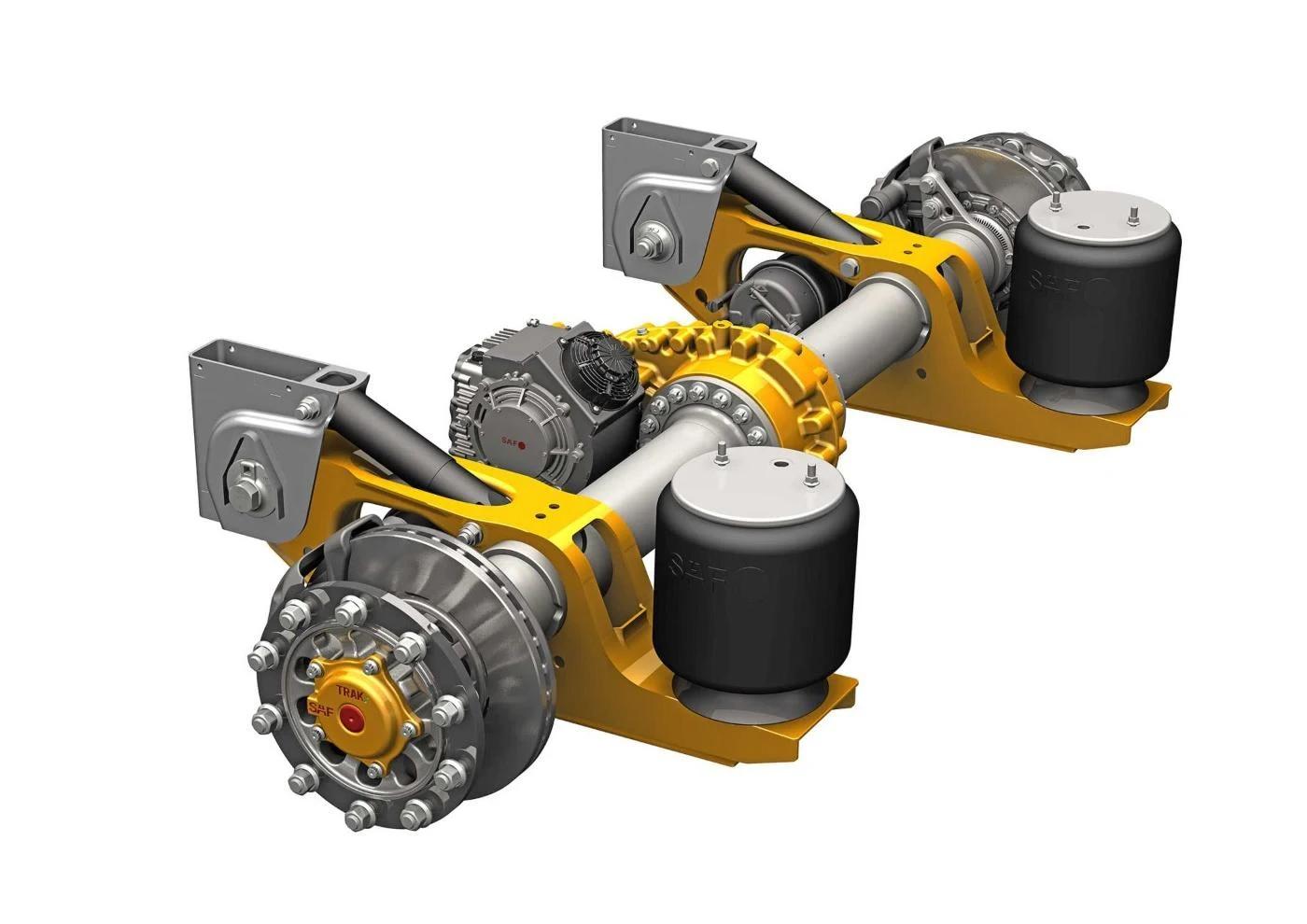
- Suspension Logic: Heavy mechanical multi-leaf spring suspension dominates rugged export markets (Africa, Latin America, Central Asia) due to zero electronics and easy field repair. Air ride suspension is preferred on paved highway routes with strict bridge formula limits.
Quick Answer: How do you calculate the required number of axles for a lowbed trailer?
The required number of axles depends on: (Gross Vehicle Weight = Equipment Weight + Trailer Tare Weight) – Kingpin Fifth-Wheel Transfer Load divided by Maximum Statutory Axle Load.
For example, hauling a 52-ton CAT 349 excavator on a 12-ton trailer yields 64 tons total gross trailer weight. If the tractor fifth wheel absorbs 20 tons at the kingpin, the remaining 44 tons must be supported by the trailer bogie. Under standard 11-to-12-ton legal axle caps on public roads, a minimum of 4 axles (4 × 11T = 44T) is required. Attempting this haul on a 3-axle trailer overloads the suspension bogie by 8+ tons, triggering severe road penalties and structural fatigue.
Key Decision Takeaways for Heavy Transport Fleets
- Concentrated Machine Footprint: Equipment weight is concentrated across narrow crawler tracks (typically 4.0 to 4.8 meters long). Never rely solely on gross trailer tonnage ratings; verify that the main beam has sufficient flange thickness (16–20mm) to resist concentrated mid-deck bending moments.
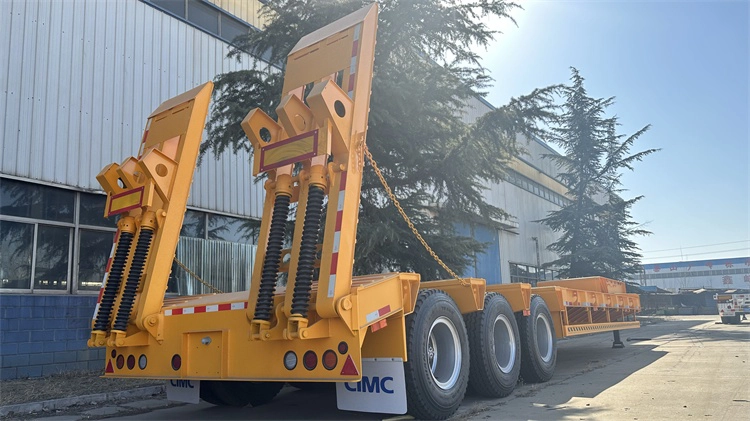
- Fixed Rear Ramps vs. Front RGN: Fixed gooseneck trailers require rear climbing ramps with a 15° to 18° incline, creating slip and rollover risks for wet steel crawler tracks. Detachable goosenecks (RGN) eliminate rear ramps by dropping the deck flush with the ground (6° incline), providing maximum safety for low-clearance equipment.
- Outriggers for Wide Crawler Stances: Excavators exceeding 40 tons typically have track widths of 3,200 mm to 3,500 mm. Ensure the trailer includes heavy forged swing-out outriggers and hardwood planks to support track overhang securely.
- Steel Yield Strength Margin: Specify HG60 (590+ MPa) or T700 (700 MPa) structural steel for trailers rated above 60 tons to eliminate permanent beam deflection and maintain safe road ground clearance over multi-year duty cycles.
1. Axle Configuration Matrix: Matching Payload to Axle Lines
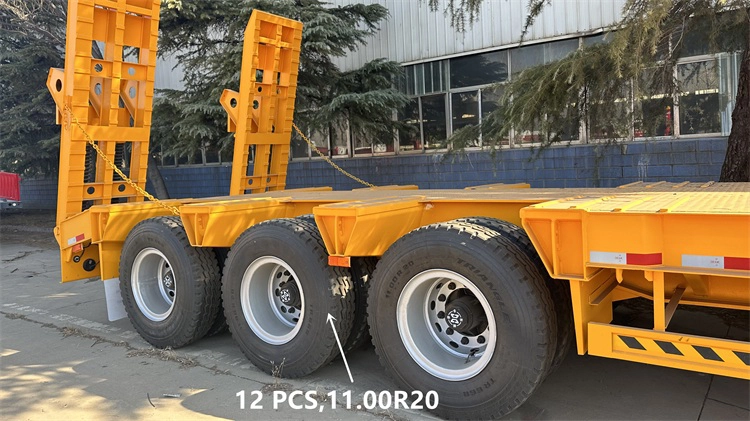
In specialized transport, trailer axle configurations determine legal payload capacity, axle weight distribution, and maneuverability:
2-Axle Lowbed Semi-Trailers (30 to 40 Ton Class)
- Target Equipment: 15-to-25-ton hydraulic excavators (CAT 320, Komatsu PC200), medium wheel loaders (CAT 950), backhoes, and tandem road rollers.
- Chassis Architecture: Straight flat deck or single step-down neck, overall length 11.5 to 12.5 meters.
- Operating Fit: Urban civil construction, utility contracting, municipal road repairs, and short regional equipment mobilization. Highly maneuverable in tight city roundabouts and job site accesses.
3-Axle Lowbed Semi-Trailers (50 to 70 Ton Class)
- Target Equipment: 30-to-40-ton production excavators (CAT 336, Komatsu PC300/PC350), medium crawler dozers (CAT D6/D7), motor graders, and mobile screeners.
- Chassis Architecture: 13.0 to 13.75 meters length, 3,000 mm deck width with 250 mm side brackets. Main beam height 500 mm with HG60 or Q345B steel.
- Operating Fit: The universal heavy haulage workhorse. Delivers the optimal balance between acquisition cost, payload versatility, and tire maintenance for regional transport fleets.
4-Axle Lowbed Semi-Trailers (75 to 100 Ton Class)
- Target Equipment: 45-to-55-ton mining excavators (CAT 349, Komatsu PC400/PC450), heavy crawler dozers (CAT D8T), piling rigs, and aggregate cone crushers.
- Chassis Architecture: 13.75 to 16.0 meters length, 550 mm heavy box main beam with double-layer 20mm flange plates. 4 × 16-ton heavy-duty FUWA axles with 10-leaf spring packs.
- Operating Fit: Off-road mining corridors, bauxite extraction belts (such as our Guinea 80-Ton Bauxite Mining Case Study), and mega infrastructure projects where concentrated point-loads would destroy a 3-axle trailer.
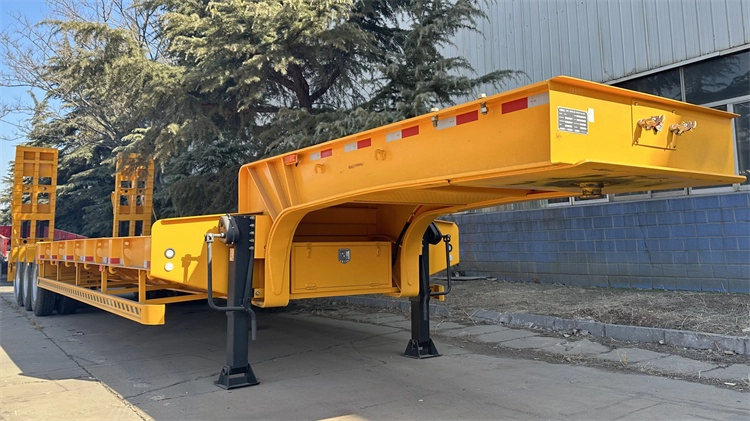
2. Gooseneck Architecture: Fixed Neck vs. Detachable RGN
Fixed Gooseneck (Rear Loading)
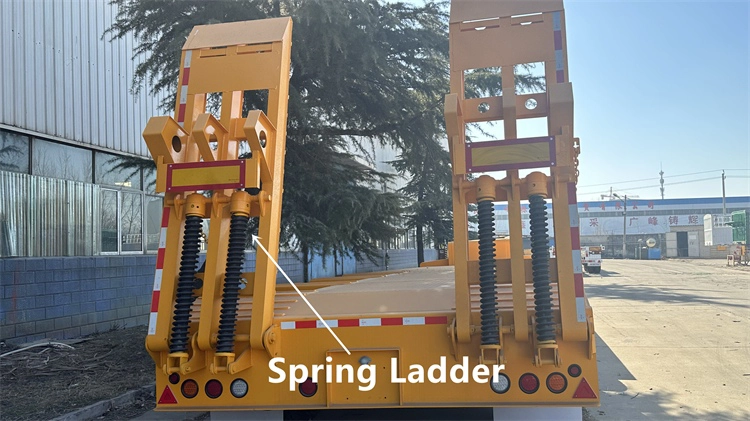
Fixed gooseneck lowbeds are the traditional industry standard across emerging markets. Equipment drives onto the deck from the rear using heavy spring-assisted or hydraulic ramps:
- Advantages: Simpler mechanical design, lower tare weight (800–1,500 kg lighter), zero hydraulic coupling connections, lower initial purchase price ($6,000–$10,000 less than RGN), and minimal maintenance in dusty conditions.
- Limitations: Ramps create an incline of 15° to 18°. When loading steel-tracked machines on wet, muddy, or icy sites, crawlers can slide off sideways. High center-of-gravity machines risk tipping backward when cresting the rear axle beaver-tail. Not suitable for low-ground-clearance machines like asphalt pavers.
Detachable Gooseneck (RGN / Front Loading)
On a Removable Gooseneck (RGN) trailer, the gooseneck uncouples hydraulically from the trailer deck, allowing the tractor unit to drive away. The front of the deck drops flat to the ground, creating a ramp angle of just 6 to 8 degrees:
- Advantages: Machines walk directly onto the deck from ground level, completely eliminating rear climb tipping hazards. Critical for self-propelled machinery with minimal ground clearance (asphalt milling machines, pavers, rollers) and 50-ton excavators.
- Limitations: Higher initial acquisition cost, requires an onboard diesel hydraulic power pack (HPU) or tractor wet kit, higher tare weight, and hydraulic cylinder seals that require regular maintenance.
3. Working Deck Profiles & Bridge Clearance Calculations
Highway overpasses, pedestrian bridges, and toll plazas enforce strict vertical clearance limits (typically 4.50 to 5.00 meters). Selecting the correct lowbed deck height is essential to transport tall machinery legally:
- Flat Deck (Deck Height: 1,150–1,250 mm): The conventional standard. Tires sit beneath or flush with the deck. Best for general equipment with moderate overall height (<3.2 meters).
- Step-Deck / Drop-Deck (Deck Height: 850–950 mm): The cargo bed steps down between the gooseneck and the rear axle bogie, utilizing low-profile 235/75R17.5 or 245/70R19.5 dual tires. This lowers the laden cargo center of gravity by 300 mm, enabling machines up to 3.6 meters tall to clear 4.8m bridge limits.
- Ultra-Low Well Deck / Beam Deck (Deck Height: 500–650 mm): The trailer frame drops between the axles, with the cargo resting in a central trough. Essential for moving massive transformers, turbines, and large industrial vessels while complying with extreme bridge height constraints.
Engineering Specification Matrix Across Lowbed Configurations
| Engineering Parameter | 2-Axle Fixed Lowbed (35T) | 3-Axle Fixed Lowbed (60T) | 4-Axle Heavy Lowbed (80T) | 3-Axle Detachable RGN (60T) |
|---|---|---|---|---|
| Rated Payload Capacity | 35,000 kg | 60,000 kg | 80,000 kg | 60,000 kg |
| Axle Specification | 2 × 13T FUWA Heavy | 3 × 13T or 16T FUWA | 4 × 16T Heavy Mining Spec | 3 × 13T Heavy Air/Mech |
| Tare Weight | ~7,200 kg | ~8,800 kg | ~11,200 kg | ~10,500 kg |
| Loading Method | Rear (Spring Ramps) | Rear (Spring Ramps) | Rear (Reinforced Ramps) | Front Drive-On (Detachable) |
| Loading Ramp Incline | 16° | 15° | 14° | 6° to 8° (Ultra-Shallow) |
| Working Deck Height | 1,150 mm | 1,150 mm | 1,150 mm | 850–900 mm (Drop Bed) |
| Main Beam Material | Q345 Carbon Steel | HG60 High-Yield Steel | HG60 / T700 High-Tensile | HG60 High-Yield Alloy |
| Tire Size | 8 units 11.00R20 / 12R22.5 | 12 units 12.00R20 / 315/80 | 16 units 12.00R20 Mining | 12 units 235/75R17.5 Low-Pro |
Operational Comparison: Fixed Rear-Loading vs. Front-Loading Detachable RGN
| Evaluation Metric | Fixed Gooseneck (Rear Ramps) | Detachable Gooseneck (Front RGN) | Fleet Operational Impact |
|---|---|---|---|
| Loading Safety | Moderate risk of track slipping on steep ramps | Zero rollover hazard; ground-level entry | RGN eliminates crawler sliding accidents entirely. |
| Asphalt Paver / Roller Compatibility | Poor (machines scrape bottom on ramp crest) | Excellent (drives directly onto bed) | RGN handles low-clearance paving equipment. |
| Purchase Capital Cost | Lowest cost baseline ($24,000–$28,000) | Higher investment ($34,000–$42,000) | Fixed neck is $10k cheaper for basic excavator work. |
| Off-Road Bush Maintenance | Ultra-simple; mechanical spring ramps | Requires hydraulic maintenance and HPU checks | Fixed neck has fewer failure points in remote mines. |
| Bridge Clearance Capability | Standard 1,150 mm deck height | Lower 850 mm deck clears low overpasses | RGN carries 300 mm taller machinery legally. |
4. Structural Engineering Checklist for High-Concentration Loads
Heavy machinery does not distribute its weight evenly across a trailer deck. A 50-ton excavator concentrates its entire mass through two steel crawler tracks measuring approximately 4.5 meters in length. Fleet buyers must verify the following structural details before ordering:
- Main Beam Flange Thickness: For loads over 60 tons, the upper and lower flange plates of the main beam must be at least 20 mm thick in high-yield steel (HG60 or T700). Standard 14mm or 16mm commercial plates will develop permanent center sagging after repeated point-loading.
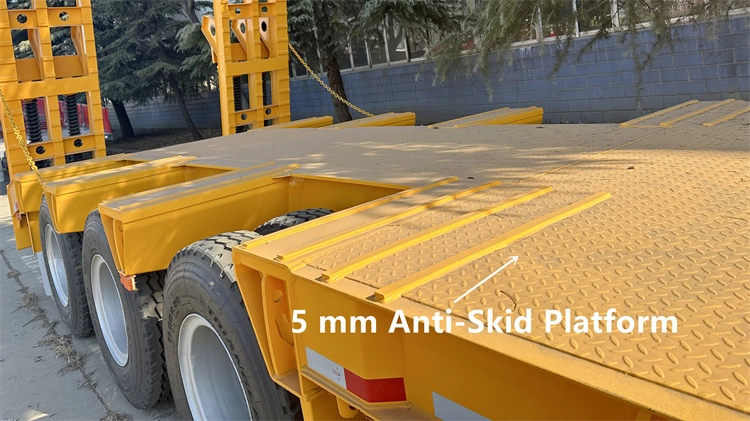
- Crossmember Spacing: Crossmembers beneath the working deck must be spaced no more than 250 mm to 300 mm apart. Wide 500mm spacing allows the 5mm checkered plate to bow downward under heavy excavator track cleats.
- Reinforced Gooseneck Arch: The gooseneck neck transition experiences extreme shear stress when traversing unpaved corrugations. Ensure the gooseneck features double internal vertical web plates and reinforced gusset plates.
- Wide Track Outriggers: For machines wider than the standard 3,000 mm deck, specify heavy cast-steel swing-out outriggers spaced every 500 mm along both side coamings with matching hardwood planks.
Heavy Haulage Procurement Step-by-Step Guide
- Catalog Exact Machinery Dimensions: Record operating weight, track width, track length, ground clearance, and overall height for every machine in your fleet.
- Check Route Bridge and Axle Laws: Identify maximum legal axle limits and lowest overhead bridge clearances along your primary operating corridors.
- Select Gooseneck Format: Choose a fixed gooseneck for rugged off-road mining excavators where simple maintenance is paramount; choose a detachable RGN if your fleet transports low-clearance paving equipment or tall machinery.
- Specify Genuine Running Gear: Insist on genuine FUWA or BPW heavy-duty axles and genuine WABCO pneumatic relay valves with 30/30 double spring brake chambers.
Explore Proven Kales Lowbed Export Deliveries
Review real-world lowbed delivery cases and technical specifications from our global projects:
Frequently Asked Questions: Heavy Lowbed Semi-Trailers
- How do I choose between a 3-axle and a 4-axle lowbed trailer?
- Choose a 3-axle lowbed if your primary cargo weighs between 30 and 50 metric tons (such as CAT 330/336 excavators). Choose a 4-axle lowbed if you haul machines weighing 50 to 80 metric tons (such as CAT 349/PC400 excavators, CAT D8 dozers, and drill rigs). The fourth axle is critical to keep individual axle loads below statutory legal limits and prevent frame bending on soft mining haul roads.
- What are the benefits of a detachable gooseneck (RGN) compared to fixed ramps?
- A detachable gooseneck disconnects from the trailer, dropping the deck directly onto the ground at a gentle 6-degree slope. This completely eliminates the danger of crawler equipment slipping off steep rear ramps, makes loading asphalt pavers and low-clearance rollers effortless, and allows a lower deck height (850 mm) to clear low highway overpasses.
- What steel grade should be specified for an 80-ton lowbed main beam?
- For trailers rated at 60 tons and above operating on rough or unpaved routes, main beams should be fabricated from HG60 high-yield structural steel (590+ MPa yield strength) or T700 high-tensile alloy steel (700 MPa). Standard Q235 or generic Q345 carbon steel lacks sufficient elasticity and will develop permanent center sag under concentrated crawler loads.
- Why are outriggers necessary on heavy lowbed trailers?
- Standard export lowbeds feature a 3,000 mm wide working deck. However, heavy mining excavators (40 tons and above) frequently have track-to-track widths exceeding 3,300 mm to 3,500 mm. Heavy swing-out steel outriggers expand the supporting deck width by 250 mm to 300 mm on each side, supporting track overhang securely.
- What is the typical lifespan of a heavy-duty mining lowbed trailer?
- With HG60 high-strength steel beams, genuine FUWA 16-ton axles, and proper greasing of suspension equalizer bushings, a Kales heavy-duty lowbed semi-trailer delivers an operational lifespan of 10 to 15 years under severe African mining and construction conditions.
Conclusion: Engineering the Right Lowbed for Your Heavy Fleet
Selecting the right lowbed trailer is an engineering calculation, not a guessing game. By properly calculating concentrated crawler track loads, selecting between fixed-neck and detachable RGN architectures, and specifying high-tensile HG60 steel with genuine heavy-duty axles, fleet operators prevent catastrophic structural failures, ensure full bridge formula compliance, and maximize heavy haulage profitability.
Request a Heavy Lowbed Engineering Proposal & CAD Drawing
Are you transporting heavy excavators, bulldozers, or industrial project cargo? Consult with Kales Vehicle heavy transport specialists to model payload distribution, deck dimensions, and axle configurations tailored to your machinery fleet.
Contact Kales Heavy Haulage Technical Team | WhatsApp / Phone: Direct Factory Export Office