

Proper lubrication is one of the most critical yet often overlooked aspects of Kales semi-trailer maintenance. Regularly greasing the right components with the correct lubricants not only ensures smooth operation but also prevents premature wear, enhances road safety, and significantly extends your trailer’s service life.
In this guide, we’ll walk you through everything you need to know about lubricating your Kales semi-trailer—from recommended grease types and lubrication intervals to best practices that keep your fleet running efficiently.
Technical basis and service scope
How this trailer lubrication guide is supported
This guide is based on Kales semi-trailer service practice and the grease grades already shown in the original maintenance table. The international reference point is the NLGI consistency grade: it describes grease stiffness, while the thickener type, base oil viscosity and EP additives decide whether the grease is suitable for wheel bearings, kingpin plates, landing gear or brake camshaft bushings.
For evidence and terminology, the guide references ASTM D4950 automotive service grease classification, SKF bearing lubrication guidance, SKF lubricant selection information, the Timken lubrication selection guide, and Timken grease application data. These sources support the same workshop rule: temperature, load, water, dust and relubrication interval must be considered together.
For fleets, do not choose grease by color or price alone. Use the trailer manual, component supplier instruction and operating route. A trailer on quarry dust, water crossings, port storage or mountain descents needs shorter service intervals than a highway trailer.
| Condition | Lubrication response |
|---|---|
| Dust, mud or water wash | Shorten interval and purge contaminated grease where possible |
| Hot hub or bearing noise | Stop, inspect bearing and seal before adding grease |
| Changing grease base | Clean or purge old grease before switching thickener type |
Why Lubrication Matters for Your Kales Semi-Trailer
Friction is the silent enemy of heavy-duty trailers. Without adequate lubrication, you risk:
- Accelerated wear on moving parts
- Heat buildup in axle bearings and joints
- Component seizure or unexpected failure
- Reduced fuel efficiency due to increased rolling resistance
- Increased Safety Risks: Especially in critical systems like brakes and suspension.
By following a structured Kales semi-trailer lubrication schedule, you protect your investment, reduce repair costs, and avoid costly roadside breakdowns.
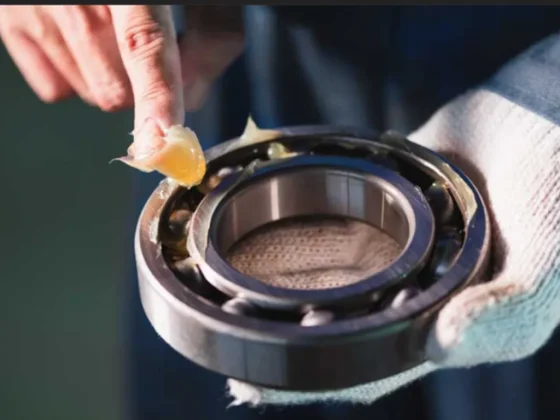
Recommended Lubricants for Kales Semi-Trailers
Kales specifies three primary grease types. Using the correct lubricant is essential. Below is a comparison of the Chinese Standards (found in your manual) and their International Equivalents for global maintenance teams.
| Code | Lubricant Name | Standard (China) | International Equivalent (Ref.) | Recommended Use Case |
|---|---|---|---|---|
| GZ | Calcium-Based Grease | ZG-4 | NLGI #2 (Calcium) | General-purpose, moderate temps, chassis points |
| QLZ | Automotive Universal Lithium Grease | GB5671-85 | NLGI #2 (Lithium EP) | High-load, multi-point applications (Axles) |
| SGZ | High-Temperature Grease No. 4 | ZN6-4 | NLGI #3 (High Temp) | High-heat zones (e.g., brake pins) |
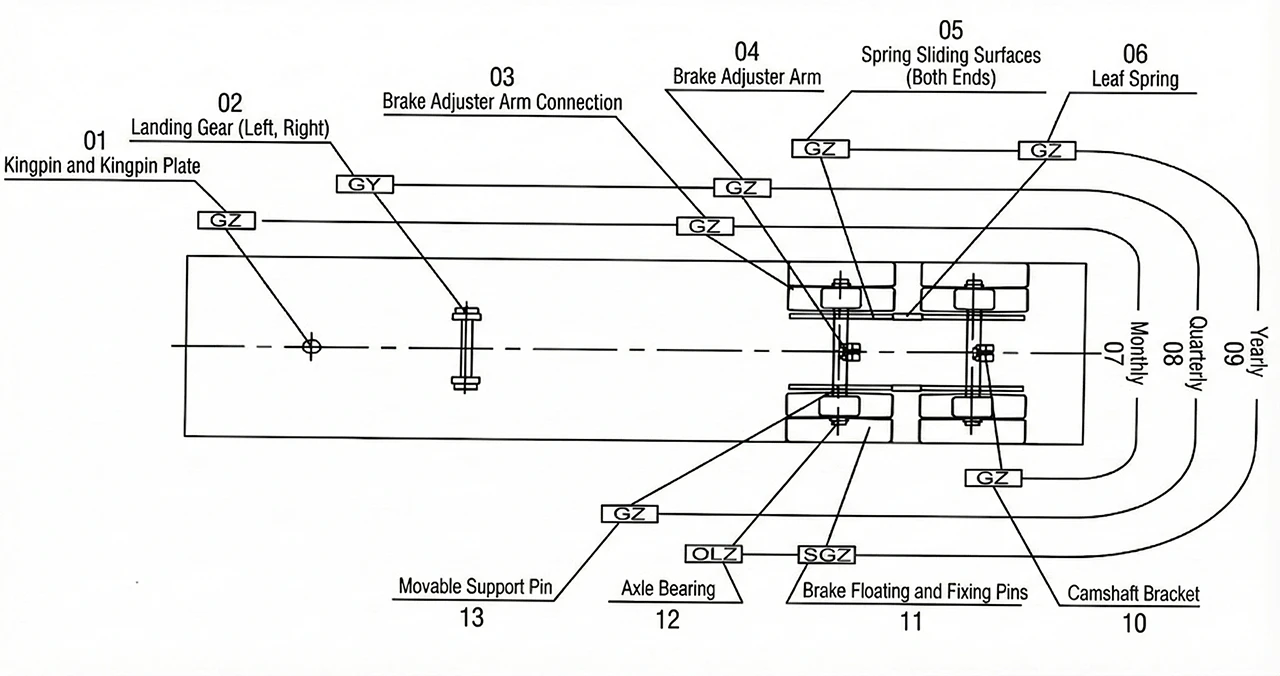
Lubrication Points Key:
01: Kingpin & Plate | 02: Landing Gear | 03-04: Brake Adjusters | 05-06: Leaf Springs & Slides
10: Camshaft Bracket | 11: Brake Pins | 12: Axle Bearing | 13: Movable Support Pin
Kales Semi-Trailer Lubrication Schedule
Below is the official maintenance chart detailing daily, monthly, and annual greasing points.
Lubrication Frequency Chart
| Lubrication Point | Daily | Monthly | Annually | Recommended Lubricant | |
|---|---|---|---|---|---|
| Kingpin & Fifth Wheel Plate | ✓ | Calcium-Based (ZG-4 / NLGI #2) | Identify high wear under heavy coupling frequency. | ||
| Landing Gear (Support Device) | ✓ | Calcium-Based (ZG-4 / NLGI #2) | Grease gears and internal screws. | ||
| Brake Slack Adjuster | ✓ | Lithium Grease (GB5671 / NLGI #2 EP) | Essential for automatic adjuster mechanics. | ||
| Slack Adjuster Linkage | ✓ | Calcium-Based (ZG-4 / NLGI #2) | Prevent road salt and dirt binding. | ||
| Leaf Spring Pins & Slides | ✓ | ✓ (Ends) | Calcium-Based (ZG-4 / NLGI #2) | Required to minimize friction wear. | |
| Brake Camshaft Bracket | ✓ | Calcium-Based (ZG-4 / NLGI #2) | Prevents binding in S-cam shafts. | ||
| Axle Wheel Bearings | ✓ | Lithium Grease (GB5671 / NLGI #2 EP) | Must check bearing clearance and grease condition. | ||
| Container Twist Lock Pins | ✓ | Calcium-Based (ZG-4 / NLGI #2) | Keep rotating lock mechanism operating smoothly. |
1. The Science of Grease Compatibility (Why Bases Matter)
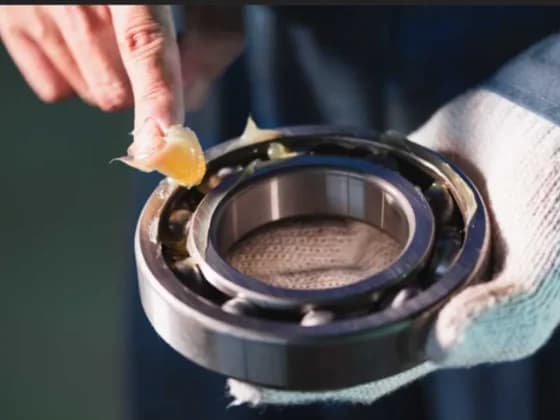
Grease consists of three parts: a base oil (typically mineral or synthetic), an additive package (such as extreme pressure EP agents), and a thickener (which acts as a sponge holding the oil). The thickener determines the grease’s heat resistance, water resistance, and shear stability. Incompatibility arises when the thickeners of two greases react chemically, turning the mixture into a runny liquid that leaks out of bearings or hardening it into a wax-like block that cannot lubricate.
Kales semi-trailers rely on three chemical thickeners: Calcium-based (ZG-4), Lithium-based (GB5671-85), and Complex Synthetic High-Temperature thickeners. Maintenance operators must understand how these bases interact when servicing a trailer globally.
| Thickener Base Type | Calcium-Based (ZG-4) | Lithium-Based (GB5671) | Lithium Complex / Synthetic | Polyurea |
|---|---|---|---|---|
| Calcium-Based (ZG-4) | Compatible | Incompatible | Incompatible | Incompatible |
| Lithium-Based (GB5671) | Incompatible | Compatible | Borderline | Incompatible |
| Lithium Complex / Synthetic | Incompatible | Borderline | Compatible | Borderline |
| Polyurea | Incompatible | Incompatible | Borderline | Compatible |
Failure Consequence: If a technician pumps lithium grease into a wheel hub that still contains calcium-based grease, the mixture will separate within 1,000 km of high-speed hauling. The oil will separate from the thickener and drain past the inner seal onto the brake linings, causing immediate brake fade, wheel seal failure, and bearing seizure due to dry friction.
2. Comprehensive 13-Point Trailer Lubrication Map
To establish a world-class fleet maintenance standard, operators should follow the Kales 13-Point lubrication matrix. This map covers the chassis, suspension, wheel-ends, and auxiliary hardware.
| Map ID | Lubrication Point Description | Standard Interval | Target Lubricant Spec | Specific Maintenance Procedure |
|---|---|---|---|---|
| 01 | Kingpin Collar & Fifth Wheel Contact Plate | Prior to every coupling | Calcium Grease ZG-4 / NLGI #2 Heavy duty | Clean off old grease contaminated with sand. Apply a 3mm uniform coating across the fifth-wheel plate using a putty knife. Lubricate the kingpin groove. |
| 02 | Landing Gear Internal Bevel Gears | Every 6 Months | NLGI #2 Calcium with Graphite additives | Remove gearbox cover plate. Pack gear teeth with grease. Crank leg up and down twice to distribute grease. |
| 03 | Landing Gear Elevating Screws & Nut | Annually | NLGI #2 Low-Temperature Synthetic | Extend the legs fully. Pump grease through the housing grease zerk while slowly raising the leg to coat the internal screw shafts. |
| 04 | Brake Automatic Slack Adjusters (LHS) | Every 10,000 km | NLGI #2 Lithium EP (Extreme Pressure) | Locate grease zerk on adjuster body. Pump grease until fresh grease emerges around the manual adjustment nut or pressure relief seal. |
| 05 | Brake Automatic Slack Adjusters (RHS) | Every 10,000 km | NLGI #2 Lithium EP (Extreme Pressure) | Ensure adjuster clevis pin rotates freely. Do not use high-pressure grease guns to prevent damage to internal one-way clutches. |
| 06 | Equalizer Beam Center Hanger Pins | Every 5,000 km | Calcium Grease ZG-4 / NLGI #2 | Grease under loaded vehicle conditions to ensure grease penetrates the load-bearing side of the brass bushing. |
| 07 | Leaf Spring Shackle Pivot Pins | Every 5,000 km | Calcium Grease ZG-4 / NLGI #2 | Pump grease until it purges from the outer edges of the spring hanger plates. Replace pins if they fail to accept grease. |
| 08 | Brake Camshaft Outer Bracket Bushings | Every 10,000 km | ZN6-4 High-Temp (NLGI #3) | Pump grease slowly. Be careful not to blow the inner camshaft grease seal, which would allow grease to migrate onto the brake shoes. |
| 09 | Brake Camshaft Inner Anchor Pin Bushings | Every 20,000 km | ZN6-4 High-Temp (NLGI #3) | Typically greased during brake shoe replacement. Apply a thin layer of grease to S-cam rollers and anchor pins. Keep friction surfaces clean. |
| 10 | Wheel Hub Bearings (Left Assembly) | Every 100,000 km / Annually | Lithium GB5671 / NLGI #2 EP Synthetic | Disassemble wheel end. Wash bearings clean of old lubricant. Pack bearing cones manually or with a bearing packer. Set hub endplay. |
| 11 | Wheel Hub Bearings (Right Assembly) | Every 100,000 km / Annually | Lithium GB5671 / NLGI #2 EP Synthetic | Inspect hub oil level if oil-bath type. Ensure oil level is between center line and refill mark on hub cap windows. Use SAE 75W-90 oil. |
| 12 | Chassis Suspension Equalizer Slides | Every 10,000 km | NLGI #2 Calcium with MoS2 (Moly) | For spring slide suspensions, apply grease directly to the wear plates where spring leaves make sliding contact with hangers. |
| 13 | Container Twist Lock Assemblies | Every Month | ZG-4 / NLGI #2 General Purpose | Spray twist-lock pins and rotating collars with grease. Verify detent pins snap securely into locked and unlocked positions. |
3. Temperature-Grease Selection Guide for Global Routes
Viscosity and grease structure change dramatically with ambient temperature. A grease that performs perfectly on flat terrain in Central Europe will fail under high load in the Sahara Desert or the freezing terrain of Northern Canada.
3.1. Hot Climate and High-Load Operations (e.g., Middle East, Sahel Desert)
In regions where pavement temperatures can exceed 60°C (140°F), grease viscosity drops. The grease can run out of the components, leaving metal-on-metal contact.
Recommendation: Use a Lithium Complex or Polyurea grease with a high base oil viscosity (ISO VG 220 to ISO VG 460) and a high dropping point (minimum 260°C / 500°F). Additives like Molybdenum Disulfide (MoS2) or Graphite are highly recommended as they provide solid film lubrication even if the base oil vaporizes under extreme heat.
3.2. Cold Climate and Alpine Operations (e.g., Northern Andes, Canada, Scandinavia)
At temperatures below -20°C (-4°F), standard grease becomes extremely stiff, acting like solid clay. In this state, the grease cannot flow into contact zones, and it can cause automatic slack adjusters to lock or fail to return.
Recommendation: Transition the fleet to synthetic base oil greases (specifically PAO or Ester bases) with low-temperature thickeners. The grease must have a low-temperature torque limit rated down to -40°C. Typically, NLGI #1 or NLGI #00 semi-fluid greases are used in centralized auto-lubrication systems in freezing climates to ensure flow.
4. Landing Gear Lubrication Deep-Dive (Hyva & Kales Systems)
The landing gear (support legs) must lift up to 28 metric tons of loaded trailer weight. Standard 28T landing gear systems use a dual-speed internal gearbox containing high-reduction spur and bevel gears, along with an internal screw shaft and lift nut. Lack of lubrication leads to stripped gear teeth, bent crank handles, and internal screw binding.
Technicians frequently pump grease into the landing gear housing without clearing old grease. Over 5-8 years, this old grease oxidizes and hardens, trapping water condensation inside the lower tube and causing the lifting screw to corrode. When greasing, check the lower vent plug. If water drains, the leg must be disassembled, flushed with solvent, and repacked.
4.1. Gearbox Greasing Procedure:
- Shift the landing gear into high gear (crank shaft pushed inward).
- Locate the primary grease zerk on the gearbox cover plate (usually requiring 10-15 pumps of NLGI #2 Calcium grease).
- Shift the gear into low gear (crank shaft pulled outward). Rotate the handle 10 turns.
- Locate the secondary grease zerk on the leg column tube to lubricate the vertical lift screw. Pump grease while cranking the leg from fully retracted to fully extended to distribute grease along the thread length.
Route-based lubrication adjustment
The schedule in this guide is the baseline. In real fleet service, the interval should be tightened when the route adds contamination or heat. A trailer running paved highway distribution can usually follow the normal calendar, while a dump trailer, lowbed, flatbed or tanker working on mines, ports and job sites should be checked by condition.
- Dust and quarry roads: grease kingpin plate, landing gear screws, suspension pins and brake camshaft bushings more often because dust turns grease into abrasive paste.
- Water and coastal routes: inspect wheel-end seals, landing gear and exposed pins for emulsified grease or corrosion after washing, rain or port storage.
- Mountain descents: check hub temperature trends and brake camshaft lubrication after heavy downhill braking, especially before the next loaded trip.
- Long storage: relubricate exposed pivot points before dispatch because idle grease can separate, dry out or collect dust.
Lubrication Best Practices
✅ DO:
- Use clean equipment: Wipe grease fittings (zerks) with a clean lint-free cloth before attaching the grease gun to prevent forcing sand, dust, and rust into the joint.
- Purge old grease: Apply grease until fresh grease emerges from the seals. This flushes out moisture, metal particles, and dirt.
- Log it: Record all maintenance in your fleet log for compliance and warranty purposes.
❌ DON’T:
- Don’t mix grease bases: Stick to one type or thoroughly clean the component before switching.
- Don’t over-pressurize sealed bearings: This can blow out the seals and invite contamination.
- Don’t ignore winter needs: Cold temperatures thicken grease. Ensure your lubricant is rated for your operating temperature.
Fleet lubrication record checklist
A lubrication plan is only reliable when the workshop records what was actually done. Use a simple service log for each trailer number so the next mechanic can see the grease type, quantity, point condition and route reason for any shortened interval.
- Record trailer number, odometer or trip date, cargo type and route condition.
- Record grease brand, NLGI grade, thickener type and whether old grease was purged.
- Note abnormal findings: dry nipples, blocked zerks, damaged seals, water in grease, hot hubs or loose pins.
- Flag the next service date and link unresolved faults to the troubleshooting guide.
Contamination Triage: When Grease Failure Becomes a Safety Defect
Lubrication failure is rarely caused by “not enough grease” alone. In field service, the bigger risk is contaminated grease: dust creates abrasive paste, water turns grease milky, excessive heat separates oil from thickener, and incompatible bases can soften or harden unexpectedly. Treat these signs as inspection triggers, not as normal workshop dirt.
Frequently Asked Questions (FAQ)
How often should I grease the Kingpin on a Kales Trailer?
The Kingpin and Kingpin Plate are high-friction areas that carry the trailer’s weight. Kales recommends greasing these daily or prior to every new coupling to prevent grinding and uneven wear.
What is the best grease for trailer axle bearings?
For axle bearings (Point 12), use a high-quality Automotive Universal Lithium Grease (NLGI #2 EP). This resists high temperatures and heavy loads better than standard chassis grease.
Why do my trailer brakes squeak even after greasing?
Squeaking can occur if the Camshaft Bracket or Brake Pins are dry. Ensure you verify points 10 and 11 on the diagram. If greased and still noisy, check for worn linings or glazed drums.
When should a trailer be removed from service for lubrication contamination?
Remove the trailer from service when grease shows metal particles, milky water contamination, burnt odor, repeated hot hubs, seized pins, or brake camshaft binding. Treat those findings as safety defects, clean the point, inspect the component, and record the repair before the trailer returns to route.
Related Kales maintenance resources
Final Thoughts: Lubrication = Reliability
For fleet managers and owner-operators, consistent lubrication is non-negotiable. By adhering to Kales’ recommended grease types and maintenance intervals, you ensure driver safety, regulatory compliance, and maximum ROI.
Need Professional Technical Support or Lubricants?
Don’t let friction shorten your trailer’s lifespan. Our engineering team can analyze your operational parameters and recommend the ideal lubricants.
Need help applying this guide?
Share your trailer type, payload, routes, operating climate, and photos with Kales. Our team can review the key points from this guide and recommend a practical specification for your fleet.
- Send photos of your tractor, trailer, or current component layout
- Confirm payload, road conditions, gradients, climate, and duty cycle
- Receive a specification or maintenance recommendation within 24 business hours
Email: jennylee@kalestruck.com | WhatsApp: +86 131 5638 8843 | Request a quote