

Semi-Trailer Electrical Systems Guide: 7-Pin vs 15-Pin Architecture & Troubleshooting

Reviewed by Jason
Lead Engineer, Kales Vehicle
For most export semi-trailers, the real connector choice is not about counting pins. It is about deciding whether the trailer only needs basic lighting circuits or whether it also needs reversing lamps, rear fog lamps, auxiliary electrical functions, and cleaner integration with modern tractor electrical systems. Choose the wrong standard and the result is not only annoying lighting faults. It can mean mismatched adapters, repeated roadside repairs, and avoidable downtime across mixed fleets.
Quick Answer for Fleet Managers
- 7-pin ISO 1185 / 24N remains the rugged basic-lighting choice for many developing-market trailers where simplicity and roadside repairability matter most.
- 15-pin ISO 12098 is the better fit for modern export builds because it combines normal and supplementary lighting circuits in one connector and supports a cleaner electrical architecture.
- Do not use the lighting connector for braking electronics. Trailer ABS/EBS systems require their own dedicated ISO 7638 connector and must not be treated as an extension of the lighting plug.
- The most common field failure is still a bad ground. Dimming lamps, erratic flash rates, and “all lights go strange when braking” usually point to an earth fault before they point to a bad LED lamp.
- Harsh-route survival depends on sealing and routing, not only connector type. IP-rated lamps, molded harness branches, and proper chassis clamping matter as much as the plug standard itself.
The practical export rule is simple: use 7-pin when the trailer only needs basic lighting and easy field service; use 15-pin when the build needs full rear-light coverage and cleaner modern integration; and keep ISO 7638 separate for ABS/EBS braking electronics.
Critical Safety Rule
Never try to “borrow” power or data for the trailer braking system from the lighting connector. Even on modern trailers, the lighting plug and the braking-electronics plug are different systems with different safety consequences.
- Lighting connector: handles road-lighting and auxiliary lighting circuits.
- ISO 7638 connector: supplies dedicated power and communication support for trailer ABS/EBS.
- Workshop rule: if a trailer has both lighting and braking-electronics issues, diagnose them as separate circuits before replacing parts.
What 7-Pin and 15-Pin Actually Mean on a Semi-Trailer
In export heavy-duty fleets, the connector decision usually sits between the older ISO 1185 24N 7-pin system and the newer ISO 12098 15-pin system. The older system was built around the minimum legal lighting functions needed to keep trailers moving. The newer system was built to reduce connector count and handle a fuller rear-light package in one housing.
The important practical distinction is this: the 7-pin system is a basic-lighting connector, while the 15-pin system is a broader trailer-electrical connector. That is why 15-pin is usually the better default for new higher-spec trailers, especially when fleets want reverse lights, rear fog, better sealing, and fewer “mystery adapter” problems across mixed tractor units.
How to Read the Featured Connection Layout
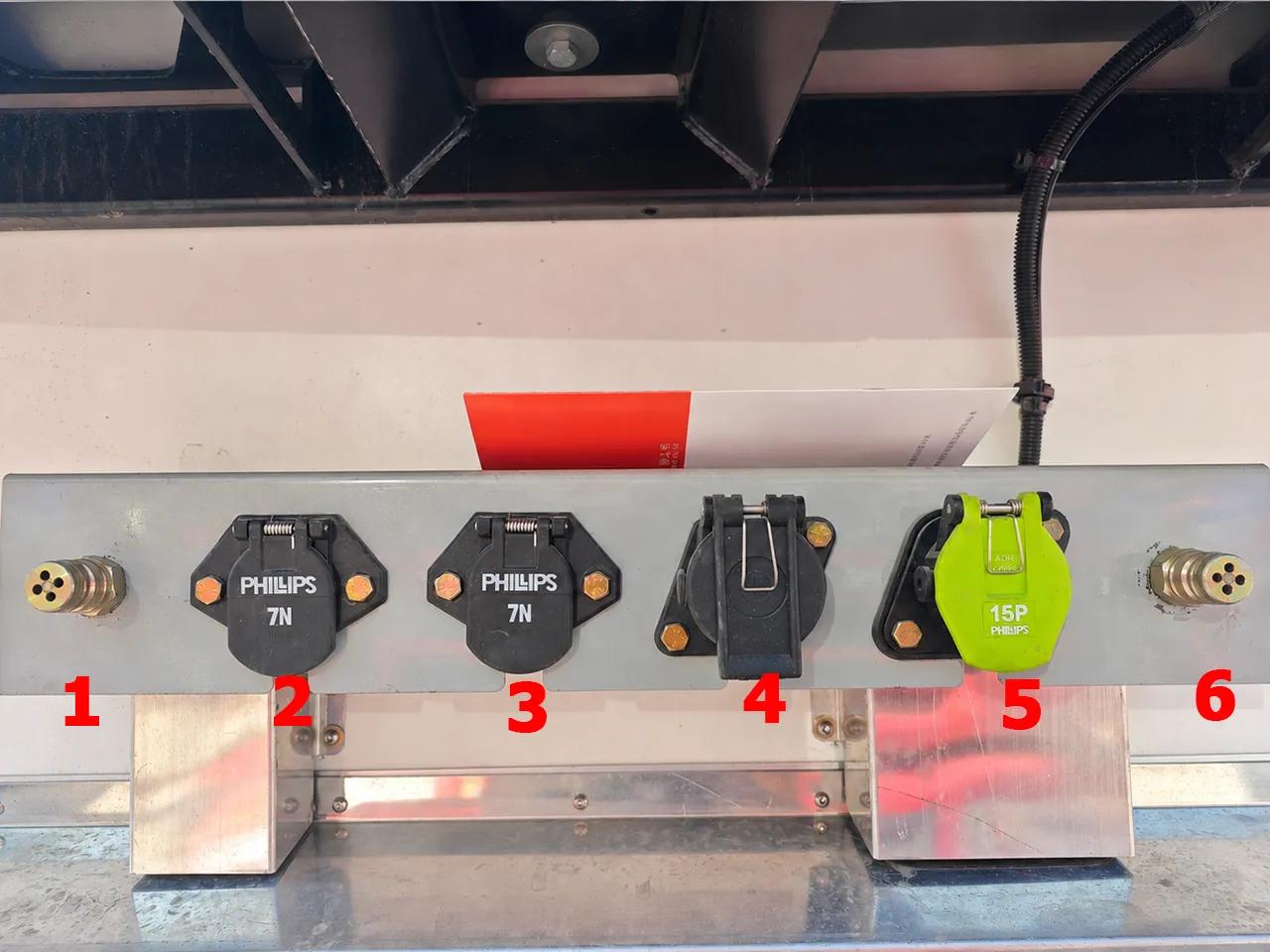
The featured image on this page shows a typical front connection set used on a KALES refrigerated semi-trailer. The exact socket mix can vary by destination market and tractor matching, but the numbered photo should be read as a functional map, not as six interchangeable connectors.
- No. 1 – Supply air line: this line charges the trailer air reservoirs directly and maintains the continuous air source needed for parking-brake release and emergency-brake reserve.
- No. 2 – ISO 1185 7-pin main lighting socket: this is the primary road-lighting connector for legally required lamp functions such as turn signals, brake lamps, tail lamps, and marker lamps. It remains the most common heavy-trailer lighting standard across Europe, China, and many export markets.
- No. 3 – Supplementary 7-pin auxiliary socket: in older twin-plug 24N/24S layouts, this socket is used for auxiliary electrical functions beyond the basic lighting circuit. On KALES refrigerated trailer builds, it is often reserved for reefer monitoring signals or backup auxiliary power logic.
- No. 4 – ISO 7638 ABS/EBS socket: this connector is dedicated to trailer braking electronics. It provides the separate power and communication support required by ABS or EBS and should never be treated as an extension of the lighting plug.
- No. 5 – ISO 12098 15-pin 24V socket: this connector combines normal and supplementary lighting functions in one housing and is usually chosen when the trailer needs a cleaner high-spec electrical architecture. On some higher-spec KALES reefer programs, the same front connection package also supports broader tractor-trailer integration such as CAN-based data exchange, refrigeration-status interfaces, TPMS feedback, or reversing-assist expansion, depending on market specification.
- No. 6 – Service / control air line: this line transmits the driver’s brake-pedal signal to the trailer control valve so the trailer braking force follows the tractor braking command.
The practical takeaway from the image is straightforward: Nos. 2, 3, and 5 handle lighting or auxiliary electrics, No. 4 belongs only to ABS/EBS, and Nos. 1 and 6 are pneumatic lines rather than electrical connectors. That separation is exactly why 7-pin, 15-pin, and ISO 7638 should never be treated as interchangeable in workshop practice.
| Standard | What it usually covers | What it does not replace | Best-fit operating profile |
|---|---|---|---|
| ISO 1185 7-pin (24N) | Basic trailer lighting such as turn, stop, tail, and marker logic | Supplementary lighting often needs a second connector; ABS/EBS still stays separate | Basic flatbeds, tippers, skeletal trailers, and mixed-road fleets that prioritize simplicity |
| ISO 12098 15-pin | Normal plus supplementary rear-light circuits in one connector, with cleaner support for modern trailer electrics | ABS/EBS still requires ISO 7638; it is not a substitute for braking-electronics wiring | Modern export trailers, ADR-minded fleets, and higher-spec combinations running newer tractors |
| ISO 7638 | Dedicated trailer braking-electronics power and communication support | It is not a lighting connector and should not be used to power rear lamps | Any trailer with ABS or EBS |
7-Pin vs 15-Pin: Functional Difference That Matters in the Workshop
The classic 7-pin system remains common because it is easy to understand, easy to repair, and widely familiar in workshops from East Africa to Central Asia. If the trailer only needs basic lighting and the fleet already carries common 7-pin suzi coils, it still does the job well enough.
The limitation is that the 7-pin system was never designed to be the clean answer for every modern rear-light function. Once a trailer needs supplementary circuits, more disciplined waterproofing, or smoother compatibility with newer tractors, the 15-pin system becomes easier to defend technically and commercially.
Functional Coverage Comparison
| Electrical need | 7-pin 24N | 15-pin | Field implication |
|---|---|---|---|
| Basic stop / tail / turn lighting | Yes | Yes | Both systems can support standard highway trailer lighting. |
| Supplementary rear-light circuits such as reverse or rear fog | Usually needs extra connector logic | Integrated more cleanly in one plug | 15-pin reduces adapter confusion and duplicate connector maintenance. |
| Single-plug higher-spec lighting architecture | No | Yes | 15-pin is easier to manage on modern higher-spec trailer builds. |
| ABS/EBS braking-electronics support | No | No | Use ISO 7638 separately every time. |
Workshop note: do not rewire by memory or by color alone. Exact pin assignment should always be confirmed against the tractor and trailer wiring documentation, especially in mixed fleets or regional crossover setups.
Where ISO 7638 Fits and Why It Must Stay Separate
The most common misunderstanding in mixed export fleets is assuming that “more pins” means the lighting connector can also handle trailer braking electronics. That is incorrect. If the trailer uses ABS/EBS braking control, the system should use a dedicated ISO 7638 connector for power and braking-electronics support.
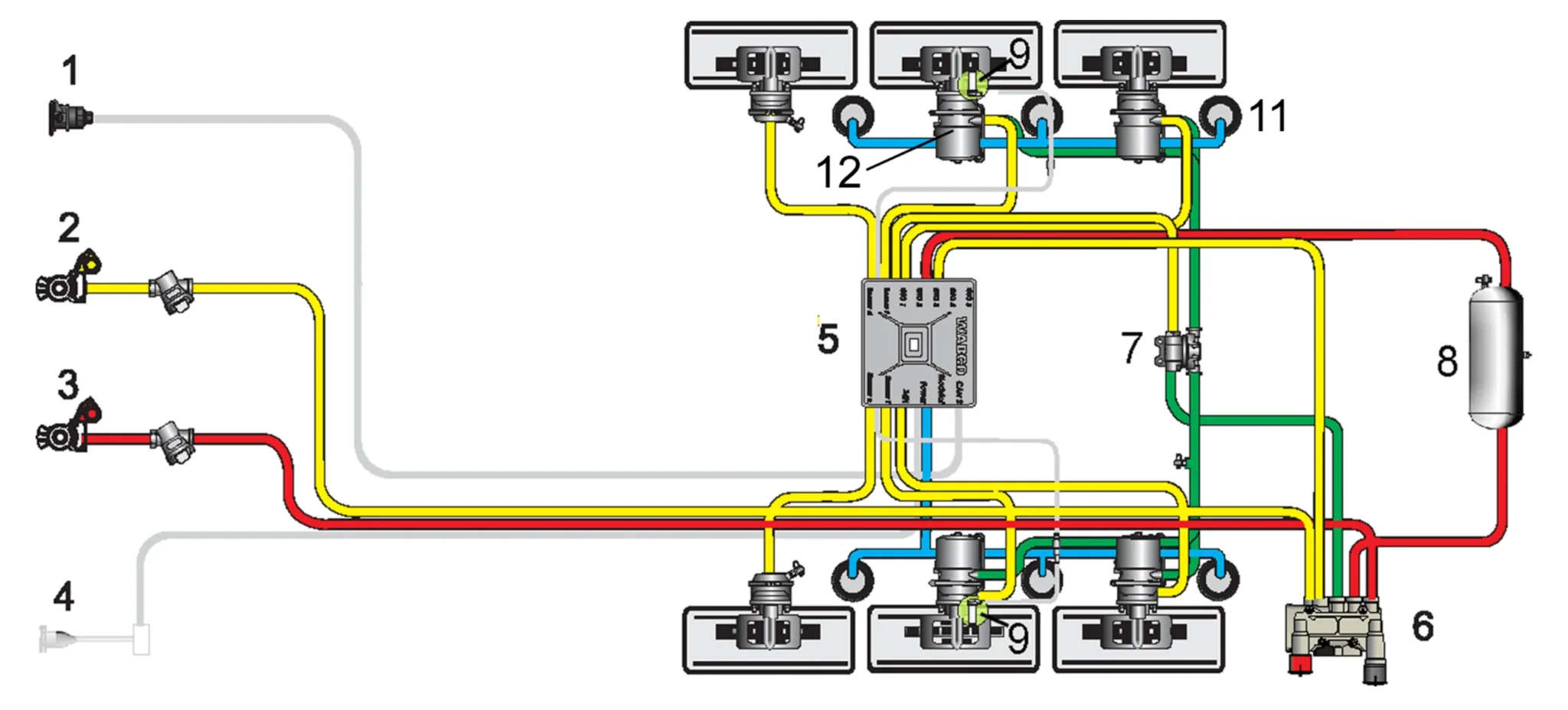
This separation matters because lighting faults and braking faults behave differently, fail differently, and carry completely different risk levels. A bad tail-lamp ground is an inconvenience and a legal risk. A compromised ABS/EBS feed can remove anti-lock or stability-support function from the trailer. For that reason alone, lighting and braking circuits should never be merged in workshop improvisations.
Regional Compatibility Traps Fleets Should Check Before Shipment
Connector failures in export markets are often caused before the trailer reaches the road. The real problem is usually standard mismatch: one side of the combination expects one connector logic, the other side expects another, and the workshop tries to solve the difference with a low-quality adapter or improvised rewiring.
Australia is a common example because fleets may encounter 12V and 24V crossover situations plus local pin-function expectations that do not align cleanly with a European trailer specification. The right answer in those cases is not guesswork. It is a confirmed crossover solution, proper voltage adaptation where needed, and a documented tractor-trailer electrical check before dispatch.
Pre-Shipment Electrical Compatibility Checklist
- Confirm whether the tractor fleet is standardized on 7-pin, 15-pin, or mixed connectors.
- Confirm whether supplementary rear-light functions are mandatory in the destination market.
- Confirm whether the tractor and trailer both use 24V or whether voltage adaptation is needed.
- Confirm that the trailer has a separate ISO 7638 plug if ABS/EBS is specified.
- Confirm whether the fleet expects direct connection or will depend on adapters in daily service.
Why IP Rating and Harness Design Decide Real-World Uptime
On rough export routes, connector standard alone does not keep the lights working. Water intrusion, vibration, and abrasion usually kill the system first. That is why the lamp IP rating, harness branching method, and chassis routing standard matter as much as whether the trailer uses 7-pin or 15-pin.
| Component choice | Minimum acceptable logic | When to upgrade further |
|---|---|---|
| Rear LED lamps | IP67 highway-duty sealing | Move to IP68 or IP69K for mining, flooded roads, or frequent pressure washing |
| Main chassis harness | Molded branch points and sealed connectors | Avoid taped or open-splice repairs on high-humidity routes |
| Suzi coil / spiral cable | Correct length, no catwalk drag, no overstretch at full articulation | Replace at first sign of sagging, cracking, or intermittent light faults |
| Chassis routing | Clamp every 500 mm to 600 mm and protect pass-through points | Add rubber grommets and abrasion sleeves anywhere the loom crosses steel edges |
The Most Common Trailer Lighting Failure Is Still a Bad Ground
Across working fleets, the number-one electrical fault is not a failed LED board. It is a bad ground path. If the tail lamps dim when the brake lamp comes on, if one turn signal makes another lamp glow weakly, or if the flash rate becomes erratic only under load, the first suspect is the earth connection.
This is especially common on older repairs where the ground eyelet was bolted over paint, corrosion, or contaminated chassis metal. A poor ground raises circuit resistance and creates cross-feed behavior that makes the lamps look “haunted” even though the lamp assemblies themselves are still good.
Fast diagnosis: if multiple rear lamps behave strangely at the same time, check the main ground pin, ground wire continuity, and the chassis attachment point before you replace any lamp body.Fast Diagnostic Sequence for Trailer Electrical Faults
| Field symptom | First check | Second check / do not assume first |
|---|---|---|
| All rear lamps are dead | Connector seating, tractor output, main ground continuity | Then inspect suzi coil damage and fuse logic before replacing lamp units |
| Lights dim when braking | Main earth path and chassis ground point | Then inspect corrosion inside the connector body and branch connectors |
| Turn signal flashes erratically | Ground quality and connector pin contact | Then isolate trailer-side lamp load versus tractor-side flasher logic |
| Fault only appears in rain or after washing | Connector sealing and branch-splice moisture ingress | Then inspect lamp IP rating and cracked cable jackets |
| Fault happens only on full articulation | Spiral cable stretch, broken internal conductor, connector strain | Then inspect catwalk drag damage and routing length mismatch |
Top 3 Maintenance Practices That Prevent Most Lighting Downtime
- Clean and re-seat the ground path first: if the trailer has weird combined-light behavior, remove corrosion and ensure the ground eyelet bites into clean bare metal.
- Inspect the suzi coil every service cycle: if the coil sags, cracks, or rubs on the catwalk, replace it before intermittent faults become total failure.
- Secure the harness properly: clamp the loom at regular intervals and protect every pass-through point so vibration cannot cut the insulation.
When Fleets Should Prefer 15-Pin Over 7-Pin
Specify 15-pin when the trailer program already includes higher-spec lighting, newer Euro-oriented tractors, or fleet rules that prioritize clean standardization over lowest first cost. In practice, this often applies to tanker fleets, hazardous-goods-minded programs, refrigerated or high-spec dry vans, and export buyers who do not want to live with a second supplementary connector.
Specify 7-pin when the trailer is intentionally basic, the service environment is rough, and the fleet values mechanical simplicity above all else. Many flatbeds, tippers, and skeletal trailers still fit that logic well, especially when the workshop must keep equipment running with minimal specialized parts.
Frequently Asked Questions
Can I run a modern trailer on a 7-pin connector if it only needs basic lights?
Yes, if the trailer truly only needs basic lighting circuits and the fleet accepts that supplementary functions may require extra connector logic. The decision becomes risky only when the operating requirement quietly grows beyond what the basic connector was chosen to support.
Can I use the 15-pin lighting connector instead of ISO 7638 for ABS/EBS?
No. The lighting connector and the ABS/EBS connector serve different functions and different safety priorities. Trailer braking electronics should stay on their dedicated ISO 7638 circuit.
Why do my trailer lights dim or flash strangely when I hit the brakes?
The most common cause is a bad ground connection. Check the main earth point, connector corrosion, and ground continuity before replacing lamp bodies or rewiring the whole rear harness.
When should I treat a trailer electrical fault as a harness problem instead of a lamp problem?
If the fault appears only in rain, only during articulation, or affects multiple lamps at once, suspect the harness, connector body, or ground path before blaming a single LED fixture.
What should I send if I need remote electrical troubleshooting support?
Send the tractor connector type, trailer connector type, voltage, photos of the plug faces, a short video of the symptom, and photos of the chassis ground point and spiral cable. That usually shortens diagnosis much faster than describing the fault by phone.
Our Final Recommendation
For most export fleets, 7-pin still makes sense when the trailer is deliberately basic and the workshop values easy roadside repair. But for new higher-spec trailers, 15-pin is usually the cleaner long-term choice because it simplifies supplementary lighting and reduces connector sprawl. In both cases, the non-negotiable rule stays the same: keep ABS/EBS on its own ISO 7638 connector, and treat the ground path as the first diagnostic point whenever lighting behavior becomes erratic.
Need help choosing the right trailer electrical specification?
Send your trailer type, destination market, tractor connector standard, voltage, and whether the build needs reverse lights, rear fog, or ABS/EBS integration. The KALES engineering team can recommend the practical connector and harness package before production.