

⚡ Quick Answer
Semi-trailer braking systems form a 3-tier safety hierarchy:
- ABS (Foundation) — Prevents wheel lock-up during braking. Mandatory in most regions.
- EBS (Platform) — Uses electronic control to shorten the brake command path when the tractor and trailer are correctly connected through ISO 7638; the exact response gain depends on the complete pneumatic and electronic setup. It also supports diagnostics, wear balancing, coupling force control and lift axle management.
- RSS/AEBS (Advanced) — Roll Stability Support detects lateral forces and auto-brakes to prevent rollover. AEBS compatibility ensures the trailer can execute the tractor’s emergency stops without delay.
⏱ Reading time: ~8 minutes | Last updated: May 2025
Common Questions from Fleet Managers:
“My tank trailer has EBS; does that mean it brakes automatically?”
“Is standard ABS enough? Why do I need RSS (Roll Stability)?”
“Does the trailer need to support AEBS, or is that just for the tractor?”
If you think a semi-trailer is just a “passive metal box” being dragged behind a truck, think again.
In modern intelligent transport systems, the trailer’s own safety and braking architecture directly determines whether the entire combination can stop safely, stay stable, or actively avoid accidents in critical moments. As a professional semi-trailer manufacturer, Kales Vehicle is here to walk you through ABS, EBS, RSS, and AEBS—clarifying their relationships, capabilities, and common misconceptions.
📋 In This Article
Technical basis and scope
How this braking guide is supported
This guide is based on Kales trailer specification practice, the ABS/EBS/RSS logic already used in the article, and public braking-system references. The technical basis includes UNECE Regulation No. 13 for vehicle braking systems, ISO 7638 for the ABS/EBS trailer connector, UNECE Regulation No. 111 for rollover-stability concepts, FMVSS 136 for electronic stability control on heavy vehicles in the United States, and CVSA brake inspection results showing why brake condition still matters after electronic systems are specified.
It is written for fleet buyers, not as a substitute for a homologation file. Before ordering, the buyer should define axle layout, brake type, suspension, tire size, operating speed, cargo center of gravity, tractor compatibility and whether the trailer must support EBS, RSS/RSP, diagnostics or AEBS coordination.
- ABS is the base layer: it helps prevent wheel lock during braking, but it does not calculate load transfer or rollover risk by itself.
- EBS is the control layer: it shortens command response, improves axle-load logic and provides diagnostics when the tractor and trailer are compatible.
- RSS/RSP is the stability layer: it can intervene when lateral acceleration and wheel-speed behavior indicate rollover risk.
1. ABS — The Anti-Lock Braking Foundation
ABS (Anti-lock Braking System) is the mandatory baseline for trailer braking safety in most regions worldwide. It is an electronic intervention layer added to the traditional pneumatic braking system that prevents wheel lock-up during emergency stops.
For buyers comparing brake hardware, KALES also provides 13T disc brake axles, 13T drum brake axles, and a detailed guide to disc brakes vs drum brakes for semi-trailer fleets.
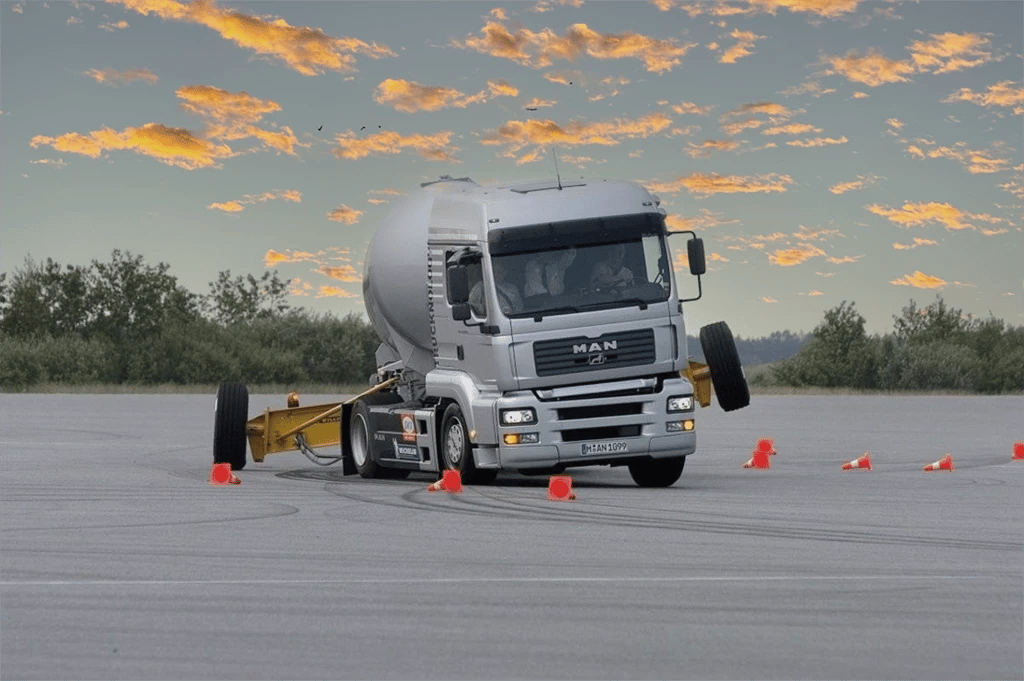
Core Function: During emergency braking, ABS monitors wheel speed via sensors. When a wheel begins to lock, the tire loses lateral grip, causing the trailer to slide, swing, or trigger a catastrophic jackknife accident. ABS prevents this by rapidly pulsing brake pressure several times per second.
The image on the right compares tire marks under three conditions:
- Rolling: Clear tread pattern, reliable steering control.
- ABS Active: Dotted/intermittent marks — “brake-and-roll” cycle maintains directional control.
- Locked-up: Solid dark skid marks, total loss of directional control.

How Trailer ABS Works
The driver’s braking action is transmitted pneumatically via the foot valve. Wheel speed sensors are installed on key axles in 2S/2M or 4S/2M configurations (Sensors/Modulators). When the system detects impending lock-up, the modulator valve rapidly adjusts air pressure, achieving a high-frequency pulsing effect.
- Simple & Reliable: Adds electronic monitoring to traditional air lines. Low cost and easy maintenance.
- Foundation for Expansion: ABS hardware forms the platform for advanced functions like ESP and RSS.
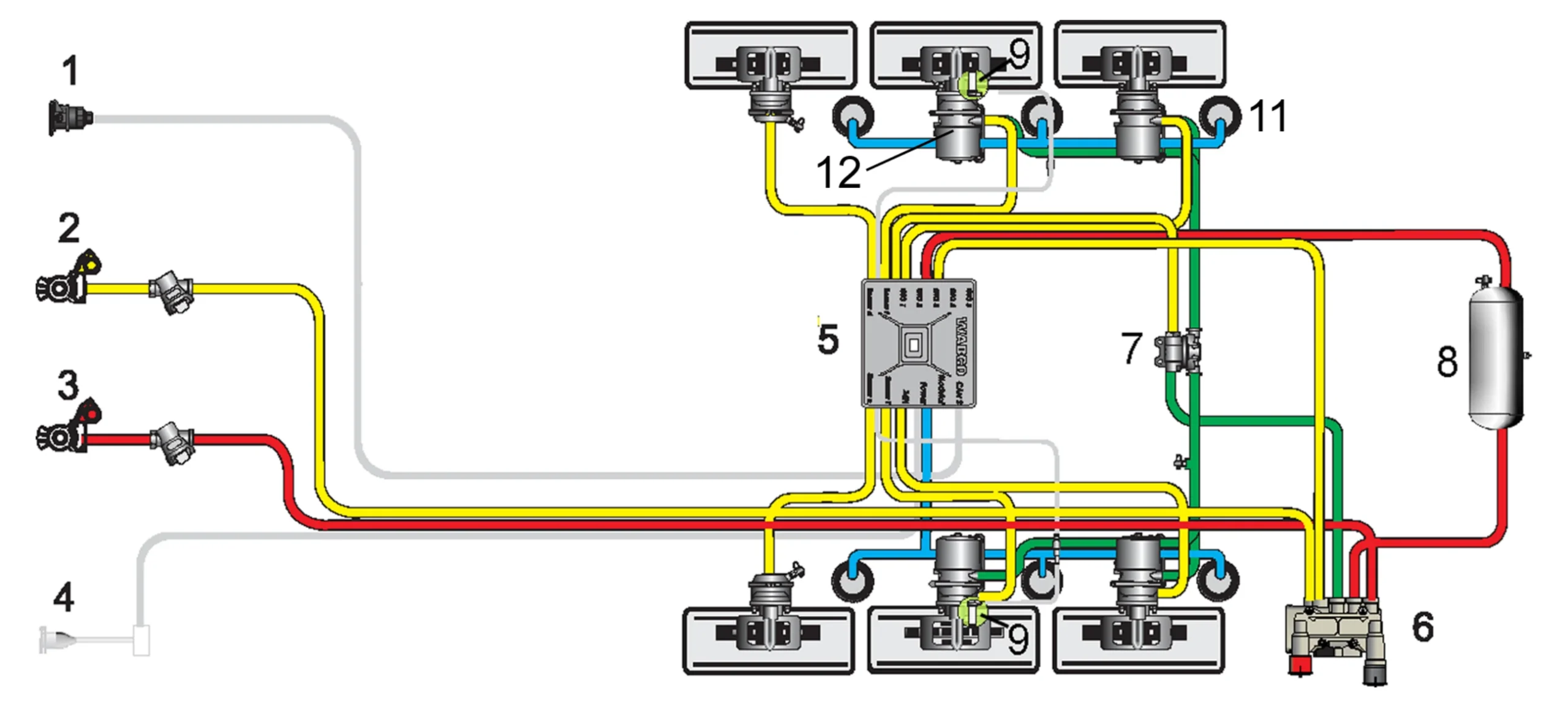
1. ISO 7638 Power Supply 2. Service Line 3. Supply Line 4. Stop Light Power (ISO 1185, Optional) 5. TEBS Modulator (with pressure sensors) 6. Park Release Emergency Valve (PREV) 7. Overflow Valve 8. Service Brake Reservoir 9. ABS Speed Sensor 11. Suspension Air Bag 12. Spring Brake Chamber
2. RSS — The Rollover Prevention Guardian
Roll Stability Support (RSS) is the most critical active safety system for trailers carrying high-risk loads. Different manufacturers use different names, but the core objective is identical — preventing trailer rollover by detecting lateral forces and automatically applying targeted braking:
- RSS (Roll Stability Support) — ZF / WABCO
- RSP (Roll Stability Program) — Knorr-Bremse
- RSC (Roll Stability Control) — Haldex
Why Do Trailers Roll Over?
According to the ECE R111 standard, rollover becomes a critical risk when lateral acceleration reaches approximately 0.4G. For trailers carrying liquids, hanging meat, or unevenly distributed loads, this threshold is significantly lower due to dynamic load shifting.
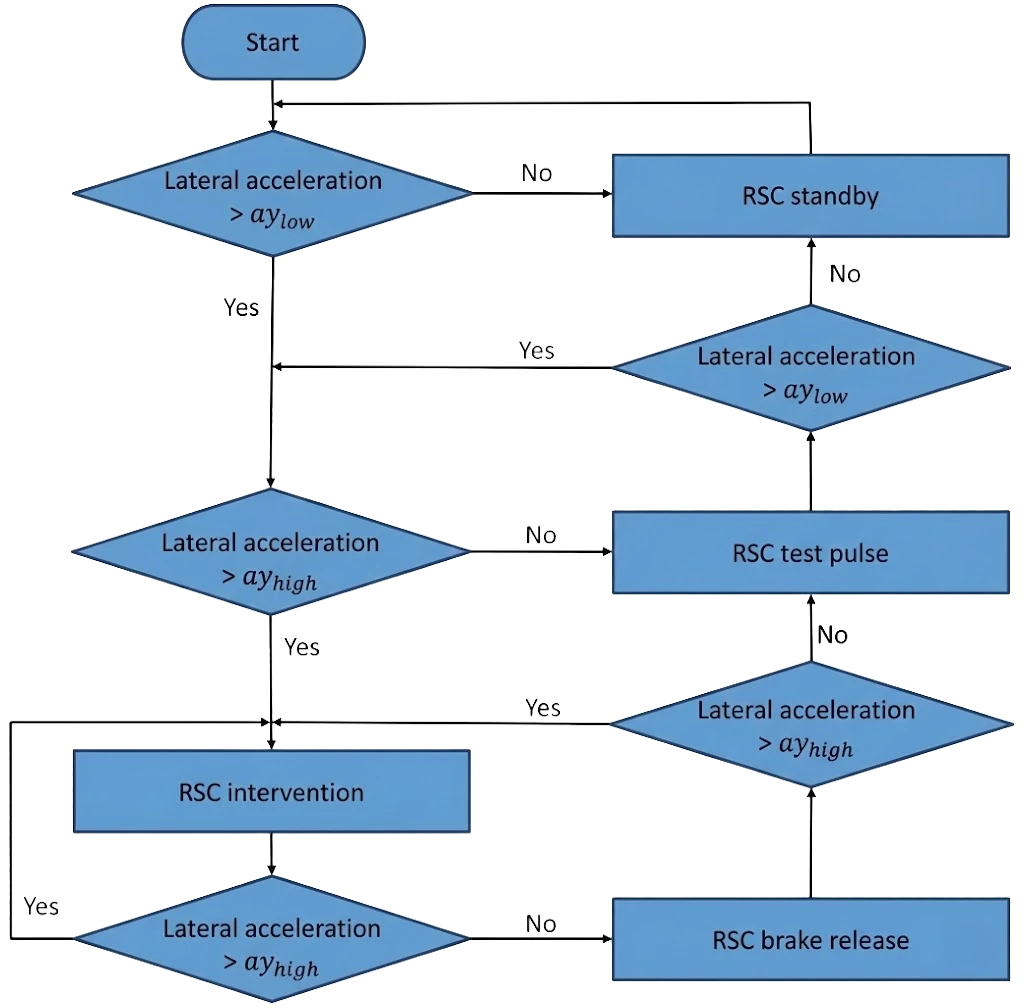
How RSS Reacts Faster Than a Human Driver
RSS relies on physics sensors and algorithms — not driver reaction time. Here are the two mainstream working approaches:
🔵 WABCO RSS — 3-Stage Intervention
- Stage 1 (Warning @ ~0.2G): Light braking (~2 bar). Tests wheel grip and pre-charges the system — not intended to decelerate.
- Stage 2 (Intervention @ ~0.3G): If lateral force increases, the system brakes hard to forcibly reduce speed.
- Stage 3 (Correction): Higher brake pressure on inner-curve wheels prevents abrupt straightening, guiding the trailer through the turn.
🟠 Knorr RSP — Smart Pulse Logic
Test Pulse: When rollover risk is detected, the system sends a micro brake signal to check if the inner wheels decelerate.
If wheels respond → they have grip. If they do NOT slow down → the wheels are lifting off the ground, confirming high risk. The system immediately applies full emergency braking.
Critical Warning for Fleet Operators
🚨 RSS Activation = Near Miss Event
If the driver feels the trailer “tugging” back, or telematics reports an RSS activation, take it seriously:
- Without this system, the vehicle would likely have rolled over.
- It signals dangerous driving behavior (excessive cornering speed) or improper load distribution (center of gravity too high).
- Mandatory Check: Frequent activation increases component wear. Always inspect brake linings and suspension systems after events. For mountain routes, also review our guide to brake fade on long downhill routes.
!– ===== SECTION 3: EBS ===== –>
3. EBS — Making Braking Fast, Precise, and Smart
EBS (Electronic Braking System), also known as Brake-by-Wire, is not a single function — it is a comprehensive electronic control platform. EBS integrates sensors, actuators, and digital communication, often linking deeply with the trailer’s air suspension system to create a unified chassis management solution.
When EBS is specified together with air suspension and matched heavy-duty trailer axles, the trailer can achieve more stable braking, better axle load control, and lower tire wear on export routes.
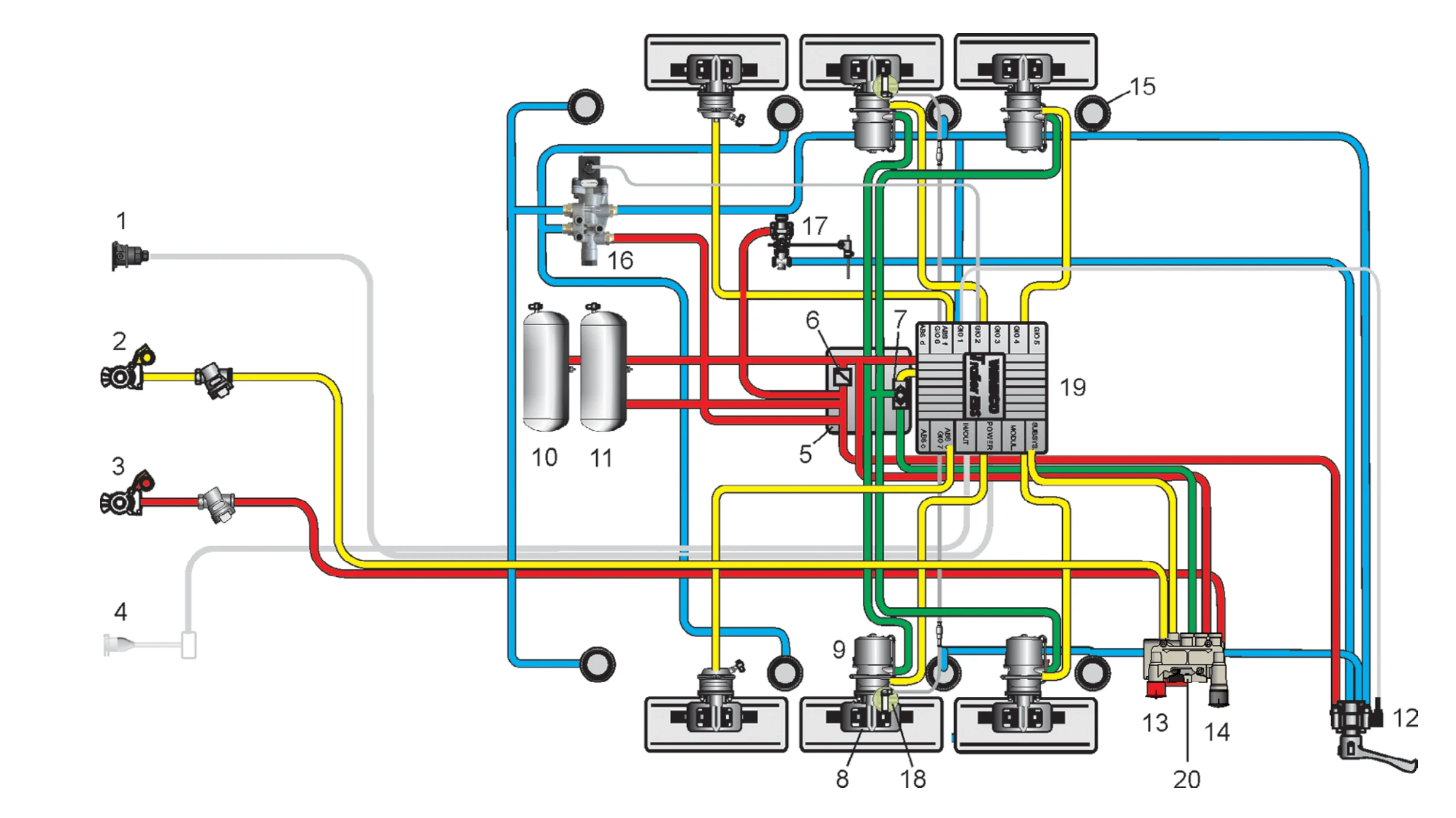
1. ISO 7638 Power 2. Service Line 3. Supply Line 4. Stop Light (Opt.) 5. PEM 6. Overflow Valve 7. Charging Valve 8. Service Brake 9. Spring Brake Chamber 10. Service Reservoir 11. Air Suspension Reservoir 12. Raise/Lower Valve 13–14. Park/Release Buttons 15. Air Bag 16. Lift Axle Valve 17. Levelling Valve 18. ABS Sensor 19. TEBS Modulator 20. PREV
From Pneumatic Delay to Digital Precision
Traditional air brakes rely on the foot pedal to physically control air flow through long pneumatic lines — introducing significant delay. EBS replaces this with a pedal position sensor that reads the driver’s braking intent digitally. The ECU calculates required brake pressure for each axle based on speed, load, and wheel speed, then transmits commands via CAN Bus to Electro-Pneumatic Modulators (EPM) located near each wheel.
Hidden Benefits: Why EBS Is More Than Fast Braking
Modern EBS platforms (including systems configured by Kales Vehicle) use modular designs integrating the ECU, sensors, and pneumatic control into compact components that simplify chassis layout.
🔍 The “Invisible Bonuses” of EBS
- Coupling Force Control (CFC): Optimizes braking timing between tractor and trailer, preventing dangerous “trailer push” or “tugging” sensations.
- Brake Blending: Intelligently distributes deceleration between endurance braking (retarders) and service braking (pads), extending component life.
- Lining Wear Control: Automatically adjusts force distribution across axles to ensure even brake pad wear, reducing fleet maintenance costs.
- Multi-Function Integration: Modern EBS modules integrate Lift Axle Control (LAC), RSS, TPMS, and overflow valves — eliminating complex external plumbing.
ABS vs EBS: Head-to-Head Comparison
| Feature | Traditional ABS (Pneumatic) | Smart EBS (Electronic) |
|---|---|---|
| Signal Transmission | Air Pipes (Slow) | CAN Bus Digital Signal (Near-Instant) |
| Response Delay | 0.3 – 0.6 Seconds | ≈ 0 Seconds |
| Core Functionality | Anti-lock Only | Anti-lock + Wear Balance + Coupling Control + Lift Axle |
| AEBS Compatibility | Poor (pneumatic lag) | Full (zero-delay response) |
| Maintenance Insight | None | Real-time diagnostics & wear data via telematics |
4. AEBS Synergy — The Danger of “Lag”
AEBS (Advanced Emergency Braking System) decisions are made by the tractor’s radar and camera — but the trailer’s execution capability determines whether those decisions actually save lives.
❌ Trailer with ABS Only
When the tractor triggers AEBS emergency braking, the ABS-only trailer reacts with a 0.3–0.6 second pneumatic lag. The trailer’s massive inertia pushes the tractor forward — extending braking distance and creating a dangerous “Pushing Effect” that can cause jackknifing or loss of control.
✅ Trailer with EBS
The trailer receives the braking signal via ISO 11992 / ISO 7638 interface instantly. It applies full braking force with zero delay, creating a “Stretching Effect” that keeps the entire vehicle combination straight and stable throughout the emergency stop.
5. The Pyramid of Trailer Intelligent Braking
Semi-trailer braking technology follows a clear hierarchy. Each level builds on the one below it:
L3 · ADVANCED
RSS + AEBS
Active Rollover & Collision Prevention
L2 · PLATFORM
EBS
Electronic Brain · CAN Bus · Integrated Control
L1 · FOUNDATION
ABS
Anti-Lock · Legal Baseline · Mandatory Standard
Fig 5: Hierarchy of Semi-Trailer Intelligent Braking Technology
Export buyer note: specify braking by route risk, not by brochure level
For African export fleets, port corridors, mining roads and long downhill routes create different braking risks. A flatbed on short paved routes may start with ABS, but tankers, container chassis, dump trailers, high-center cargo and mountain corridors should be evaluated for EBS plus RSS/RSP. The higher system cost is easier to justify when one rollover, jackknife or thermal-fade incident can stop a fleet for days.
The practical purchasing question is not “ABS or EBS?” but “Can the tractor power and communicate with the trailer system every day?” A missing or damaged ISO 7638 cable, incompatible tractor ECU, poor air quality, wrong sensor gap, contaminated connectors or mixed axle specification can make an advanced system behave like a basic system.
6. Advice for Fleet Managers and Buyers
As a professional trailer manufacturer, Kales Vehicle recommends considering the following when specifying braking systems:
① Think Long Term: Choose EBS + RSS
If your fleet operates liquid tank trailers, livestock carriers, or high-value cargo trailers, we strongly recommend EBS with RSS. While the initial cost is higher, preventing a single rollover or jackknife accident pays for the upgrade many times over — in vehicle damage, cargo loss, insurance claims, and human cost.
② Never Ignore the ISO 7638 Cable
🔌 A Fatal Blind Spot for Drivers
The trailer’s ABS/EBS must be powered and communicate via the ISO 7638 coiled cable — the thickest connector between tractor and trailer.
If unplugged or damaged, even the most advanced EBS becomes “brain dead” — reverting to basic pneumatic braking with zero anti-lock, zero anti-rollover protection. Always check before every trip.
③ Verify Tractor-Trailer Compatibility
When purchasing, confirm the spec sheet states “EBS Supported” and “RSS/RSP Functionality.” Even if your tractor is equipped with the latest AEBS system, an outdated trailer braking system will compromise the safety of the entire rig. Read our tractor-trailer matching guide →
Related guides before approving the braking specification
- Disc brakes vs drum brakes TCO guide
- Disc brakes, EBS and air suspension configuration
- Tractor-trailer matching measurement guide
- Brake fade and long downhill driving guide
- Semi-trailer brake and ABS troubleshooting
- Semi-trailer maintenance manual
- Semi-trailer chassis material selection guide
- Request a braking configuration review
Brake Release Gate: ISO 7638, Warning Lamps and First-Trip Diagnostics
A trailer braking specification is not complete when the purchase order says ABS, EBS or RSS. It is complete only after the tractor, trailer, cables, sensors and diagnostics prove they work as one system. Treat this as a release gate before the first loaded dispatch and after any brake, axle, suspension or wiring repair.
The evidence supports a strict gate. UNECE Regulation No. 13 frames braking performance and compatibility, ISO 7638 defines the tractor-trailer electrical connector family, and CVSA Brake Safety Campaign Results continue to show how often brake defects remove commercial vehicles from service.
- Power and communication: connect ISO 7638, inspect pins and cable strain relief, and confirm the ABS/EBS warning lamp proves out then clears.
- Wheel-end signals: inspect sensor position, tone ring condition and cable routing near axles, air suspension arms and moving brake components.
- Air and response: check reservoir pressure recovery, audible leaks, modulator response and a low-speed progressive brake test before loading.
- Diagnostics: save or clear fault codes with the correct tool, then record tractor ID, trailer ID, route risk and corrective action in the maintenance file.
For fleet practice, connect this release gate with the semi-trailer troubleshooting guide and the Kales maintenance manual. A warning lamp, missing ISO cable or slow trailer response is a repair item, not a driver preference.
7. Frequently Asked Questions
Safety Is the Biggest ROI
In the era of intelligent transport, the trailer is no longer a silent partner. Don’t just compare volume and price — ask: “Is the braking system smart enough?”
Kales Vehicle provides the safest, most durable semi-trailer solutions for global clients.
Get a Custom Braking System Quote →
Or message us on WhatsApp
📖 Continue Reading This Series:
Need help applying this guide?
Share your trailer type, payload, routes, operating climate, and photos with Kales. Our team can review the key points from this guide and recommend a practical specification for your fleet.
- Send photos of your tractor, trailer, or current component layout
- Confirm payload, road conditions, gradients, climate, and duty cycle
- Receive a specification or maintenance recommendation within 24 business hours
Email: jennylee@kalestruck.com | WhatsApp: +86 131 5638 8843 | Request a quote